
Scientists have found liquid water inside meteorites. The water resources of the solar system are more abundant than imagined?
The solar system has more water resources than thought

Water is the source of life. When human beings explore planets other than the earth, they often give priority to finding water resources.
So far, scientists have found water resources on the moon, in the rings of Saturn, and liquid water and ice on Mars. Many planets also have abundant water resources underground. In addition to these planets, the water resources of the solar system may be Even more abundant, a large amount of water resources may also be stored in meteorites.
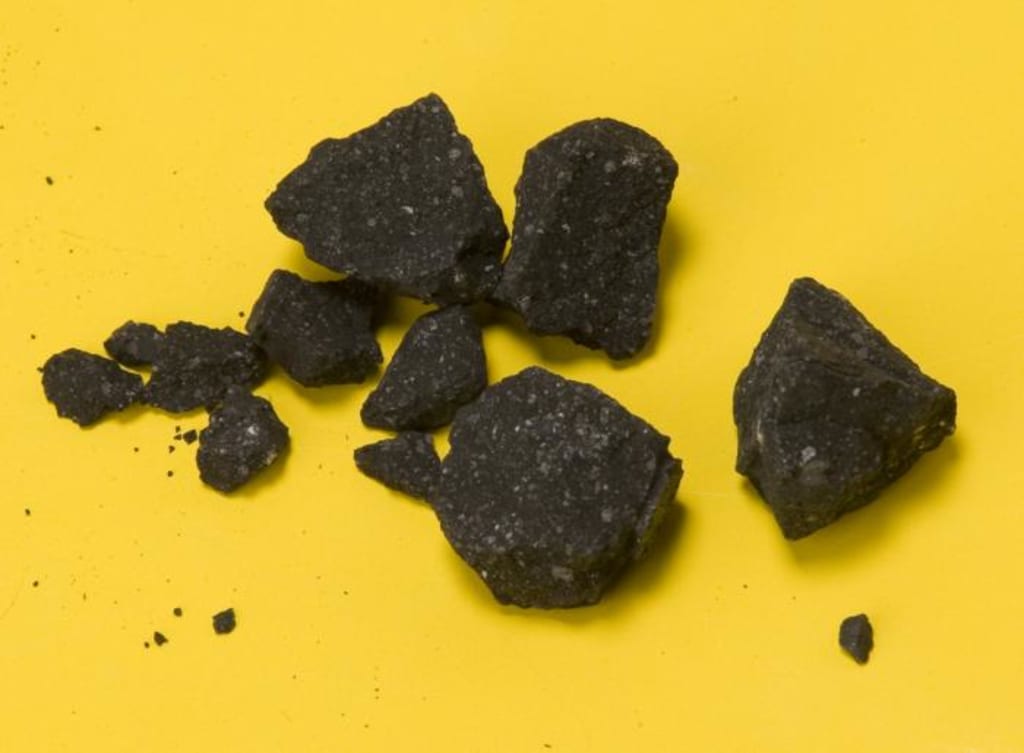
When scientists were studying a meteorite formed 4.6 billion years ago, they unexpectedly found that there were special crystals inside the meteorite. In the crystals, there was a nano-scale liquid, 15% of which was composed of carbon dioxide.
Did the ancient solar system have abundant water resources?
This special discovery shows that the rocks formed in the ancient solar system contain liquid water and carbon dioxide, and the water resources on the earth may be brought by these meteorites. The accumulation of billions of years has allowed the earth to have oceans and life. Have a habitat.
The meteorite that discovered liquid water, although formed 4.6 billion years ago, only hit the earth in 2012. The meteorite is small in size and did not have any impact on the local area, and there are many similar meteorites near the impact point of the meteorite.
Scientists believe that this special crystal may be formed by the combination of water molecules and carbon dioxide in a low temperature environment, which means that the formation of this meteorite should be outside the orbit of Jupiter.
The celestial bodies rich in water molecules are often formed away from the sun, and then begin to approach the sun, and then collide with other planets to provide water for the planets.
By studying water molecules in meteorites, it may be possible to find the source of Earth's water resources.
Where does the earth's abundant water resources come from?
At the beginning of its formation, a planet is often just a simple rocky planet. With the evolution of the sun, the motion trajectories of various celestial bodies are very chaotic, and various celestial bodies collide and merge with each other, and finally form a relatively stable system.
However, Earth is very different from other planets - it has an atmosphere, a magnetic field, water, and everything else for life. Compared with Mars, which is also in the habitable zone of the sun, the earth is more vibrant at first glance.
Why is the earth suitable for life? In fact, this is a series of interlocking miracles.
The Earth has the right size and mass, which gives the Earth a warmer core that traps the atmosphere and forms a denser atmosphere.
If a planet is too small, an atmosphere cannot be formed; if a planet is too large, the huge gravitational force will make life on the planet difficult, and it is basically impossible to fly.
Due to the presence of an atmosphere and a magnetic field, the Earth has the ability to withstand solar storms, thereby protecting all resources on Earth.
With the formation of the solar system, the remaining matter in the outer periphery of the solar system began to be attracted by the gravity of the sun and attacked the solar system again. These asteroids far away from the sun may carry rich water resources. As the asteroid hits the earth, organic matter and water resources begin accumulate on earth.
If the water in the meteorite has a certain relationship with the water on the earth, then it can provide evidence for this hypothesis. Although there is no pie in the sky, there may be a "source of life" in the sky~
About the Creator
crudden elle
Partagez un peu de science chaque jour
Keep reading
More stories from crudden elle and writers in Earth and other communities.
In 1881, what happened to the savage girl caught in the primeval forest by Norwegian hunters? Sad ending
About 65 million years ago, due to a meteorite hitting the earth, the dinosaurs that dominated the earth at that time died out, and many reptiles were also tragically extinct. Since then, mammals have survived this race for survival, and evolved rapidly, and finally became the current human.
By crudden elle4 years ago in Earth



Comments
There are no comments for this story
Be the first to respond and start the conversation.