
Rising from the Depths: Archaeologists Lift Massive Stones from the Legendary Lighthouse of Alexandria
How 70‑to‑80‑ton Blocks from One of the Ancient World’s Greatest Wonders Are Rewriting History Beneath the Mediterranean
The Lighthouse of Alexandria, also known as the Pharos of Alexandria, has fascinated historians and travelers for centuries. Built over 2,300 years ago, it was one of the Seven Wonders of the Ancient World, guiding sailors safely through the treacherous waters of the Mediterranean. Now, modern archaeology is uncovering parts of this legendary beacon in a way few could have imagined.
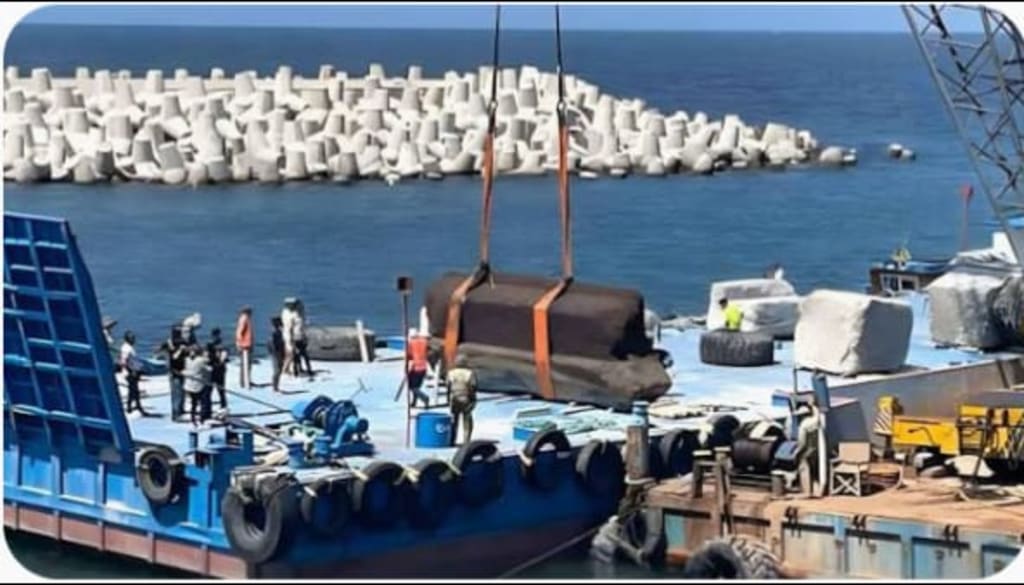
In an extraordinary underwater operation, archaeologists have lifted massive stone blocks—some weighing 70 to 80 tons—from the submerged ruins of the Lighthouse. Among these finds are pieces that appear to belong to a long-lost monumental doorway, hinting at an entrance of grand scale that has not been seen for over a millennium.
The Lighthouse of Alexandria: A Wonder of the Ancient World
The Lighthouse of Alexandria was commissioned in the early 3rd century BCE by Ptolemy I Soter and engineered by the Greek architect Sostratus of Cnidus. Standing on the island of Pharos, just off the coast of Alexandria, Egypt, it served as a guiding beacon for ships navigating the busy Mediterranean trade routes.
At its peak, the lighthouse is believed to have been over 100 meters tall, making it one of the tallest human-made structures of the ancient world. Its light, said to be visible for miles, was produced by a massive fire atop the tower, reflected through polished bronze mirrors. The Lighthouse not only served a practical purpose but also symbolized the wealth, power, and architectural ingenuity of Hellenistic Alexandria.
Unfortunately, a series of earthquakes over several centuries caused gradual destruction, until the structure ultimately collapsed into the sea in the 14th century. Its remains lay hidden under the waters of Alexandria’s eastern harbor—until now.
The PHAROS Project: Breathing Life into Ancient Ruins
The recovery of these enormous stone blocks is part of the ongoing PHAROS Project, a collaboration between French and Egyptian archaeologists, led by the CNRS (France’s National Center for Scientific Research) and Egypt’s Ministry of Tourism and Antiquities. The project aims to study, scan, and digitally reconstruct the Lighthouse, revealing its scale and grandeur in unprecedented detail.
Using specialized cranes, divers, and advanced underwater lifting equipment, the team has so far raised 22 massive stone blocks from the seabed. These include foundation stones, paving slabs, and intriguing architectural fragments such as lintels and uprights—some of which may have formed part of a monumental doorway.
The sheer size of these stones—each weighing 70 to 80 tons—demonstrates the extraordinary ambition and engineering prowess of the ancient builders. Handling and lifting them from the seabed is a technical marvel in its own right, showcasing the fusion of modern technology and archaeological expertise.
Unveiling the Long-Lost Doorway
Among the recovered blocks are elements that could belong to a grand entranceway, possibly the main door to the Lighthouse or an associated ceremonial portal. Experts note that the lintels and jambs exhibit a blend of Egyptian and Greek design influences, reflecting Alexandria’s multicultural character during the Hellenistic period.
If confirmed, the monumental doorway would rewrite our understanding of how the Lighthouse was accessed and experienced in antiquity. It suggests that the structure may have been far more elaborate than previously thought, with grand entrances that impressed visitors and signaled the city’s wealth and architectural sophistication.
This discovery also emphasizes the scale and ambition of ancient construction. Moving and fitting such massive stones would have required intricate knowledge of materials, geometry, and manpower—highlighting the Lighthouse’s status not only as a navigational aid but as a symbol of human ingenuity.
Digital Reconstruction: Bringing the Lighthouse Back to Life
Once the stones are brought ashore, they are scanned using photogrammetry, a digital process that captures every minute detail of the surface. This data is used to create a digital twin of the Lighthouse, allowing researchers to study its design, structural techniques, and architectural features.
Volunteers and engineers from organizations such as the Dassault Systèmes Foundation assist in creating these digital models. The result is a virtual reconstruction that enables scholars—and eventually the public—to explore the Lighthouse as it might have looked over 2,000 years ago.
This approach not only preserves the physical fragments but also breathes life into history, providing insights into the Lighthouse’s construction, cultural significance, and the ingenuity of ancient engineers.
Bridging the Ancient and the Modern
The lifting of these massive stones is more than a technical achievement; it represents a bridge across millennia. Each block tells a story: of the quarrying and transportation methods used in antiquity, the craftsmanship of the builders, and now, the skill and technology of modern archaeologists.
Through projects like PHAROS, the Lighthouse of Alexandria is not merely a memory of the past but a living, evolving story, connecting ancient civilizations with contemporary technology and imagination. For historians, engineers, and the general public alike, it’s a chance to witness one of humanity’s greatest architectural feats rise again—this time from the depths of the sea.
Why This Discovery Matters
Uncovering parts of the Lighthouse, including its monumental doorway, offers tangible links to the past, helping us understand the scale, design, and cultural significance of one of history’s most celebrated structures.
It reminds us that history is not fixed in textbooks; it is waiting to be rediscovered, piece by piece, stone by stone. As archaeologists continue to bring fragments to light, our understanding of the Lighthouse—and the ingenuity of ancient civilizations—continues to grow, illuminating not just the past, but the enduring human spirit that built wonders meant to stand for centuries.
About the Creator
Keep reading
More stories from Ayesha Lashari and writers in Earth and other communities.
Scrapping of Jersey Solar Farm Plans Welcomed
The decision to scrap the proposed solar farm plans in Jersey has been widely welcomed by residents, environmental groups, and agricultural stakeholders, marking a significant moment in the island’s ongoing debate over sustainable development. While renewable energy remains a vital priority in the fight against climate change, the shelving of this particular project has highlighted the importance of balancing green ambitions with land preservation, food security, and community consent.
By Ayesha Lashariabout 12 hours ago in Earth
Enoch Burke Case: Disciplinary Panel Members Resign in Major Blow to Efforts to Resolve Row Over Teacher’s Dismissal
The long-running dispute surrounding Irish teacher Enoch Burke has taken another dramatic turn after members of a disciplinary panel resigned, dealing a significant setback to efforts aimed at resolving the controversy over his dismissal. The case, which has attracted widespread public attention, continues to raise complex questions about employment rights, institutional authority, and the handling of disputes involving personal beliefs in professional settings.
By Aarif Lashari5 days ago in Earth



Comments
There are no comments for this story
Be the first to respond and start the conversation.