
Reusing is the Goal
We need an entirely new lifestyle, and to connect to the Earth in a way that is foreign to many.


I’m not going to beat around the bush here... Little changes just aren’t going to cut it anymore. We no longer have the luxury of time, which means I am no longer interested in little steps toward change. What we need is an entirely new lifestyle, and to connect to the Earth in a way that is foreign to many.
We’ve been presented with a few options for how we can contribute to a sustainable world, and they’re called the Three R’s: reduce, reuse and recycle. Since kindergarten, we’ve been told that utilizing these systems makes us a good person, and ignoring them makes us selfish. What I want to bring attention to, however, is that there are a plethora of options beyond what we’ve been told.
Reusing is when we gift our hand-me-downs to a friend, fix the coffee maker instead of buying a new one or continue to use a soda bottle once the soda is gone. Unfortunately, many things are built to break nowadays, so fixing your phone or handing down your car seat isn’t always an option. There are so many products that can be reused, though, and they still end up in our oceans and landfills.
What do you do with your empty pop cans and water bottles? Throwing them in the recycle bin is the option we’re presented with, but now we know that this isn’t sustainable. Of course, you can go the route of reducing and not buy those bottles and cans in the first place, but that doesn’t address the waste spread across the Earth at this very moment. So, what do we do with the dirty cans discarded in our ditches? What if you could build your house with them?
What if you could walk around your neighbourhood and visit local businesses, collecting bottles, cans, cardboard and tires? What if you could build your house with all that you find? What if that house was completely self-sustaining and absolutely beautiful? And what if that house had NO BILLS? Would you build it?
Three years ago, I discovered a design for a building that completely changed my life. It altered my perception of contemporary homes, and I just couldn’t live in one anymore. I made the move from a beautiful blue house on the lake to living full-time in a 32’ camping trailer. I am reducing my dependence on anyone but myself, as well as reducing the negative impact I have on the Earth. Reducing is just the transition, however; reusing is the goal.
Living in a trailer has reduced my carbon footprint, but in all honesty, that’s just a by-product of the real reason I live this way. I don’t have a mortgage or rent to pay, so I don’t need to slave away at a job to pay those bills. I am free of the things that hold so many people hostage, and I am able to spend my time creating the life I truly desire. With my talent for writing, my hope is to also spread awareness of the building design that will change the world: Earthships.
The Earthship design was developed over 40 years ago in Taos, New Mexico by a man named Michael Reynolds. He chose the name, Earthship, because when these buildings are built with the six principles he laid out, they are entirely self-sustaining –just as a cruise-ship contains everything needed to sustain life for a certain period of time, so does the Earth-ship. These buildings will stay strong for hundreds of years, even though hurricanes and tsunamis, and when they’re maintained properly, they provide everything you need to live!
While the climate in Taos is similar to that where I live in Eastern Ontario, they don’t have the same sustained cold that we experience –long durations of well-below freezing temperatures. Therefore, the original design of the Earthship had to be modified to suit this Northern climate; and I am fortunate enough to live with the man who did just that. He calls these buildings Earthship-Inspired Holistic Homes.

Talking Trees’ Holistic Homes follow the same six principles as the Earthship, with modifications in the architecture to keep us warm in the winter, and to increase food production. In fact, one of the six principles is that your building has the ability to grow food! With a greenhouse on the South side of your home, and the North side buried in the Earth, these buildings are heated and cooled passively, allowing the Earth to maintain temperature and severing our dependence on outside sources of heat. Of course, many designs incorporate a woodstove, for added heat and comfort on the coldest days.
These buildings also collect water on their roofs, stored in cisterns below the Earth’s surface, and is used several times before it’s returned to the Earth. Fresh rain water is naturally treated and flows from your taps and toilets, similar to those in a conventional home. However, instead of the water from showers, laundry and sinks being discarded right away, it is filtered through the planters in your greenhouse, watering the plants that are growing your food. The fact that we water our plants with that which we’ve washed our hands in, means that the plants have a better understanding of our bodies and the nutrients we might be lacking –so our food is actually tailored to our needs!
And this brings me to the next of the six principles: sewage treatment. Once the water has nourished the plants a few times around the planters, the water then goes into our toilets, instead of using fresh drinking water to flush our waste. And, don’t worry, with stones and filtration systems built into the planters, the water in your toilet looks as clean as what you drink. Only once the water reaches the black water tanks is it discarded back to the Earth.
Power in these buildings is generated through renewable, sustainable resources, collected via solar panels, windmills and water turbines. And remember, maintaining the temperature in these homes does not require electricity, so your power needs are much less than you may realize.
Finally, the last principle is described as the requirement of being built with “natural and recycled materials.” However, rather than labeling them recycled materials, I see this as a form of reusing that doesn’t widely exist in the broader world –upcycling! Rather than using more energy to turn an old pop can into a new pop can, or ignoring it on the side of the highway, aluminum cans are able to stay in their form and be used as structural filler.
Holistic Homes incorporate a beautiful aspect called bottle walls. We take glass bottles, cut them in half (to remove, for example, the stem from a beer bottle), then tape them to another bottle with the same width, creating a bottle brick. These clear, glass bricks –of all different shapes, sizes and colours– are laid horizontally, encased in mortar. We typically leave the bottoms of the glass bottles exposed on each side, so the sun can shine through like a stained glass window. In between the bottles used as art, there are crushed aluminum cans completely encased in mortar, to hold the bottles in place while the mortar is drying, and to provide further strength to the wall.
The construction of these buildings begins with a retaining wall on the North side that is backfilled and buried in the Earth. Due to this design, we are able to utilize a product that is constantly being produced and discarded –tires.
There are an estimated 290 million rubber tires discarded every year, in the USA alone; and those that are recycled are shipped away to be doused with chemicals and melted down into asphalt. So, rather than creating further pollution and using more energy to recycle such a material, we can turn them into bricks –and all you need is a few hundred tires, lots of dirt, some hand tools, and of course, some good old fashioned human effort!
With cardboard lining the bottom of the tire, we fill it with dirt and used a sledge hammer to pound it into the walls of the rubber. It may not seem like it, but we can pack up to 36 cubic feet of Earth into a space that is only 5 cubic feet; and once completely filled, one single tire can weigh up to 300 pounds. As they’re far too heavy to move, the tires are rammed with Earth exactly where they need to be, and we stack them up to 10 rows high.
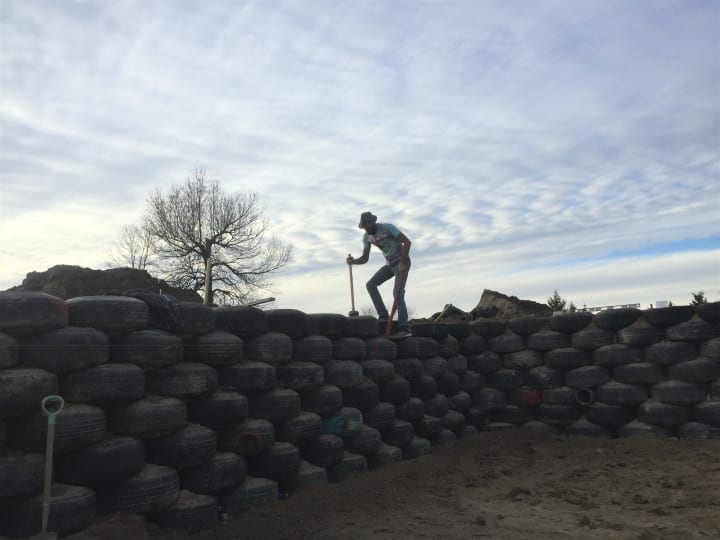
This tire wall is insulated and backfilled with Earth, creating an incredible amount of thermal mass, which provides passive healing and cooling. With such a connection to the Earth, we are intertwined with our environment like no other building is able to offer. In fact, there is nothing separating us from the Earth in these Holistic Homes –imagine doing the dishes in your bare feet; knowing that the water will nourish the plants that grow your food, and the only thing between you and the Earth is a cob floor made of sand, straw and clay.
These buildings are like nothing I have ever seen, and even the construction process is exceptionally unique. My step-sons have helped pound tires and build concrete forms, and my nephew learned how to walk on a site like this. This is the sort of building that you can actually have a part in creating, and I am proud to say that my blood, sweat and tears will be in and around the walls of my home.
Although I am still transitioning to a life of Holistic Homes, I can already tell you, for a fact, how incredible these buildings are. As I write this piece, I am in the greenhouse of a Holistic Home, pausing to provide extra hands as we complete its construction. I am sitting in the planter where food will be grown in a matter of weeks, with the sun shining through the glass, sheltering me from the swirling Spring winds outside. The interior isn’t quite complete, but I already feel more at home within these walls than any other building before.
- Part 1 –Recycling is Just the Start
- Part 2 –Reducing is the Transition
About the Creator
Maeple Fourest
Hey, I'm Mae.
My writing takes on many forms, and -just like me- it cannot be defined under a single label.
I am currently preparing for Van Life, and getting to know myself before the adventures begin!
Subscribe, Stay Tuned & ENJOY!
Keep reading
More stories from Maeple Fourest and writers in Earth and other communities.
Reducing is the Transition
I’m not interested in “small steps to sustainability,” because those steps fall short. What I am interested in is a complete overhaul of human life and behaviour, and that is what I’ve dedicated my life to. I am committed to looking past the shallow solutions that are being offered to us, to live a life that I choose for myself.
By Maeple Fourest5 years ago in Earth
Review of 'Man on the Run'
My wife and I saw Man on the Run, a nearly 2-hour documentary on Amazon Prime, about Wings, Paul McCartney's group that flew around the world from shortly after The Beatles broke up in early 1970 to shortly after John Lennon was murdered at the end of 1980, making a Beatles reunion forever impossible.
By Paul Levinson2 days ago in Beat


Comments
There are no comments for this story
Be the first to respond and start the conversation.