
Rethinking the future of lab-grown meat
how far away is it from store shelves?
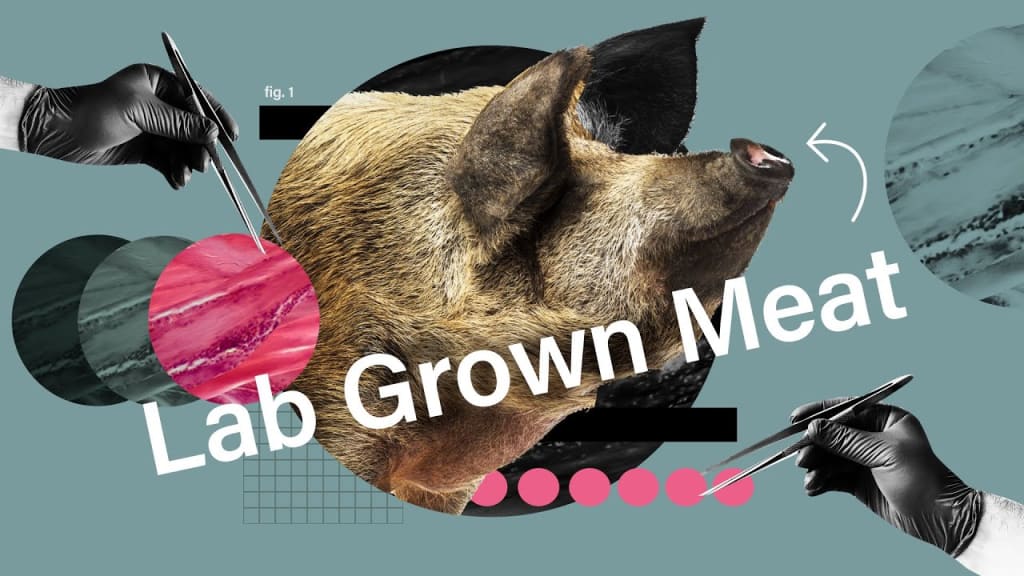
[Interviewer] So, Lizzy, can you tell us what we're doing here today?
Lizzy: We're here with Bosco, the pig. You suggested I work on overcoming my fear of pigs, and now here we are. But there’s another reason we're here, too. We recently read about how, in the future, a pig like Bosco could theoretically feed an entire neighborhood for years. Well, not this particular pig, but a pig in general.
We've been diving into the future of meat production and what we’ve found is pretty fascinating. The idea revolves around animals being raised for food, but without the need for slaughter. Instead, we could grow live tissue from animals cell by cell in bioreactors. There's a thought experiment we've been looking into that explores where animals might fit into our needs and desires as consumers in the future.
[Interviewer] So, to break it down for people who aren’t familiar, what exactly is cultured meat?
Lizzy: Cultured meat, or cultivated meat, or lab-grown meat, as it’s known by various names, is a process where cells are taken from an animal—whether it’s a cow, chicken, or pig—and grown outside of its body in a bioreactor. The cells are fed the nutrients they need to multiply and form muscle tissue, creating real animal meat without the need to slaughter an animal. This isn’t about plant-based alternatives like Impossible Foods or Beyond Meat; we’re talking about real animal tissue, just grown in a lab setting.
It’s been almost a decade since the first lab-grown burger was taste-tested on live TV. However, it’s only in the last two to three years that the research and investment in this technology have really begun to gain traction.
[Interviewer] That sounds promising, but what’s the debate around it?
Lizzy: There are a lot of arguments, both for and against cultured meat. Supporters argue that it could significantly reduce the environmental impact of traditional meat production. The livestock industry has a massive toll on land, water, and emissions, plus it involves the suffering of animals. Cultured meat, in theory, could address many of these issues. But critics point out that it's still too early to know for sure how eco-friendly it will be when scaled up. There are also those who believe that rather than spending billions on developing a "better" version of meat, society should focus on completely eliminating meat consumption altogether.
But there’s an interesting, specific question in this debate: how could cultured meat change the relationship people have with the food they eat?
[Interviewer] So, where does Culture Biosciences fit into all of this?
Lizzy: Culture Biosciences is an example of one company that is advancing this technology. They run a network of bioreactors that researchers can use to grow different kinds of proteins or engineered microbes. For example, if you're a lab working on a cultured meat product, you can send your raw materials to Culture, and they’ll handle the entire process for you.
Let me show you around their facility. These bioreactors look a lot like industrial blenders, except they're doing much more than mixing ingredients. They're growing cells, creating tissue, and mimicking the conditions inside an animal's body, all in an artificial, controlled environment.
[Interviewer] Can you explain how the whole process works?
Lizzy: Sure! To start, say you want to grow pork in a bioreactor. You would begin with a small sample of cells from a pig, usually taken through a biopsy. These cells are used to create a cell bank—a sort of reservoir of cells that can be used for future experiments. Once you’ve got your cell bank, you take a few cells and add them to a flask filled with nutrients that encourage the cells to grow and divide. Over time, these cells multiply and eventually, you have enough density of cells to transfer them to a larger bioreactor.
From here, the cells continue to multiply, creating muscle tissue that can eventually be harvested for food. The entire process usually takes anywhere from two to eight weeks, depending on the type of meat being grown and the specific techniques used.
[Interviewer] So, it’s not like you’re getting a steak out of the bioreactor right away?
Lizzy: Not exactly. What you get from the bioreactor is more of a slurry of cells—essentially a mass of undifferentiated tissue. That doesn’t look appetizing at all! The easiest food to make from that slurry is something like sausage or ground meat. But if you want to create specific cuts of meat like a pork chop, you would need to teach the cells to grow in a more structured way, possibly using a scaffold. This is a challenge that requires more research and development.
There’s still a lot of work to do. For one thing, this process needs to be far more consistent, automated, and, most importantly, cheaper than it is now. There are also significant safety concerns. The cells being cultured are very susceptible to contamination. You’ve essentially got cells from mammals growing in a perfect environment for bacteria to thrive. Any contamination could ruin the entire batch.
[Interviewer] What are the other challenges?
Lizzy: One major challenge is that most animal cells don’t thrive when suspended in a liquid in a bioreactor. To grow enough meat to make it viable for widespread consumption, you need a lot of bioreactor space. This means huge facilities are required just to produce small quantities of meat. The more space you need, the more materials and energy you require, which raises the question of whether cultured meat can really be scaled up efficiently.
But if these hurdles can be overcome, what could the future look like?
[Interviewer] Where do you see this technology going?
Lizzy: There are a few potential paths for how cultured meat might develop in the future. One scenario could be something similar to companies like Anheuser-Busch, which has massive fermentation facilities to produce beer. In the same way, we could see cultured meat being produced on a large, industrial scale in fermentation tanks.
On the other hand, there could be a craft approach, much like the craft beer movement. Smaller companies could specialize in different types of cultured meat, experimenting with various methods to create unique flavors and textures. This model could lead to more artisanal, small-batch production of cultured meats.
[Interviewer] What about the most extreme future scenario?
Lizzy: The most radical vision for the future is one where consumers could actually grow meat at home. Imagine having a bioreactor in your kitchen that allows you to grow fresh meat whenever you need it. This is obviously a huge technical challenge. You would need a fully automated system to ensure safety and consistency. But it’s not out of the realm of possibility, and some experts think this could become a reality in the future.
[Interviewer] That sounds fascinating, but it’s also pretty futuristic. Is there a more practical way forward?
Lizzy: One thought experiment proposed by a Dutch researcher, Cor van der Weele, offers an interesting perspective. He ran focus groups in the Netherlands to see how consumers might feel about cultured meat. While some people initially found the idea "unnatural," many began to rethink what they considered "natural" in the context of modern meat production. The group found that meat, whether produced in a traditional way or through bioreactors, was still meat—just produced differently.
There was also a shift towards valuing local, community-based production of meat. The idea of having a pig in the neighborhood and using local cells to grow meat in bioreactors at home seemed less alienating. In this scenario, the community could be involved in the process, raising the animal, taking a biopsy, and growing the meat themselves. It would combine the benefits of reducing animal suffering, local food production, and the availability of fresh meat without relying on large corporations.
[Interviewer] Is this just an idea for now?
Lizzy: Yes, it’s purely theoretical for now. This vision is still far from reality due to the technological, logistical, and cost barriers. But Cor believes it's an example of how technology can change lifestyles. As new technology advances, it may trigger shifts in how we live and think about food.
[Interviewer] So, we have a lot to think about regarding the future of meat production.
Lizzy: Absolutely. It’s an exciting and challenging space, with a lot of potential. As the technology evolves, we’ll likely see these questions become more pressing. But for now, it's a time of exploration and big ideas about how we might reshape the relationship between meat, technology, and our consumption habits.
[Interviewer] Sounds like the future of meat will be anything but predictable.
Lizzy: Exactly! It’s an exciting time to be thinking about where all of this could go.
About the Creator
The Day the Stars Went Silent
It began without darkness. The stars still shone. On a clear Thursday night, children in deserts and cities pointed upward at familiar constellations. Satellites orbited peacefully. Aircraft crossed continents. The sky looked exactly as it had the night before.
By Abubakar2206 days ago in Earth



Comments
There are no comments for this story
Be the first to respond and start the conversation.