
Point Nemo: The Loneliest Spot on Earth
"Where Even Astronauts Are Your Nearest Neighbors"

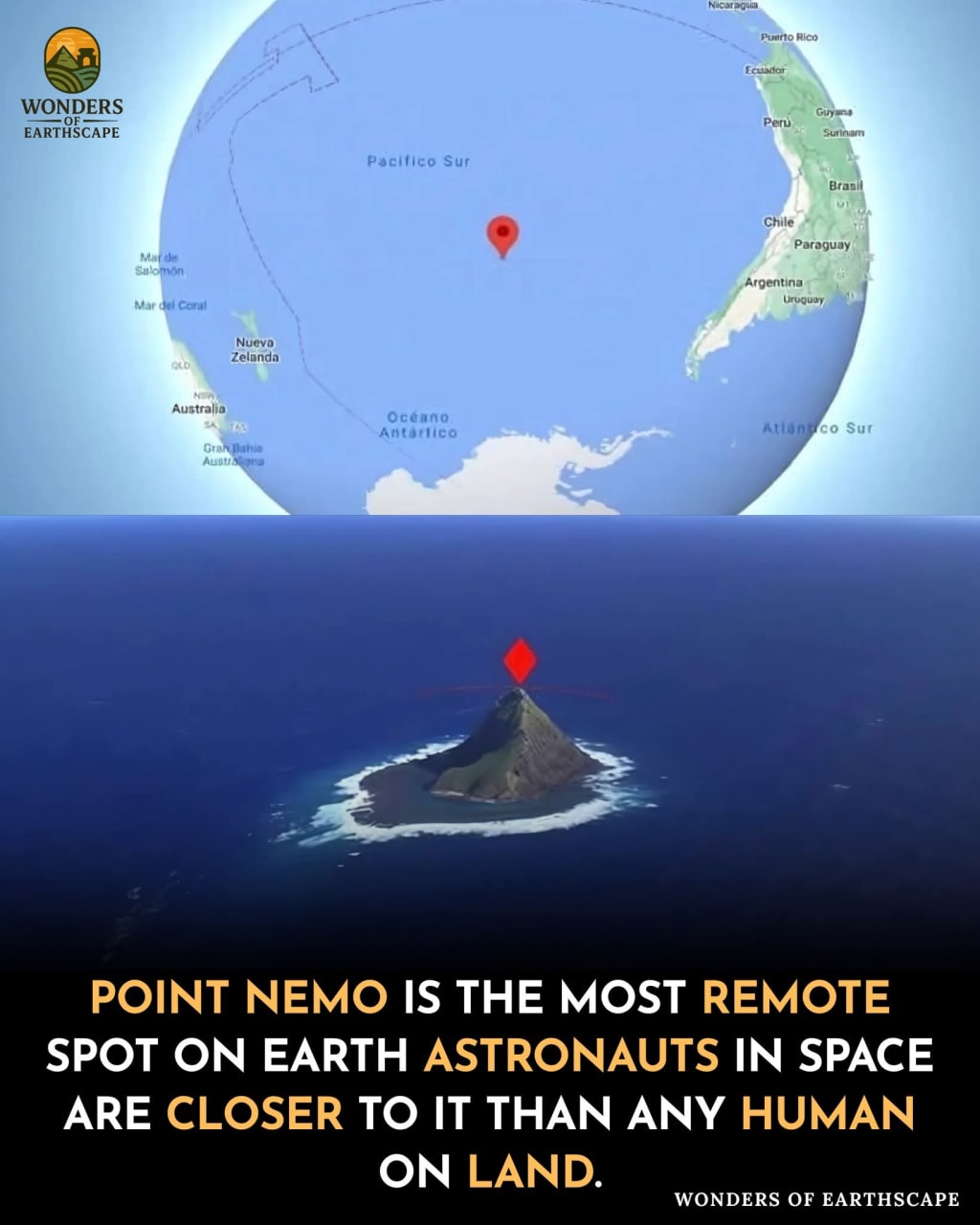
Point Nemo: The Loneliest Spot on Earth
Point Nemo, tucked deep in the South Pacific Ocean, holds a title that very few places can rival—it is the most isolated point on our planet. Officially referred to as the oceanic pole of inaccessibility, this location is the farthest spot from any coastline, lying about 2,687 kilometers (1,670 miles) from the nearest landmasses. These include the coasts of Antarctica to the south, Easter Island to the northeast, and the Pitcairn Islands to the north. Reaching Point Nemo isn’t just a challenge—it’s practically an expedition into one of Earth’s most profound voids.
This remote point wasn’t even identified until relatively recently. In 1992, survey engineer Hrvoje Lukatela used advanced computer models and geospatial calculations to pinpoint the exact coordinates. Before that, the concept of finding the ocean’s “middle of nowhere” was mostly theoretical. The name “Point Nemo” was chosen in homage to Captain Nemo, the enigmatic submarine commander from Jules Verne’s classic novel Twenty Thousand Leagues Under the Sea. It’s a fitting tribute, as both the fictional character and this real-world location embody mystery, solitude, and exploration far from human contact.
What makes Point Nemo especially captivating is the sheer magnitude of its isolation. In a world where satellites track shipping routes, airplanes crisscross the skies, and even remote islands have visitors, Point Nemo remains profoundly empty. Ships rarely pass through this part of the ocean, and flight paths avoid it entirely. It is so far from human habitation that, at times, the closest people to Point Nemo aren’t on Earth at all—they’re aboard the International Space Station, orbiting roughly 417 kilometers (259 miles) above the planet. The idea that astronauts in space are nearer than any land-based human really drives home how vast and untouched this region is.
Marine life here is sparse, too. The waters around Point Nemo form part of the South Pacific Gyre, a swirling ocean current that isolates it from nutrient-rich waters elsewhere. This means fewer fish, fewer seabirds, and almost no large marine animals compared to more biologically active parts of the ocean. Some scientists have called it an “oceanic desert,” not because it is devoid of water, but because it is largely barren of life.
Point Nemo also has a surprisingly modern role—it serves as Earth’s spacecraft cemetery. Since the late 20th century, space agencies have used its remote location to dispose of defunct satellites, cargo ships, and even entire space stations. The Russian space station Mir met its end here in 2001, and numerous cargo vehicles from the International Space Station have been guided to re-enter Earth’s atmosphere and crash into this watery grave. The logic is simple: its distance from human activity makes it one of the safest places to bring down large objects without risking harm to people or infrastructure.
Yet, for all its practicality, Point Nemo symbolizes something deeper. It reminds us of how much of our world remains unexplored. The oceans cover over 70% of Earth’s surface, but we have mapped only a fraction of their depths. Point Nemo sits in one of those underexplored stretches, far from research stations, underwater cables, and fishing fleets. This means it is one of the few places on Earth where the modern human footprint is almost nonexistent.
In an age when GPS tracking can pinpoint your location within meters and the internet connects us instantly across continents, places like Point Nemo stand as rare exceptions—regions where human presence is fleeting, if it exists at all. For explorers, scientists, and dreamers alike, it serves as a reminder that the world still holds pockets of mystery. There are still coordinates on the map that are more imagination than reality, more myth than memory.
So, whether you see it as a lifeless patch of water, a practical dumping ground for retired spacecraft, or a symbol of Earth’s enduring wilderness, Point Nemo is a testament to both our planet’s immensity and our limited reach. It’s the kind of place that invites reflection—not just on where we can go, but on the vast swaths of our home world where we haven’t yet set foot, or in this case, anchor.
Point Nemo may be physically inaccessible for most of us, but it holds a unique place in the human story: a lonely coordinate in the middle of the world’s largest ocean, quietly reminding us that no matter how far we travel, some corners of Earth remain beautifully out of reach.
About the Creator
Furqan Elahi
Writer of quiet thoughts in a loud world.
I believe stories can heal, words can build bridges, and silence is sometimes the loudest truth. On Vocal, I write to make sense of the unseen and give voice to the unsaid.
Keep reading
More stories from Furqan Elahi and writers in Earth and other communities.
New Snow and Ice Warning for Friday and Saturday: What You Need to Know
The UK is bracing for another round of disruptive winter weather as meteorologists issue fresh snow and ice warnings for Friday and Saturday. Across England, Scotland, and Wales, residents are being advised to prepare for hazardous conditions, with local authorities urging people to limit travel and stay safe. The latest forecasts indicate a combination of heavy snowfall, freezing temperatures, and icy patches, all of which could affect daily routines, public transport, and emergency services.
By Fiaz Ahmed 4 days ago in Earth



Comments
There are no comments for this story
Be the first to respond and start the conversation.