
On foraging an craft
Natural dyeing and textile art
The scissors in my bookbag are the most versatile tool that bridges worlds: They bridge the world of nature and the world of art. As a forager, a natural dyer, and a textile artist, I use them at every step of the way.
No matter how my art has changed or my creative joy has evolved in each stage of my life, my scissors are always the most valuable tool. All through highschool and college I have loved sewing, and I have loved the outdoors. Natural dyeing is my bridge between the two.
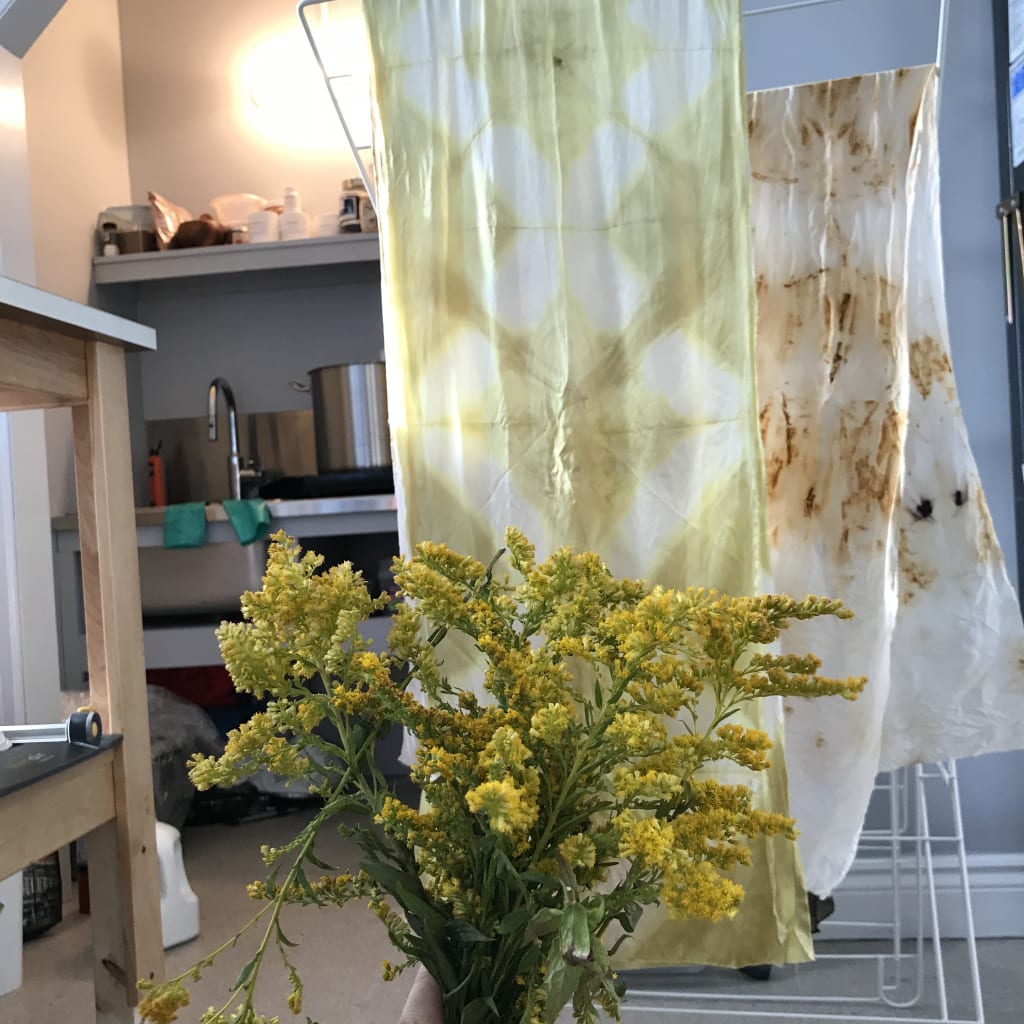
I use plants that I forage in the wild, as well as plants that I grow in my own garden to make natural dyes and textile paints to make a rainbow of colours on fabric and yarn. My scissors help me cut wild goldenrod flowers, maple leaves, sumac,weld and yarrow from the forests around me. They kindly trim marigolds, safflower, madder, Indigo, and coreopsis from my greenhouse. All these plants are waiting to become something amazing. These plants are my muse, integral to my creative process.
Then, while the plants are dried and processed, the other components of my creative passion take place: Surface design and sewing. I get to draft patterns and cut fabric. My surface design is done using Shibori techniques, where the cloth is either folded, stitched, tied or sewn to make negative space in the fabric before colour is applied in the dye bath.
As I stitch, and fold and tie, and clip, I think about the land and the plants and nature all along the way. I think about what messages and what energy the plants radiate to me, and how I can incorporate that into the overall piece.
Perhaps the tide washes up to flower patches of weld. I look at how it swirls, how it ripples, the patterns it makes. I think about the cooperation between the water and the flower. Perhaps the sumac bushes entangle in the tall sweetgrass in a kind of embrace, or dance. I think about all of this when I stitch and tie, and I continue the story. My fashion accessories I make pay homage to this. The pieces I make are like wearing a story, wearing a piece of art.
In this way, what is made and what is natural are not separate to me. They exist in symbiosis. I combine these two passions in order to create my happiness.
Foraging is important to me because it reminds me of where I come from, and sewing is important to me because it gives me space to express who I am as an individual. They are important opposites to creating a happy life, they keep me grounded no matter where I go. Through high school, college, and multiple moves across the country. These hobbies are my constant to keep me grounded.
Foraging is a comfort. Everything I remember about my childhood was outdoors. I was surrounded by people who valued a relationship with the land. It was a highly important part of my culture. I remember picking berries with grandma, or gardening with mom, or fishing with dad.
When we did those activities, it was also a space for people to show what they had made as well. Berries meant baking, gardening meant pickling, and fishing meant artfully crafted homemade lures. It was a space of trust and infinite possibility that brought me comfort as a child.
Sewing came into the picture in highschool, when I got to take a home economics class. Suddenly, I could make something more of myself than what I was used to. I couldn't often have new expensive clothes, but home economics class took that stigma away. With a little hard work and resourcefulness, and a good pair of scissors, I could make clothes that were unique to me. It didn't matter about money, or how humble the materials were, or where the materials came from. I could make something all my own, something to express myself, something beautiful out of next to nothing.
Sewing was the spark of creativity I never knew I needed. It gave me the courage to apply for design school after high school, and I took off to the big city, scissors in tow.
When I moved away from my rural home to go to college in a major city, foraging was how I held on to my culture in the land of concrete and commutes. I would pick blackberries by the railroad tracks, and shaggy mane wild mushrooms in the park, and I grew herbs in pots in my tiny studio apartment. I needed some kind of familiarity to get me through those hard times and big changes. Those same scissors were with me to help me clip what I needed.
Even beyond college, when I moved away from the city again, I kept on foraging and sewing. It is a place of healing for me, and serenity. In a world where social media is everywhere and information is constant, and we rely so much on visual input from screens, it's liberating to indulge your other senses.
When you go outside and hear the birds chirping, and smell the wildflowers, you feel free. When your hands touch cloth and your fingers run a stitch, you feel human again. You feel that you have escaped the machine.
In a world of consumerism where we are taught to believe that everything is constructed and transactional, it is freeing to know the forest exists. It's humbling to know that it has existed since time immemorial. The manmade is hard and fast, but nature is gentle and giving.
Foraging and dyeing and sewing all give me an escape from the human world, from adult obligations, and they give me a reminder that beautiful things can move slowly. It is a privilege to create such happiness.
It was a natural progression that I would learn to combine these hobbies. I started to follow accounts on social media and read old books about traditional dyeing. As soon as I learned that dyeing with plants was even possible, I knew that there was no turning back. This is my new way of living. A new generation, a new lifestyle, but carrying forward the lessons of those before us. I have now been a natural dyer for 5 years and a seamstress for 14 years, and I wouldn't have it any other way.
About the Creator
Josephine Clarke
I am a multidisciplinary artist practicing in West Arichat, Nova Scotia, Canada. My practice addresses themes of deindustrialization, labour, and environmental stewardship. I primarily work with textiles,salvage, sculpture and installation.
Keep reading
More stories from writers in Earth and other communities.
Regenerative Agriculture's Quiet Revolution
by Futoshi Tachino Regenerative agriculture — a holistic approach to farming that restores soil health, biodiversity, and resilience — has rapidly gained traction in recent years. This shift remains largely underappreciated by the public; in a 2024 survey, around 43% of U.S. consumers had never heard of regenerative agriculture (and another 28% had only minimal awareness) [4]. Despite this low profile, tangible developments in regenerative farming are delivering robust results. Farmers are proving that it’s possible to maintain high yields with fewer chemical inputs, improve profitability, and enhance ecological outcomes — all at once. This article explores the evidence-backed progress of regenerative agriculture across regions, the policies and technologies driving its adoption, and why this overlooked sustainability success story deserves greater recognition.
By Futoshi Tachino5 days ago in Earth


Comments
There are no comments for this story
Be the first to respond and start the conversation.