
Old Technology and Memory
In the attic of his grandfather’s house, he found an old radio that only played her voice.
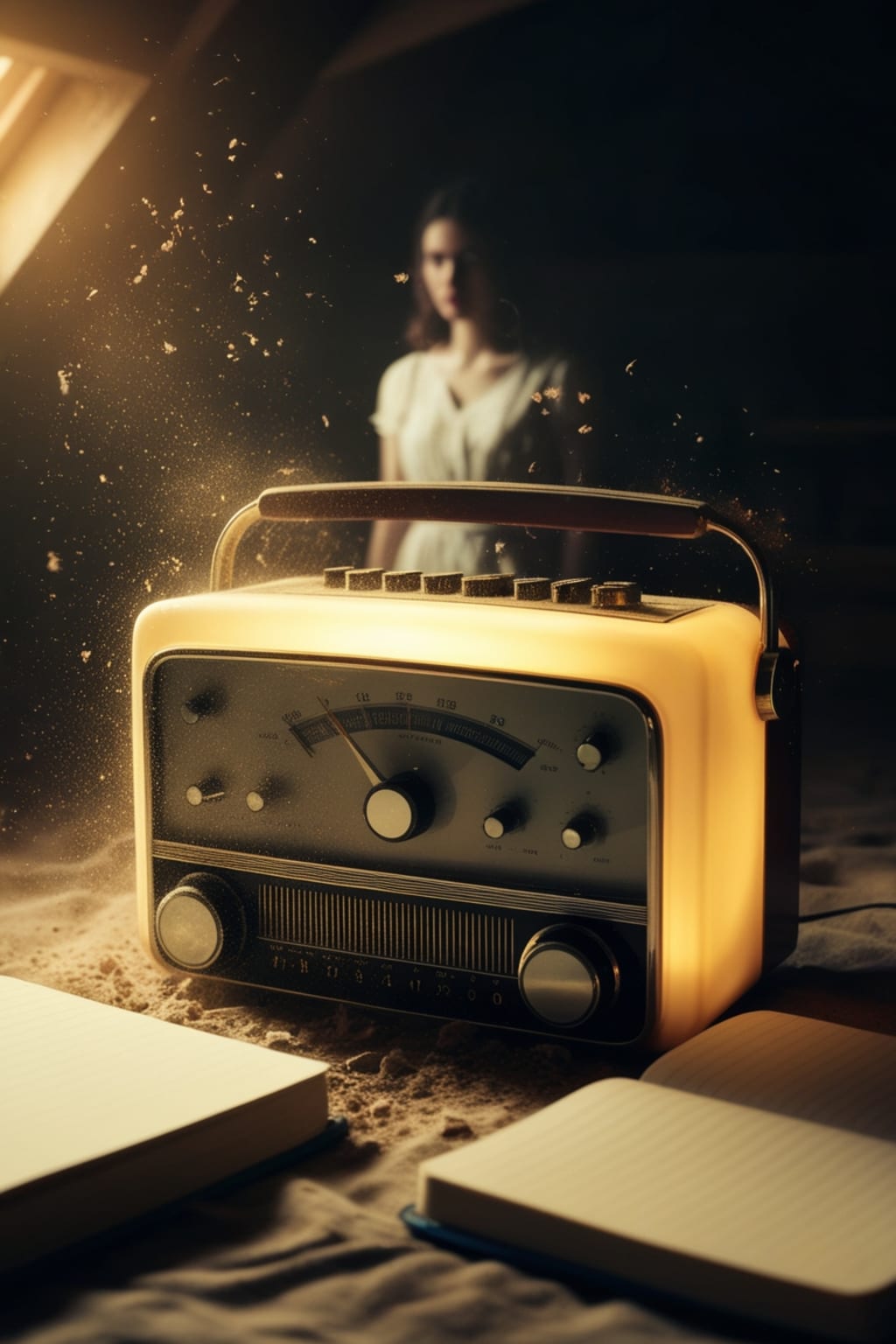
The attic smelled like dust and summers long gone. Light fell in slats through warped wooden beams, catching the air in golden flecks. Adam pushed aside a moth-eaten quilt, a cracked globe, a teetering stack of yellowing newspapers, and found the thing that would change everything: a boxy, brown Bakelite radio.
It was heavy in a way modern things weren’t—dense with time and secrets.
“Philco 38-690,” read the faint label beneath a knob. His grandfather had mentioned it once, in one of his more lucid moments before the dementia took over completely.
“She sang through it,” the old man had whispered. “Only ever at night. I never found her, but she remembered me.”
Adam had laughed then, thinking it a fable built from foggy memories. But now, staring at the antique, his hands trembling with dust and disbelief, he remembered the weight in his grandfather’s voice.
He hauled the radio downstairs.
It shouldn’t have worked. The wiring was brittle, the cloth-covered cord frayed. But Adam was a patient man with calloused hands and a mind that understood circuits better than conversations. He cleaned the vacuum tubes, rewired the transformer, and plugged it in, half-expecting a puff of smoke.
Instead, there was silence.
And then, crackling.
A voice broke through the static—not a news broadcast, not a song.
“Hello?”
Soft, uncertain. A woman.
Adam froze. His heart thudded like a hammer against hollow wood.
“Is someone there?” the voice asked again. She sounded no older than twenty. Her words were laced with the delicate accent of the 1940s, and something else—loneliness, maybe. Or longing.
He turned the dials. Nothing changed. No stations. Just her.
“Where am I?” she murmured, almost to herself. “It’s been so long…”
For three nights, Adam listened. She never repeated herself. The radio didn’t act like a recording. Her name, he learned, was Margaret. She loved the smell of oranges and hated thunder. She once lost a locket at the beach and still dreamed of finding it in the tide.
And she was afraid.
Of forgetting. Of being forgotten.
“I think I used to be real,” she said one night. “Or maybe I’m just a voice someone needed to hear.”
Adam didn’t know how to speak back. The radio had no microphone, no obvious transmitter. He tried once, shouting into the speaker. No reply. But the next night, she whispered, “Don’t be afraid. I hear you. In ways that don’t need words.”
He stopped leaving the house. Work emails piled up. Friends called and he ignored them. Every evening at 10:16 PM sharp, she would arrive—sometimes singing softly, sometimes weeping, sometimes remembering strange fragments:
“The dress was yellow. I danced barefoot.”
“There was a garden… or a war. I can’t tell anymore.”
“Someone called me daisy once. Not the flower—the name.”
Adam started writing everything down. Not because he thought it would make sense, but because it felt sacred. Like archiving a ghost.
He brought the radio to his grandfather.
The old man, confined to a wheelchair and slipping further from clarity every day, stared at it for a long while. Then, with trembling fingers, he reached out and touched the dial.
“She sang to me,” he murmured. “When the war ended. When I couldn’t sleep. When everyone else forgot, she didn’t.”
“Who was she?” Adam asked.
His grandfather blinked slowly. “Not a person. A moment, maybe. A memory so strong it refused to die. We were all so lonely, then.”
He fell asleep not long after, a faint smile lingering on his face.
That night, Margaret told a story.
About a man who used to listen to her during the war. How he would sit by the radio, hands stained with engine oil, heart bruised by grief.
“He never asked who I was,” she said. “He just listened. And that was enough. I remembered him because he needed to be remembered.”
Adam’s chest tightened.
Was she… a voice created by need? An echo from a time where sorrow made spirits out of sound?
“I think I’m made of everyone who ever waited for someone to come home,” she said. “I think you needed that too.”
On the seventh night, she didn’t come.
No static. No voice. Just the faint hum of circuitry.
Adam waited. For hours.
When the sun rose, he unplugged the radio.
And buried it in the garden beneath the lavender bushes.
Years passed.
Adam moved on—eventually. He married, had a daughter, named her Margaret.
But some nights, when the house is quiet and the world is too sharp around the edges, he steps into the backyard.
He places his hand on the earth above the radio.
And listens.
Just in case.
Because some memories are louder than grief.
And some technology, if loved enough, never really dies.
Image Prompt:
A vintage radio glowing softly in a dim attic, surrounded by dust particles caught in golden light. A shadowy figure of a young woman seems to hover just behind the dials—faint, as if caught between frequencies. There's a notebook beside the radio, pages fluttering as if by breath.
About the Creator
Keep reading
More stories from Abuzar khan and writers in Earth and other communities.
Raw Emotional Confessionals
I’m writing this now because it’s too late to say it out loud. And maybe that’s the point. You never heard me—not really. You heard the filtered versions of me: the polite one, the funny one, the one who apologized too much. I told you I was fine even when I couldn’t breathe. I laughed at your jokes when they cut like glass. I pretended the silence between us was peaceful instead of painful.
By Abuzar khan8 months ago in Earth
The Day the Stars Went Silent
It began without darkness. The stars still shone. On a clear Thursday night, children in deserts and cities pointed upward at familiar constellations. Satellites orbited peacefully. Aircraft crossed continents. The sky looked exactly as it had the night before.
By Abubakar2205 days ago in Earth
Review of 'Man on the Run'
My wife and I saw Man on the Run, a nearly 2-hour documentary on Amazon Prime, about Wings, Paul McCartney's group that flew around the world from shortly after The Beatles broke up in early 1970 to shortly after John Lennon was murdered at the end of 1980, making a Beatles reunion forever impossible.
By Paul Levinson7 days ago in Beat




Comments
There are no comments for this story
Be the first to respond and start the conversation.