
New Discoveries Are Changing What We Know About the Sun
The Sun unveiled, its secrets unfold, a tale of light both new and old

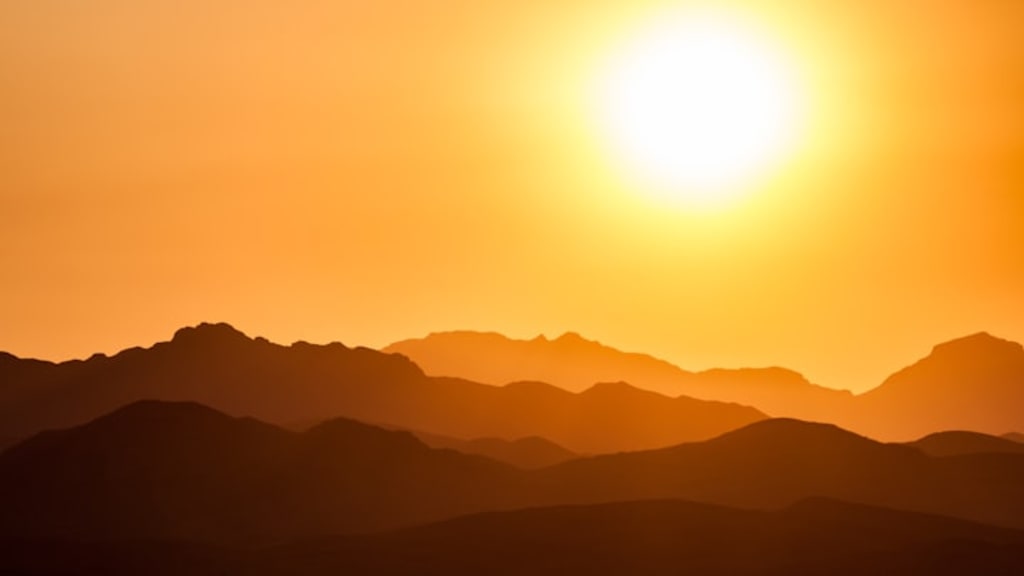
What happens when a star runs out of its fuel? First of all, paradoxically, it grows to a million times its original size. You see, when the core of a star runs out of hydrogen, it starts contracting under the weight of its own gravity. But some hydrogen fusion continues in the upper layers. While the core contracts, it heats up. This causes the upper layers of the star to heat up too and expand. The radius of the star increases.
As the star grows, it engulfves any matter, even its own planets, in its wake. Astronomers have watched stars right before or straight after swallowing entire planets. But until recently, they have never seen the process itself. Scientists from different universities have reported that for the first time in history, they've observed a star swallowing a planet. And this tragic event happened not somewhere in a farway galaxy, but in our own Milky Way, some 12,000 lighty years away from us. Astronomers spotted an outburst from a star, which is around 0.8 to 1.5 times the mass of our sun near the eagle-like constellation Aquila. It became over 100 times brighter than usual in a mere 10 days. And after that, it quickly faded away. Even more interesting, this white hot flash was followed by a longerlasting signal that was also colder than the first flash. And this combination, my friend, could only mean one thing. The star engulfed a nearby planet. What planet was it? Astronomers believe it could be a boiling hot world from 1 to 10 times the mass of Jupiter.
Such planets are also called hot Jupiters. They're giant exoplanets similar to the Jupiter we have in our solar system that need less than 10 days to orbit their stars. The planet we're talking about had been gradually spiraling toward the star until it was pulled into its atmosphere and eventually into the core of the perishing star. This galactic feast happened between 10,000 and 15,000 years ago when the star was about 10 billion years old.
And given its respectable age, the swallow itself happened lightning fast in one fell swoop. This is very different from other hot Jupiters, which were quite delicately nibbled by their stars. Astronomers aren't sure if there are any other planets orbiting this star, perhaps at a safer distance. But even if there are, thousands of years will probably pass before they become the stars main course or dessert. In any case, now that astronomers know what they should search for, they're going to be on the lookout for more cosmic gulps. Because one day, our planet, as well as part of our solar system, will suffer the same fate. Everything around us will be gone in a flash. But you may relax and breathe out. It won't happen for another 5 billion years. That's when the sun is supposed to burn out and expand so much that it will swallow the inner planets of the solar system, Mercury, Venus, Earth, and Mars. If people managed to colonize some other world by that time, which should be at least 10,000 light years away from Earth, they would be able to observe this catastrophe. The sun would suddenly become much, much brighter, and it would eject some material into space. It would swallow several planets, including Earth, before nonchalantly setting back to what it was.
But stars are not the only things in the universe that swallow other space objects. There's another kind of cosmic monsters that munch on everything, even light. Have you guessed? Right. I'm talking about ruthless black holes. But what is more interesting, they not only devour stuff, but also seem to spit it out. Not so long ago, scientists found out that the super massive black hole at the center of our home Milky Way galaxy seems to be leaking. Why is it a gamecher? Because it might mean that this black hole called Sagittarius A asterisk, whose mass is 4.1 million times the mass of our sun, isn't a sleeping giant as previously thought. It might still be active. And this leakage may be the whole hiccuping while swallowing clouds of gas. During the research, the team of astronomers used the Hubble Space Telescope. It helped them spot a jet that looked like a blowtorrch. It was pushing into clouds of hydrogen at the center of our galaxy.
The jets seem to spew gas like a hose directed into a pile of sand. This often happens around active black holes surrounded by the material pulled toward them by their immense gravitational pull. Some of this material gets into the black hole, but a small part of it gets swept outward by powerful magnetic fields. The research suggests that when a giant gas cloud gets too close to our super massive black hole, it gets swallowed and then the hole belches many jets of matter.
Fairmy bubbles might be the result of the belches that happened around 2 to 4 million years ago. But recently, scientists have discovered another giant glowing bubble of hot gas. It aligned with the jet stretching for 35 light years or more from the super massive black hole. Astronomers suspect that the jet could have plowed into this bubble of gas and inflated it. Now, I'll tell you something even creepier. There seem to be black holes that might be eating each other. Well, kind of. They're actually trying to share their meal at the moment, but who knows what will happen in the near future. But let me go into detail. Astronomers have spotted two super massive black holes feasting on the cosmic material of two merging galaxies in distant space. These giants have been located with the help of the Adakama largem submillm array of telescopes, also known as ALMA. These telescopes are in northern Chile's Adakama desert. Scientists originally used them to watch two merging galaxies located about 500 million lightyears away from Earth. Astronomers have also noticed that two gigantic black holes were growing alongside each other not far from the center of the coalescing galaxy UGC 4211. Apparently these black holes came across each other when their host galaxies collided. One of the black holes is around 200 million times the mass of our sun. And the other is a bit smaller, about 125 million times the mass of our star. Even though they aren't visible directly, the black holes are surrounded by bright clusters of warm glowing gas and stars. All of this has been tugged close by the black holes gravitational pull. Times will pass and these black holes will start circling each other and eventually they will collide creating one probably even bigger black hole. Scientists have been observing these black holes across multiple wavelengths of light and have come to the conclusion that they are kind of unique. They're located the closest to each other astronomers have ever seen.
The distance between them is a mere 750 lightyear which astronomically speaking is just next door. Even more exciting, this distance is close to the limit of what modern technologies can detect. Interestingly, such ginormous merges are more typical for distant galaxies. This makes it harder for Earth-based telescopes to see them. But the sensitivity of ALMA helped astronomers observe those bright and compact regions where matter swirls around black holes. Imagine how surprised astronomers were when instead of one black hole, they saw two of them munching on the dust and gas stirred up by the massive space merger. The most important thing about this discovery is that it may mean that such black hole binaries are likely to be much more common than we previously thought. And if pairs of black holes are so common, it might make it easier for us to study gravitational waves that occur when black holes collide. Such waves are also known as ripples in spaceime. If we talk about the recently discovered pair of black holes, it might still take them several hundred million years to crash into each other. But by observing their behavior, scientists can figure out how many binary black holes that are about to collide exist in the universe. NASA sent a spacecraft right into the sun. It's the fastest humanmade object ever and could cover the distance from Philadelphia to Washington DC in just 1 second. The Parker Solar Prob's mission is to study our stars dangerous behavior. Scientists warned that massive solar storms are inevitable and the consequences could be catastrophic for our planet. The spacecraft got seven times closer to the sun than any other probe ever did. It managed to do so during its 22nd flyby to the star since its launch in 2018. Because our star is so massive, its gravity is really strong, like a giant magnet. As the probe flies around the sun, it uses gravity to go faster and faster and eventually picks up that crazy speed. As it got closer and closer to the sun's corona, which is its outer atmosphere, the probe had to survive temperatures of 2552° F. That's hot enough to melt many metals. It was protected from that heat and radiation by a 4.5 in thick carbon shield. It kept the tools inside the probe safe and running at around room temperature. The scientists went to all this effort because they're hoping to solve a big mystery about the sun that's been puzzling them for ages. The surface of our main star is already super hot.
But as you move closer out to the corona, the temperature shoots up to millions of degrees. And it doesn't make any sense because it's farther away from the sun. So maybe we could finally get some answers about this heat phenomenon.
The mission is also going to help us understand something called solar wind.
The sun is constantly shooting out tiny bits of energy and charged particles into space like a neverending breeze of electricity. When this solar wind hits Earth, it can create amazing light shows in the sky called auroras. The more active the sun is, the farther south you can see auroras. Our star follows natural cycles that last about 11 years. The activity goes from low to high and back down to low. Right now, we're in the solar maximum, the peak of the activity cycle. That's why we've spotted beautiful auroras in the most unexpected places in 2024. The downside to it is that the sun's activity can send out bursts of energy and charged particles that can mess up things like radios, satellites, and even GPS. It can be dangerous, especially for astronauts out in space who aren't as protected as we are here on Earth. Humans wouldn't feel the compression of the planet's electromagnetic field because of all the extra radiation. But power grids are really sensitive to it. If we don't act fast when it happens, the influx of energy will go into power transformers all over the world, disrupt them, and leave big areas without electricity.
If this happens during a hurricane or a tornado when communication is already super important, it could make it much harder for emergency services to communicate and save lives. That's why it's so important to learn to predict this space weather.
It's tricky because unlike most disasters like earthquakes, floods, and volcanoes, it doesn't leave behind any kind of physical evidence. The only big solar storms we really know about happened in 1859 and 1921. The first one called the Carrington event was so wild that it made sparks fly from telegraph wires.
The auroras were seen all the way near the equator. Scientists back then were using a special kind of paper that reacted to light to record solar activity. During the Carrington event, the reading from the sun went off the page, literally. Whatever was happening, it was so extreme that we still don't fully understand it. Then there was the New York railroad storm of 1921. It was powerful enough to knock out telegraph systems across the US, Europe, and the Southern Hemisphere. The storm boosted radio transmissions for a bit, making them travel farther than usual. But back then, there weren't nearly as many radios, so it wasn't super helpful. The bigger problem was the electrical grid in the US, which was heavily damaged.
Back in 1859 and 1921, people weren't as dependent on tech as we are now. If a storm like that hits today, the consequences could be way more catastrophic. Scientists from New Zealand who study space weather are working on simulations trying to prevent disasters from happening.
They say one of the possible options to do it is to study other suns like ours elsewhere in space. If we get data from thousands of stars, not just one, the picture for analysis would be more complete. So far, scientists have launched or plan to launch several other missions in addition to the Parker Solar Probe. Meanwhile, NASA is working on another mission, launching Endurance, Robotic Moon Machinery on steroids.
Its main mission will be to collect samples from key lunar locations that will later be retrieved by astronauts from the Aremis program. These samples are spread across the largest impact basin on the moon, separated by hundreds of miles. To do it, Endurance will have to be way more advanced than Perseverance, NASA's current most cuttingedge rover.
Endurance will drive roughly 100 times further, drive 10 times faster, and collect roughly 200 times more sample mass. Endurance would also be the first planetary rover to drive at night. And because it will be on the far side of the moon with limited communication to Earth and surface data, it will have to drive autonomously between sample locks and make its own decisions in tough conditions. When it reaches its destination, it's going to switch to a more classic way of doing things.
Scientists back on Earth will get involved directly, guiding the rover to explore the sites and collect samples. The teams on Earth will also keep an eye on how the rover is doing by monitoring its telemetry, which is the data it sends back, like its health stats.
If they spot any signs that a part is wearing out or something isn't working quite right, they'll tweak the plan to keep things running smoothly. All this will cost huge amounts of money, probably way more than the Viper moon mission that was cancelled after NASA had spent around $450 million on it.
While Endurance is in the planning stage, the Blue Ghost lunar lander is already on its way to the moon. Its main mission is research. It will spend 25 days in Earth's orbit, taking measurements and waiting for the right time to fling itself to the moon. After 4 days in transit, Blue Ghost will hang out in lunar orbit for another 16 days to collect more data. Then it will descend to one of the largest basins on the moon and spend one lunar day there.
It will measure subsurface thermal data, radiation levels, and other important data. At the end of its mission, Blue Ghost will take some final pictures of the lunar sunset. It isn't designed to return back to our planet. So, when the night falls, it will do some final work and go offline for good. NASA chose the team of University of Florida aerospace engineers to work on another innovative space project. It will cost $12 million and its goal will be to improve the way we track changes in tectonic plates and oceans on Earth from space. It will use state-of-the-art sensors that will measure even the tiniest gravitational changes. The data it gets will help scientists monitor droughts, assess groundwater reserves, and better understand changes in sea levels. They expect to launch it around 2027 aboard a SpaceX Falcon 9 rocket.
Well, it turns out black holes might not be as elusive as we once thought. They might be hiding within stars. In this case, the extra mass of some of these space lanterns could explain weird gravitational effects in the universe.
Previously, dark matter was the cause of these phenomena. The black holes I'm talking about might be those itty bitty ones that appeared at the dawn of time when the universe was just a baby. And they may still be lurking in the hearts of giant stars. A team of scientists say the idea might be quite plausible.
Astronomers could detect such trapped black holes by the vibrations they produce on their stars surfaces. And if there are many of them out there in the cosmos, they might function as the very dark matter that holds the universe together.
Almost any black hole was once a massive star that collapsed in on itself and became incredibly dense. Black holes have immense gravitational pull. Even light can't escape their clutches.
People often think that black holes work like vacuums, pulling space inside. But that's not the case. Black holes can only swallow stuff that is extremely close. Usually space objects venturing into their event horizon. That's a black hole's point of no return. Once you cross this border, there's no escape. In 1971, renowned physicist Stephven Hawking suggested another origin of black holes. If we took the thick soup of particles that appeared moments after the Big Bang and the birth of the universe, we'd be bound to find some spots dense enough to collapse and create black holes. Such holes, which got the name of primordial black holes, could range in size from microscopic to gigantic. If they were pervasive and numerous enough, primordial black holes could act as dark matter, knitting the cosmos together with their enormous gravity. And dark matter is believed to make up 85% of all the matter in the universe. So, what's the matter?
Astronomers have been searching for primordial holes by looking for flashes that would occur when they pass in front of distant bright objects magnifying their light like a lens. But they haven't spotted even one yet. On the other hand, if a primordial black hole was tiny enough with a mass like that of an asteroid and a diameter as minuscule as a hydrogen atom, the flashes wouldn't be bright enough to be detected by such surveys. Then the team researching the phenomenon of primordial black holes decided to consider the consequences of a universe where dark matter was made entirely out of tiny black holes. They concluded that one of such teensy holes could be dashing through the solar system at any given time. Some might occasionally get trapped within gas clouds giving birth to new stars ending up in their centers. The next step of the researchers was to build a model of a black hole existing in the very core of a star where hydrogen atoms undergo fusion and produce light and heat. At first, they didn't see anything unusual.
Even a super dense stellar core is mostly empty space. And it wouldn't be easy for a microscopic black hole to find matter to consume there. That's why its growth would be incredibly slow. It could take longer than the lifetime of the universe for this tiny hole to eat a star. But what if a larger hole as massive as the dwarf planet Pluto or asteroid series appeared at the center of a star? Then it would get bigger in a matter of a few hundred million years.
The material would keep spiraling into the black hole, creating a disc that would heat up because of friction emitting radiation. Once the black hole grew to the size of Earth, it would start emitting even more radiation, shining extremely brightly. It would also be turnurning up the stars core, and the star itself would turn into a black hole powered rather than a fusionpowered object. Such entities were dubbed Hawking stars. To cool off, the exterior of a Hawking star would form a red giant.
That's what our sun is likely to turn into as it gets older. But a red giant star with a primordial black hole at its center would be cooler than the stars that have reached this stage through regular means. Such stars are known as red stragglers. To find out whether they indeed host a black hole, astronomers might need to tune into the frequencies at which stars vibrate. Since a honking star would mostly affect the interior of the star rather than its topmost layers, the star would thrum with a certain combination of frequencies. The waves created in the process could be detected in a way the stars light would pulse and throb. So all scientists need to do now is study the already known red stragglers and figure out whether any of them show the characteristic vibrations of a black hole. Now, should we worry about the sun? Since our star hasn't reached its red giant stage yet, we can't know whether it'll turn into a cool red straggler. What we know, though, is that our star might contain those tiny black holes that formed in the Big Bang. But now, we have no means to check whether they're indeed there. Currently, our star is around the midpoint of its existence, middle H. It creates energy non-stop by fusing hydrogen atoms within its core. Once it runs out of hydrogen in its core, it will enter its red giant phase and begin to collapse. It'll happen in about 5 billion years. Don't hold your breath.
And the phase itself will last for a billion years or so before our star depletes its fusible materials and loses its outer layers. It will leave behind a tiny white dwarf star half as massive as the sun and around the size of our planet. In some cases, when the gravitational collapse of a star's core is complete, the star remnants turn into a black hole. But that's not the fate awaiting our sun. You see, our star just doesn't have what it takes to become a black hole. It's not heavy enough. There are a few conditions that can affect whether a star can turn into a black hole, including its composition, rotation, and the processes that lead to its evolution. But the main requirement is still the right mass. Stars with 20 to 25 times the mass of the sun can potentially experience the gravitational collapse needed to form black holes. In other words, the sun is simply too small to form a black hole. But what would happen to us if it did? You might assume that if the sun turned into a black hole, our planet would be doomed to be pulled into it.
But do you remember the basics? Black holes aren't giant space vacuum cleaners just sitting there and waiting for a new planet or star to get their hands on. But black holes don't have enough gravitational force beyond that created by their incredible mass. And if the sun were to turn into a black hole, which will not happen, this hole would still have the same mass as our former star.
And Earth's orbit around this newly formed black hole wouldn't change. But all other things would change dramatically. The sun, which is currently around 432,000 mi in radius, would shrink to a mere 1.9 mi in radius. But you wouldn't be concerned with the absence of the bright yellow sphere in the sky since you have many more pressing issues on your hands. Our planet's main heat source would be gone, leaving us frozen in the dark. Without this source of energy, photosynthesis would immediately stop, disrupting entire food chains.
Eventually, all life on Earth would be extinguished. But rest assured, our hard, barren rock of a planet would continue in its orbit. Oh well.
The sun is getting ready to flip as its magnetic poles are reversing. Similar to Earth, the sun has a magnetic north and a magnetic south. But unlike Earth, the reversing process of the sun's poles is more frequent and easier to predict. The next flipping is expected to take place this year between April and August. As apocalyptic as it might sound, you don't have to worry. If you're around 30, you've already experienced this phenomenon more than once. As the sun flips every 11 years, you probably didn't notice any changes back then because this process doesn't impact Earth's life so much. But this time, things might be a little different. On Earth, ocean currents are movements that play a crucial role in influencing both climate and weather by distributing heat from the equator to the poles. On the sun, these currents are more like an ocean of plasma, but they not only transport heat, but also carry electromagnetic energy. That happens because the sun is a huge ball of hot and ionized gases that keep flowing inside its core. By fusing together hydrogen atoms and forming helium, our star releases a massive amount of energy leading to these very heavy flowing electric currents. And whenever you have currents, you have magnetic fields. It's easier to understand if you think of that classic experiment with a wire and a nail that you probably conducted in elementary school. When electricity flows through a wire, it creates a magnetic field around the wire. So when you connect a wire to a battery and wrap it around a nail, the nail becomes a magnet. This is similar to how electric currents create magnetic fields on the sun. This whole process with the help of which the sun generates its magnetic field is called a dynamo. We can't observe it directly but we can see its effects on the sun's surface. When plasma and magnetism flows become unstable and intense, they manifest as sunspots. You know those dark areas on the sun's surface. Much about how the dynamo works remains a mystery. But scientists have learned something important after observing these sunspots for centuries. The dynamo process follows a pattern. About every decade, it reorganizes itself. The sun's polar magnetic fields get weakened, eventually reaching zero, and then they return, but with the opposite polarity.
Back in the 50s, researchers figured out that when sunspots start to ramp up and become more intense, it means the poles are gearing up for a reversal.
And over the past few years, solar activity has been off the charts. We're talking about more solar flares, more electromagnetic radiation bursts, and more plasma blobs being ejected into space. It's like we're sitting in the front row at the solar system's most epic fireworks display. In fact, the sun hasn't been this lively in probably two decades. Right now, experts think the polar fields are almost in sync and steadily weakening, inching closer and closer to zero. But we haven't reached the point of reversal yet. Although it might sound like the sun flips its magnetic poles like clockwork every 11 years, the truth is that it's not as neat as it seems. This path can be bumpy and some aspects of the phenomenon are still very hard to predict. Take the last solar cycle for example. The northern hemisphere started its magnetic flip back in early June 2012, but then it kind of hit a snag and lingered around the neutral point until late 2014. Meanwhile, in the southern hemisphere, things were smoother with the polarity switching over in mid 2013.
This time around, the sun is actually playing nice. Things seem to be running way smoother this cycle with the poles transitioning more evenly. But here's the thing. Reversal processes are never the same. That's what makes this phenomenon so interesting to observe.
But at the same time, it's hard to predict how it'll affect us down here. Here on Earth, we don't have to worry too much about those intense sun explosions happening 93 million miles away.
But if, and I emphasize if, a solar storm were to reach our planet, the main threat it would bring would probably be the disruption of communication satellites in space. However, things might be different in this cycle reversal happening in 2024 because the number of satellites has skyrocketed in recent years. For example, Elon Musk's Starlink system alone involves more than 4,000 of them. All these satellites along with communication and GPS satellites could be impacted or even destroyed by a powerful solar storm. Although the chances of a powerful solar storm hitting Earth are low, it's not impossible. Back in 1859 during the Carrington event, a storm occurred near the peak of the solar cycle, causing currents to surge through telegraph lines, sparking fires and disrupting messages worldwide. Earth fell silent as telegraph communications failed. Just imagine what a solar storm could do to our vast number of satellites today. It could affect everything we rely on daily from space-based communication and navigation to weather forecasting services. The ground level power distribution could also be affected.
You can forget about watching YouTube or Bright Side because if such an event occurred today, it would cause an internet apocalypse, sending countless people and businesses offline. There's a prediction that says that if a Carrington class event happened today, it would result in damages ranging from 0.6 to $2.6 trillion. And I'm talking about the United States alone. Fortunately for us, solar storms as intense as the Carrington event happen only once every 500 years or so. Bad news for communication satellites, but great news for aurora watchers. During the Carrington event, dazzling aurora's borealis lit up the sky as polar light shows stretched far beyond their usual ranges. The northern lights were spotted as far south as Cuba and Honolulu, Hawaii, while the southern lights were seen as far north as Santiago, Chile. For many people around the world, this was their first glimpse of the aurora, leaving them obsessed with the unusually bright skies. Some of them thought it was the end of the world, while others began their day early, thinking the sun had risen after hearing birds chirping and seeing the bright skies.
Today, we know there's nothing strange about it, considering that the appearance of auroras at lower altitudes is one of the expected effects of the sun's magnetic pole reversal. Typically, these dazzling phenomena are found between 60 and 75° latitude. But during the last magnetic pole reversal in 2013, intense auroras were observed below 50°.
Eyewitnesses describe these auroras as blood or deep crimson red shining so brightly that you could read a newspaper in their light. It's important to study this phenomenon and not to fear it. The inversion of the magnetic poles on the sun is actually a great opportunity for scientists to better understand how our star works. Since many pieces are still missing in the whole dynamo situation, we're still not very good at predicting why some solar cycles are more intense than others or when exactly a coronal mass ejection will erupt. But being able to predict that is becoming more and more necessary as we venture ourselves into space. The more people are out there beyond Earth, the more exposed they are to these strong solar storms.
That's why the scientific community wants to know more precisely when a solar storm can cause damage to spacecraft and space stations. Plus, it would help meteorologists make progress in predicting weather, not only on Earth, but also in space. The whole point is to make space travel safer as the interest in crude missions to the moon and Mars grows every year. Another reason why it's important to learn more about the sun's pole inversion is to better understand how the mysterious interior of the sun works. that could actually help us figure out the aspects of other stars in the universe and maybe get closer to answering the ultimate question. Why are we here? See this? You're looking at the best full portrait of the sun by far.
Thankfully, our 4 and 1/2 billionyear-old parent star didn't use any makeup to fix its skin tone before this photo shoot. And now we can study its surface in great detail. This iconic image was taken in March 2022. NASA wanted to gain a better understanding of solar behavior and its impact on life on Earth and the future of our space technologies. Of course, to do so, they launched the Solar Dynamics Observatory Satellite or SDO mission in February 2010. This legendary photo shoot happened 12 years later when SDO was halfway between the Earth and the Sun.
The scientists had to assemble 25 individual images like a puzzle. So the final image contains 83 million pixels.
Yeah, the resolution is about 10 times better than your fancy 4K TV screen. Look at this amazing cookieike pattern. Typically the bright surface of the sun overshadows it when we observe the star from Earth. Thankfully, NASA explored the light beyond the visible range, which allowed them to discover some invisible details of the sun's face. When you adjust your selfie with filters and effects, you can end up with completely different portraits, highlighting different spots of your face, even those you didn't know existed. H the same principle works here. All these plasma balls are the same photo of the sun captured at different electromagnetic wavelengths.
The revealed spots and patterns can help us understand events happening inside the sun's skin a little better. At the speed of light is supposed to mean super quick. But this rose gold ray caressing your cheek at dawn has come a long way and is incredibly old in human terms. Photons generated by the sun's core take between 10,000 to 170,000 years to travel through the stars atmosphere and then around 8 minutes more to reach Earth.
So, let's explore what's taking them so long. Our tour begins with the upper layer of the sun's atmosphere. Remember, solar deities and movies and theater plays, they often wear luxurious crowns with golden rays. Well, the real sun does wear a fancy corona, too, which is the outer layer of its atmosphere. But, of course, its size and glory are incomparable with those plastic costume crowns. And it shape is not so stable.
Corona is a gas shell enveloping our parent star. So its size and form constantly fluctuate under the influence of the sun's magnetic field. You can spot this crown with the naked eye from Earth during total solar eclipses. It looks like a beautiful intense radiation around the solar disc, which itself is completely blocked by the moon. The corona stretches 5 million m above the sun's surface whereas our blue planet is only about 8,000 mi in diameter. So, one hypothetical ray of the corona equals a row of about 625,000 Earth-sized planets. And suddenly, all my problems begin to seem tiny. Now, here's another fun fact. The sun's corona kind of breaks the laws of known physics because it's hotter than it should be. Its temperature reaches 2 million° F, whereas the surface of the sun is only above 9,000°. Although the word only doesn't fit here because it's still super warm in human terms. Usually temperature tends to fall as you move farther from a heat source. But it's not the case here. Space scientists are still scratching their heads trying to investigate this mystery. Thankfully, the recent photo shoot allows us to explore what's going on inside this massive hot stuff without risking losing our sight. Take these beautiful bright spots for example. They depict solar flares happening under the corona layer.
Solar flares are powerful explosions that happen when magnetic fields bump into each other. When it happens, they change shape and quickly reorganize.
These fields arise from plasma, which is very turbulent itself. So, these events are no surprise for the local weather.
Now, who would have thought that the sun has dark spots on its skin just like people? These darker areas are known as coronal holes. Earthlings can experience their impact when they observe the beautiful aurora lights in the polar regions. Coronal holes look darker because plasma in these spots is cooler, less dense, and magnetically open. These conditions allow the solar winds to escape outward across the solar system rather than hang out at the sun's surface. And when they bump into the Earth's magnetosphere, auroras emerge to fascinate our eyes. Thankfully, the local fields cool down the solar winds.
Nobody wants their eyes to melt, right?
Now, if we were looking for an analogy to the sun's hairs, the best candidate would be solar prominences. These large, bright plasma loops arise from the sun's surface and stretch for thousands of miles into space. Their lifespan varies from days to several months. It's one of the most common events in this region.
Although the first detailed description of solar prominence dates to the 14th century, modern scientists are still researching how and why they're formed. Diving further inwards, we're facing the transition region. The thickness of this layer is about 62 mi, and the local weather is unthinkable.
Temperatures can rise up to 900,000° F.
The transition layer sits between the corona and the last region of the sun's atmosphere called the chromosphere. Now, speaking of which, welcome to our next stop. The chromosphere region is famous for a scientific mystery called a spicule.
Come on, say it with me. Spicule. That's fun. These spectacular grassyike jets of plasma fire upwards from the surface of the sun and reach speeds of approximately 224 m per second as if they're jumping on a trampoline from the surface of the sun. Each spicule lasts for just a few minutes in outer space before falling back into the solar atmosphere. Astronauts were having a challenging time trying to explain how magnetically charged particles could manage to escape the massive gravity of the sun while being so close to it. The possible answer emerged in 2017. A group of scientists discovered that neutral particles provided the magnetically charged particles with extra buoyancy to escape the solar gravity for a while, which is better than my cousin's explanation, which is happy thought and pixie dust. Yeah. Now, let's go ahead and travel 1,000 mi inward toward the chromosphere to finally reach the solar surface, the photosphere. It's around 248 mi thick. But unlike planet Earth, the sun's surface is not solid or stable at all. The temperatures here are insanely hot for any matter to exist. On the other hand, scientists often call plasma the fourth state of matter. And why not? It's made of ionized atoms and free electrons, so it kind of deserves to matter. So, what's the matter? Maybe someday we'll happen to meet the local civilization of plasmoid people. But I think it's best that we skip their welcoming warm hugs. You know, hot, hot, hot. Anyway, the photosphere is our final stop because humankind doesn't have the technology to explore the sun any deeper. So, if you want to learn more, you'll have to invent your own spacecraft. But time's a wasted. You'll only have about 7 to 8 billion years.
After that, our sun will fade away, according to scientists estimates.
Actually, those same scientists will be going first.
Now you have a serious competitor though. NASA's Parker Solar Probe is the current champion for the deepest dive into the sun. The spacecraft managed to travel 4 and 1/2 million miles from the sun's surface toward its core on September 27, 2023. And then the Parker probe repeated its own record once again in December of the same year. So why didn't it melt? I hear you asking. The probe has been designed to withstand insanely intense conditions and temperature fluctuations. It's equipped with a custom heat shield and an autonomous system protecting the mission from the massive solar lights. NASA has further ambitious plans. In December 2024, Parker will make its closest approach to the sun. It will travel faster than any man-made object has ever traveled at the speed of 435,000 mph. The probe will be just 3.8 8 million miles away from the sun's glowing hot surface. It's like landing on a star. Astronomers have already compared this epic upcoming milestone with the moon landing. I'm thinking, however, it might be safer if we, you know, landed at night. Yeah, you're right. That's an old joke. From where we stand, the sun seems so calm and peaceful. But like humans and basically the whole living world, the sun has its own phases when it's more or less active. It's just that the consequences are way bigger and more chaotic when the sun becomes hyperactive. Let's zoom in to see what's happening up there. So, one of the ways we measure the activity of our star is by counting sunspots on its surface.
Sunspots are dark patches that form when the sun's magnetic field gets all tangled up. It's simple. The more sunspots, the more active our sun is.
And it seems the sun has been partying like crazy recently. The number of sunspots scientists have seen is the highest for nearly 21 years. In June, 163 sunspots appeared on the sun's surface. The last time we had so many dark patches across the sun was in September 2002 when there were 187 of them. Uh-oh. It seems this chaotic party is getting closer to its peak. And that's something we call solar maximum.
How does all this even happen? The sun's magnetic field is strong and organized at some point. But as we said, sometimes comes the time when it kind of ends up tangled, sort of like a ball of rubber bands that are wound together very tightly. This also means plasma is rising from the surface, forming loops and causing a mess in the shape of solar flares and something we call coronal mass ejections, CME. That's when plasma in the sun's upper atmosphere called the corona goes crazy and bursts really strong.
Then at some point this ball snaps and completely flips and turns the south pole into the north pole and vice versa.
All this happens every 11 years or so.
So when the sun comes into this phase when it becomes very active, it shoots out hot blobs of plasma, gets big dark spots as large as planets and releases powerful eruptions of energy and radiation. Something fascinating happens when the sun becomes more active. a thing called plasma waterfall or polar crown prominence, PCP. It's like a mini eruption that starts on the sun and it seems like it tries to get away, but then the sun's magnetic field pulls it back before it can escape into space.
And this plasma waterfalls really spectacular. It goes up to 62,000 m above the surface. It's like you stack eight Earths on top of each other. Then there's something called a polar vortex. It's like a gigantic halo of plasma that rotates around the sun's north pole really fast. This vortex happens when a large tentacle of plasma snaps apart and falls back toward the surface, similar to how a plasma waterfall forms. Scientists don't know why this plasma stays above the sun's surface for so long. And one of the cool examples of CMEs was a giant one in the shape of a butterfly in March this year.
It got such an unusual shape because it exploded on the side of the sun we couldn't see. So, it was impossible to fully measure how strong it was.
Fortunately, that one didn't explode in our direction, but it might have hit Mercury a little bit. And it's possible it knocked off some dust and gas since Mercury has a weak magnetic field. All this sounds cool in theory, but it's not such good news for us.
Because of all this, we might experience more intense solar storms that can again lead to geomagnetic storms on Earth. And these don't just sound alarming. They indeed are. They create chaos and disrupt the magnetic field of our planet. Geomagnetic storms can create beautiful northern lights. True. But we'd all rather enjoy such beauties as the aurora borealis in regular conditions or just watch a good old sunset above the ocean.
It's not that every solar storm will necessarily hit Earth, even if there are more of them. To reach our planet, they must be pointed in the right direction at the right moment. But if that happens, the storm can ionize the upper atmosphere and bye-bye our communications. It can cause temporary blackouts for systems such as GPS and radio. It isn't necessarily a big problem on its own, but it can be very dangerous if it happens at the wrong time, like during a tsunami or an earthquake.
The storms can also damage electrical infrastructure like rail lines and power grids. If you're on a plane at that time, you might be exposed to higher levels of radiation. It's still not clear how dangerous that will be for you, but it can be a serious problem for astronauts in space. When solar storms mess with the magnetic field, this can affect the migrations of some animals such as sea turtles, whales, and birds. Since things in the animal kingdom mostly work in the natural order, who knows how these animals go through or even survive such changes. And when the sun is at a maximum of its activity, satellites in space are in trouble, too. We have more satellites in space than ever before.
And when the upper atmosphere becomes denser because of all these changes, this can push satellites in different directions. They might crash into one another or some can even fall back to Earth, which again is only cool in movies with superheroes who can relatively easily deal with this stuff.
Hopefully, we'll avoid a massive solar storm like the Carrington event. The story was similar. In August 1859, astronomers across the globe watched how the number of sunspots was getting bigger and bigger. A man named Richard Carrington was among them. At the beginning of September, he was sketching the sunspots when out of a sudden he was blinded by a flash of light. It lasted around 5 minutes, but it was spectacular. He later described it as a white light flare. It was a very strong coral mass ejection CME. And in only 17.6 hours, this storm crossed the long way between the sun and our home planet, 90 million miles, and unleashed its force on us.
Even though this usually takes days. And when this storm started, telegraph machines across the world sparked. Operators got electric shocks and paper even caught fire. People were really scared and confused because they had never seen such bright skies before. Some even thought it was the end of the world. The next day, telegraph workers still couldn't work properly because Earth's atmosphere was still charged. They even managed to send messages using the auroral current instead of regular electricity. But it brought something incredible. Two stunning auroras in the sky. People in Hawaii and Cuba could see beautiful northern lights while those as far north as Chile could see the southern lights. It's all slowly but steadily escalating. Take solar flares for example. These are powerful bursts of energy from the sun. In 2022, there were five times more of these flares compared to the previous year. Plus, the strongest ones, X-class flares, have been getting stronger and more common than before, too. And this might be way more extreme than anyone thought. Plus, it's likely to start a little bit earlier than we predicted. Scientists first thought the peak would happen in 2025, but it seems it could even occur by the end of 2023.
We can't completely protect ourselves if a solar storm hits us directly. But we can still do some things like ground planes, adjust the paths of satellites in space, and try to make sure vulnerable infrastructure stays safe. To do all this, we need better solar weather forecasts to help us get ready for the worst. All this might sound very bad at first, but don't worry, solar flares won't destroy our planet. They do send charged solar material toward us at pretty high speeds, but it's not like we're completely doomed if these things hit us. Our planet won't leave us unprotected. We still have the atmosphere and magnetic field that keep us relatively safe. Our thick atmosphere is like a shield that blocks radiation that might harm us. So, these solar flares can mostly affect technology, but they won't destroy Earth. I guess we have our own superheroes after all.
Okay, it seems scientists have come across a strange object in space and they're not sure if it's a star or a planet. What we do know is that it's located 1,400 light years away from us. And it makes us question what we thought we knew about the universe. Let me explain the dilemma here. We can tell if something is a star or a planet by considering the object's mass or the amount of stuff it has.
Stars have a lot of mass which gives them strong gravity that squeezes them tightly. Squeezing creates high temperatures inside them causing them to shine brightly. Planets have less mass, so their gravity is weaker. They don't experience the same squeezing or high temperatures as stars. Instead, planets shine because they reflect the light from their stars like our beautiful Earth does with our sun, too.
And this weirdo falls somewhere in between since we consider it a brown dwarf. It's a special type of big gaseous protoars. Brown dwarfs are usually like Jupiter in terms of their atmosphere. But they are much larger in size, about 13 to 80 times. If a brown dwarf has more than 80 times the mass of Jupiter, it can start burning regular hydrogen just like a star. That's what usually makes stars shine brightly.
But normally, brown dwarfs are not as hot as stars. Their inability to burn hydrogen has even earned them the nickname of failed stars. They burn at around 4,000° F, which is cooler than most stars. But this object defies the norm.
Its temperature measures an incredible 13,900° F. Now, let's put that into perspective. The hottest day in history was reported to happen in Death Valley, California, more than 100 years ago with a temperature of 134° F. People back then must have felt like they were melting along with everything around them. Now, imagine getting closer to the sun, like taking a trip to Venus. Venus can reach insane temperatures of 860°. It's not only about the distance, though. Mercury is the planet closest to the sun, but it's still colder than Venus. Venus is extremely hot due to the greenhouse effect. Did you know that Venus could have been a delightful place to live a long, long time ago or at least be home to any form of life? But at some point, it started to trap carbon dioxide and eventually created this thick, smoggy oven that doesn't release heat. And that's why it's so hard to explore. The longest a probe managed to last on Venus was 2 hours. But hey, that's longer than I can do at work. And then I melt. So yeah, then you get to the sun.
Its surface burns at an incredible 9,930° F. And what's fascinating is that this weird brown star we're talking about is hotter than that. I mean, it's not hotter than the sun's core, whose temperatures go up to 27 million°, but it's still very impressive and unusual for a brown dwarf to be this hot. At least, that's what everyone thought until they realized why it was happening. The brown dwarf is remarkably close to another star that falls into the category of white dwarfs. They're so close to each other that our mysterious star makes one orbit around its white dwarf friend in just 2.3 hours. Woo! How old we'd be over there. Since they're this close, they're tidily locked like our moon and Earth.
That means one side of this brown dwarf always faces the white dwarf and the other side is forever in darkness.
Because of all this, our brown dwarf is superheated on one side only. So, its day side is what got us confused, while the temperature on the night side is what you would expect from a brown dwarf. But these extreme conditions won't last long. Such a hot temperature makes the molecules in the dwarf's atmosphere break apart into individual atoms. And while its molecules are falling apart, this brown dwarf is slowly disappearing.
And if you think this brown dwarf is high, what would you say about Edarin?
It's a star located about 7,500 light years away from Earth, and it belongs to an elite group of stars we call luminous blue variables. One astronomer first noticed it in the 17th century, but back then it was just a regular medium bright star.
Almost 200 years later, another astronomer was observing it. But this time, it was a very bright star, one of the brightest ones in the sky. A few years later, it reached the highest level of brightness in a big event called the Great Euption. When it happened, the star could be easily seen in the night sky. It released so much light, as much as it's emitted in a supernova explosion. It remained like that for a couple of years, which is not what usually happens with exploding stars. After the party reached its peak, the star decided it was time to leave.
It's still hesitating, though, so it's still alive, but dimmer than before. There's a nebula around Edarin, too. It is a shell made of gas and dust that formed during the Great eruption.
It even blocked some of the stars light.
Edarin is a binary star system. That means there are two stars that orbit around each other. One component has a temperature of about 26,500° and the other 62,500°. The main star in the Edacarin system, which is the more massive of the two, is 100 times heavier than our sun.
Because of its enormous mass, scientists predict that this star may eventually explode in a powerful event known as a supernova. But not for another several thousand years. So, by now you might have already guessed what the hottest thing in the universe is. Tada! A supernova. The supernova is what tells us that the life of a star has ended.
We're talking about the most powerful explosions in space. They happen when a star that's between 8 and 40 times more massive than our sun flops. Its core can no longer create enough energy through a process called fusion. So, the star can't even handle its own gravity. It's like a stellar burnout. Too much work a star can't handle, and its core just collapses. During a supernova, the temperatures in the stars core can get 6,000 times higher than in the core of the sun. Or sometimes a specific type of star called a white dwarf suddenly restarts its nuclear fusion and bam, you get a supernova again. Kepler's supernova happened at the beginning of the 17th century, and it was the last really big supernova event we directly observed from Earth.
On average, supernovas in our galaxy happen three times every century. I mean, we got a smaller supernova in 1987, too, when a blue super giant exploded in one of the Milky Way satellite galaxies, which we know as the large Magelenic cloud.
This explosion was so strong people could even observe it with the unaded eye even though it was incredibly far 168,000 light years away from our home planet. What a topic for summer days, huh? But check this out. We can also talk about the hottest thing people have ever created. Made in a surprising place, Switzerland. Nah, we're not talking about a super hot chocolate. A group of scientists there created a subatomic soup called a quark gluon plasma. In this experiment, the temperature got 250,000 times as hot as the sun's core.
The purpose of this experiment was to recreate the conditions that existed shortly after the Big Bang when the universe was still in a state of chaos. Okay, let's get even more extreme. In theory, things can get even hotter. Have you heard of the plank temperature? It's an insanely high temperature with numbers so high we can't even imagine. A supernova is like tepid tea compared to this madness. And who even knows what the matter does at these temperatures. Okay, I'm done. Now we take you back to your regular universe.
Bye now. What if the sun went boom? Well, you can guess it would be super bad news for us. H, this was sure a short video, huh? Now, wait, I have more. If the sun blew up, chaos would ensue in our solar system. But scientists tell us that it will certainly happen one day. But why?
How exactly would events unfold? And is it possible for us to somehow survive this event? Hey, let's delve into it.
First of all, get ready for a journey to the sun's core. The sun's heart is packed with hydrogen atoms having an out of thisworld dance party. These atoms are so excited that they smash into each other with all their might. And when they collide, something magical happens.
It's called nuclear fusion. And in this fusion fiesta, the hydrogen atoms combine to form helium atoms. A chemistry experiment on a grand scale.
During this nuclear fusion, a teeny bit of mass from the hydrogen atoms is transformed into a massive amount of energy. It's Einstein's famous equation E= MC² coming into play. Energy is unleashed in the form of light and heat radiating outwards to brighten up the entire solar system. And once all these processes get going, a bunch of energized particles called photons join the fun. These photons are like tiny packets of light, bouncing and zipping around in all directions. They play a crucial role in carrying the sun's energy through space, illuminating our world and warming our cozy planet. But to keep all this going so that atoms don't escape and create complete chaos, the sun's core needs to be under tremendous pressure. This pressure comes from the immense weight of the sun's outer layers pressing down on the core.
The outer layers are squeezing the inner core. But the inner layers don't give up. The energy created from fusion and the bustling photon party tries really hard to escape the sun's core. But the core is so dense like me and the pressure is so big that the energy takes its sweet time to make its way out. It bounces around, gets absorbed and remitted by other particles. Eventually, after a long time, it reaches the sun's surface and zooms off into space, reaching us as sunlight. So, now you know how the sun works. Now, what happens once it reaches the end of its life? Well, here's the twist. Our sun has a limited supply of hydrogen fuel.
In about 5 billion years, it'll run out of its fuel. After that, the star will undergo some big changes. Now, pay attention because there's a pretty good chance we're all going to miss this.
First, the sun will puff up and become a red giant, exploding like a balloon. It will grow so big that it will swallow up the inner planets, including our beloved Earth. Talk about a sun taking up all the space. So, we won't even see the end of our sun unless we move somewhere further away. After the red giant phase, the sun will shrink a bit. Its outer layers will fade away into space, leaving behind a beautiful planetary nebula. It'll be revealing its glowing core. Ooh. The core now filled with helium will start sounding weird. And we'll start fusing heavier elements like oxygen and carbon. These reactions won't be as energetic, like a party with less dancing and more chill vibes.
Eventually, even the helium will be used up, and the sun will become a compact white dwarf. a stellar retiree enjoying its retirement home. Scientists estimate that the sun has about 7 to 8 billion years left before it dims its lights.
Don't worry though, by that time, humanity might have traveled to far-off galaxies or maybe even evolved into amazing space beings. So, our sun won't go out with a bang like fireworks. It's not big enough to become a supernova or a black hole. Those stellar superstars need way more mass than our sun to pull off those cosmic tricks. But what if it blew up very suddenly, just like an abrupt event without any reason? Well, let's see. Imagine this. The sun goes boom and Earth is in for a wild ride.
The event unleashes an insane amount of energy, sending a shock wave racing through space at the speed of light. It takes about 8 minutes for this shock wave to reach her. Why? Well, the sun is a whopping 93 million miles away from us on average. So, it takes a little over 8 minutes and 20 seconds for the sun's light to travel all that distance and reach us. But let's talk about the event itself. It would be a great sight to witness, but sadly it would also be the end roll credits. The crazy amounts of unleashed energy would cause the sun to expand rapidly again swallowing up the inner planets including our Earth. And that's not all. Brace yourself for a massive burst of radiation. The sun would unleash a torrent of supercharged particles. We're talking about X-rays and gamma rays, the kind that can seriously mess things up. When these high energy particles hit the atmosphere, they go wild, causing all sorts of chaos. They ionize the atmosphere, creating a ginormous electromagnetic pulse. This pulse is like a shock wave for electronic devices. It fries them, zaps them, and leaves them useless. So, if your gadgets aren't protected, they're in for a rough time. Speaking of rough times, after that, it's instant vaporization for our planet. But the sun's grand finale just doesn't mess with Earth. It reres havoc on the entire solar system. That massive burst of energy would be crashing into everything in its path. Planets and other objects get knocked off of their cozy orbits, causing chaos and unpredictability.
The asteroid belt between Mars and Jupiter, kapow. It's gone, obliterated, or scattered to the cosmic winds. And even planets that will survive this event will probably go off their orbits to wander somewhere. And let's not forget about the outer planets like Jupiter and Saturn. These giants generate their own internal heat, which keeps them cozy and attracts lots of moons. But the sun's boom would steal their warmth, turning them into incredibly cold places. And now that we've discussed how catastrophic all this would be for everything in our solar system, let's ask the logical question, can humanity make it? The short answer is nope. We wouldn't make it. Everything would be wiped out except maybe some sneaky bacteria hiding in the shadows. But in a crazy scenario where the sun gave us a heads up about its plans, we might have a fighting chance.
If we knew in advance and had time to prepare, we could get our survival gears turning. So, what could we do? Since Earth itself won't survive the sun's tantrum, we'd have to move somewhere.
Remember how we mentioned that not all planets would be completely destroyed?
Well, sadly the ones closest to the sun, Mercury, Venus, and Earth would disappear. So, the easiest option would be to move to some other solar system with its own Earthlike planet. But what if the Earth somehow managed to survive this catastrophe? Let's not think about how it happened and just discuss the consequences. Well, our climate would go crazy. During the first moments of the sun's kaboom, the radiation and particles would crank up the temperature big time, like a never-ending heat wave.
We're talking major greenhouse effect.
The oceans would evaporate, creating thick, fluffy clouds that trap heat and refuse to let it escape into space. And after that, without the sun's warm embrace, the Earth would quickly become an icy freezer. So, we'd have to think outside the box. One idea would be to take shelter deep underground where we won't be that much affected by radiation and sudden temperature changes. As you dig deeper, the temperature rises. So, with the right tools and resources, humanity could hunker down in fortified bunkers, surviving for a couple of years without the sun's rays. Why just a couple of years? Well, remember how we said the sun is a gravity center of our solar system? Without it, Earth would be a drift in search of a new center of gravity. Imagine our planet, our trusty satellite, the moon, and all the other planets slowly floating away into space.
Luckily, our trusty sun is hanging in there, keeping us warm and shining for many more cosmic adventures to come. So, we're safe for a few billion years. But it's always fun to imagine impossible scenarios. So, stay tuned for more whatifs. Ah, consider the rogue planet, the cosmic wanderer that nobody wants to take home. Basically, a rogue planet is a planet that has been ejected from its own star system and is now floating aimlessly through space like a cosmic loner. These planets aren't just a theory. Scientists have actually detected some in our galaxy. In fact, estimates suggest that there may be lots of these cosmic nomads floating around the Milky Way. And they aren't just small rocky worlds like Earth. Some of them are actually massive gas giants, many times larger than Jupiter. These behemoths could potentially have their own moons and even their own mini systems orbiting around them. For example, one of the most famous rogue planets we know of has a complicated name. Here, you read it for yourself.
It's located about 80 light years away from Earth and it was discovered in 2013. This rogue planet is estimated to be around six times the mass of Jupiter and is believed to be around 12 million years old. And yes, just because these cosmic loners don't have a star, it doesn't mean they're super cold. They can still generate heat and light from their own internal processes. Some may even have magnetic fields and auroras just like Earth. In other words, rogue planets could potentially be habitable if they have the right conditions. So, what would life on such a planet look like? And could we potentially live in such a world? Well, living on a rogue planet can be a lonely existence. They have no warm sun to bask in, no cozy atmosphere to cuddle up in, and no cosmic neighbors to have barbecue with.
That's why we'd have to get creative.
Let's start with the most obvious problem. We'd have a hard time without light and heat. So, how do we fix this?
Well, we'd probably have to invest in some really fancy space heaters and wear fashionable superwarm space suits. Or we could invent a whole new way to generate electricity without relying on solar power, for example. How about using geothermal energy? Now, that's hot stuff. Each planet has an internal source of heat. Without it, they would all be nothing more than cold, lifeless rocks floating through space. This internal heat can be harnessed and used to power everything from homes to factories to spaceships. It's like having a hot tub big enough to power an entire city. And that city most likely will be located underground closer to the heat source. And as for light, well, we'd probably have to build some really bright flashlights or maybe even learn to genetically engineer some bioluminescent organisms to light up our homes. Just imagine space base space is overgrown with neon mushrooms and plants. By the way, speaking of plants, plant life would be pretty hard to come by without a star. So, what would we eat? Well, we could use the same geothermal vents that we talked about or some chemical reactions to sustain ourselves. And hey, maybe we develop a taste for sulfurrich foods. Or we'd start fermenting our own drinks from the bubbling volcanic mud. Yum. But besides food, we'd have a more important problem. Living on a rogue planet would be breathtaking. Literally, we'd have no air. You see, not all rogue planets have good, stable atmospheres. It all depends on their size, composition, and other things. But even if our new home does have an atmosphere, it may be incredibly thin and unstable. We'd have no pretty blue skies or dramatic sunsets to admire. Instead, we'd be staring out into the infinite void of space where the stars would be brighter than ever before. And forget about weather patterns. Without an atmosphere to create them, we'd have no rain, no snow, and no thunderstorms. And that's just some minor problems. What's worse, the temperature on the planet would be wildly fluctuating, swinging from unbearable heat to unbearable cold. It would be like living in an oven that's always being turned on and off. And finally, we'd be exposed to all kinds of space debris and cosmic radiation. So, if you don't want to get crispy, you might want to invest in some serious SPF. So, how do we fix it? Well, we'd have to find a way to generate our own oxygen and probably create something like a space age biosphere, for example.
We could grow some plants that could produce oxygen, or we'd learn to filter the air like a high-tech air purifier.
Finally, we have the last most important problem, finding water. And here's where the underwater oceans come to our aid.
Now, we're really diving deep into the possibilities. Yuck, yuck. But seriously, scientists suggest that some of these planets may indeed have underwater oceans. It would be like living on a giant water balloon that's been buried underground with the ground beneath your feet made of ice and rock.
In other words, we could just tap into these underground oceans. They could provide us with a source of water for drinking, farming, and manufacturing.
Maybe even with some other resources and materials we've never seen before. And by the way, who knows what kind of strange creatures might be lurking in those underground seas. But don't worry, even if we don't have any underground oasis, there are also other options. We could get some water from comets, ice mining, and even from the atmosphere, the one we just created before. Finally, we need to find and mine some resources to build our homes and other stuff. And a rogue planet might not have the same kinds of resources as a planet that orbits a star. It's like trying to find some treasures in a desert. Not exactly a sure thing. We may have to rely on resources from nearby asteroids and things like that. And if we want to extract resources from the planet itself, we might need to drill down through miles of ice and rock. But hey, if you're up for the challenge, there'll always be a chance you'll strike it rich on a rogue planet. And who knows, maybe you'll discover some new resources that are even more valuable than gold or diamonds. Great. Looks like we've solved the most important problems. Now, there may be other small difficulties. For example, we'd also have to deal with some seriously long days and nights depending on how fast our planet was rotating. And we wouldn't have a normal regular dayight cycle. The rotation of our planet could be wildly unpredictable. Maybe we'd have weeks long nights followed by weeksl long days which could really mess with our sleep schedules. We might have to develop some really strong coffee to keep us going through those long dark nights. But hypothetically, we can adapt to all these things and overcome all the challenges. And now, finally, welcome to the rogue planet where the sun never rises, but the adventures never end.
Thanks to our advanced technology, we've managed to create a comfortable and habitable environment in this once barren world. The sky above us is now a beautiful shade of blue, filled with fluffy white clouds and the occasional flock of flying creatures. Don't ask. As we venture out from our underground habitats, we're greeted by a world that's full of surprises. Strange plants and animals have adapted to the unique conditions of this planet. Some with bioluminescent features that glow in the dark. And be careful if you want to go swimming in the underground ocean. They might be home to some bizarre creatures who want to feast on well, we'll come back to that maybe. As you can see, we've created sprawling cities and thriving communities powered by the planet's geothermal energy. We also created a bunch of artificial light sources that keep things bright throughout the dark, chilly nights. Of course, we still have some problems with navigation and timekeeping. But things aren't as dull as they used to be, are they? Overall, living on a rogue planet would definitely have its challenges, but it could also be a pretty exciting way to experience the universe. And who knows, maybe someday we'll find such a planet and actually turn it into a bustling intergalactic metropolis someday. But until then, let's enjoy and tidy up our dear Earth. Move over, Star Wars. Astronomers have discovered an exotic star system that puts you to shame. Did you know our solar system is a bit of a loner in the galaxy? Most stars actually have companions, and some even have multiple.
For example, binary star systems are very common, consisting of two stars orbiting around a common center of mass.
Usually, you can't see them with a naked eye. To an observer on Earth, they'll most likely mold together and appear to be one. For example, Alpha Centauri A and Alpha Centauri B together form a binary system. They're some of the brightest stars in their constellation and the third brightest in the night sky in general, outshined only by Sirius and Kenopus. But if you look at them, they'll appear to be a single star.
Although it's not always like this.
There are also so-called double stars.
They're located so close that they may seem like a binary system and they can either be one or not. You can even do a little eye test in the Big Dipper constellation. Try to look for Mysar and Alor. They're kind of hard to spot, but they're right there on the arm of the Big Dipper. Now, if you're able to see them not as one, but two, then you have good eyesight. And hey, why settle for just two stars when you can have more.
Triple systems are also quite common with three stars orbiting around each other in a delicate cosmic dance. These systems can be full of surprises because the orbits are so difficult to predict.
But all this pales in comparison with the recent discovery. A few years ago, a team of researchers discovered an actual five-star solar system. It's located 250 light-years away in the Ursa Major constellation and was discovered by the Super Wasp project. All of the stars there were formed from the same disc of dust and gas. And now they're connected in one complex gravitational dance. Now, this doesn't mean they're all incredibly close to each other. They don't do some kind of a square dance, you know. In fact, they're separated by more than the distance of Pluto's orbit around the sun. Usually, such large systems consist of smaller ones. For example, in this case, there are two stars that are super far away. Two stars that are so close that one is practically stealing the other's hydrogen, you bad boy. And one tagalong lone companion. But they all orbit around a common center of gravity.
With all these interactions, it's a wonder they don't collide and create one big bright mess in the sky. But it's not surprising that each such system is more complex and rarer than the previous one.
And this all raises the question, what kind of unique environments could exist in such systems? What would our life look like if we lived there? Well, let's see. Picture this. You're on a planet orbiting one of the stars in a quintuple system. It's a sunny day and you're ready to hit the beach. As you step out of your space house, you look up at the sky and see not one, not two, but five suns shining bright like diamonds. Two of them are super close together, almost as if they were one. Then you see the other pair a bit further apart, each with their own glow. And finally, the loner star in the corner just doing its own thing. It's overwhelming to say the least. Now you might be wondering, but what would the dayight cycle and changing of seasons look like on such a planet? Well, here things might get a little complicated. Depending on the orbits of the stars, the planet could experience pretty random daylight and darkness hours. They can even be constant or last for very long periods of time. All depends on the location of the planet. If we lived in a binary star system, things would be easier. There would be two distinct periods of day and night as the planet orbits around the two stars. But with five stars, their brightness and position would be constantly changing. So the dayight cycle could get extremely chaotic. Hey, I need my sleep here. On the other hand, this would make for some pretty spectacular views. We could experience several different sunrises and sunsets, each of different brightness and color per day.
The changing of seasons doesn't get easier. You know how on Earth we have four seasons caused by the tilt of our planet's axis in relation to the sun?
Well, in a five-star system, the locations of the stars could drive our planet insane. It's like having multiple chefs in the kitchen all trying to cook different dishes at the same time. For example, if we're closer to star A, we experience more summerlike conditions.
If we're closer to star B, things will be more chilly and wintry. And if we're located somewhere in the middle, we'll experience both summer and winter at the same time. It's like trying to juggle multiple balls at once. And this is a super simplified explanation. There are also things like the planet's orbital path, the tilt of its axis, the gravitational pool, yada yada. In short, the weather forecast will now become 10 times more unreliable. I'd hate to be the weather person on TV. That's a no-win scenario. And if that's not enough, then how about a roller coaster of radiation? The nasty solar winds and heat from multiple stars could make the conditions on our planet super harsh, rendering it uninhabitable. For example, if you're unlucky enough to live too close to the binary pair of stars, you'll feel like you're constantly stuck in a microwave.
But hey, at least you wouldn't have to go to the tanning salon. And if you're too far away from the stars, it would be like living in an eternal winter wonderland. And if you're somewhere in the middle, well, imagine living in a place where you can get sunburn and frostbite on the same day. And this is just the beginning. You see, with five stars in the mix, there's a whole lot of gravity to go around. That's like being in a group hug with some really strong and clingy friends. The gravitational forces from the stars could tug and pull at the planet, creating tide so strong they could wash away entire cities. And don't even get me started on the earthquakes. With all that gravity, the ground beneath our feet would feel like it's constantly shaking, rattling, and rolling. On the bright side, though, at least we'd always have an excuse for being late to work. Uh, sorry, boss. I got caught in a gravity wave and ended up on the other side of the planet. Uh, you're not buying that, are you? As you can see, we'd have to try hard to adapt to such a system. All this obviously would create some challenges for agriculture. With multiple stars in the sky, plants would have to adapt to receiving light from different angles and intensities throughout the day.
Farmers might need to create something to protect crops from excess heat and radiation. On the other hand, having multiple sources of energy from the stars is pretty awesome. Imagine fields of solar panels soaking up the rays from all five stars. But hey, maybe we would have been lucky and ended up on a planet where gravity and temperature changes wouldn't have bothered us so much. In that case, living in such a unique and inspiring environment doesn't sound too bad. It would have a great impact on our culture, arts, technology, and so on.
With such a unique view of the cosmos, people would have a whole new canvas to work with. And just imagine, this isn't even the most complex of the systems we've discovered. For example, have you heard of AR Cassiopia? It's a Septuple star system, meaning it has seven stars orbiting around each other. Now, you might be thinking, "Wow, that must be a real chaos." And you're not wrong.
Imagine trying to navigate a spaceship through all those gravitational fields.
It's like playing a game of cosmic pinball. But all this serves as a reminder of the incredible diversity of the universe. Scientists continue to study and learn more about these rare and fascinating systems. And who knows what other mind-boggling star systems are out there waiting to be discovered.
Systems of 10, 15 stars. Nearly as many stars as there are in Hollywood. Get it?
Stars. Hollywood. Okay, I agree. It's lame.
What if we lived in a world where the moon and the sun swapped places? Yeah, yeah, I know what you're thinking. The consequences would be staggering and catastrophic. But here's an interesting take. What if we somehow survived all this? What would our life look like in such a new world? And what would happen to the solar system? Time to find out.
Let's start with the moon. Did you know that the moon is responsible for the tides on Earth? You know that thing where the ocean goes in and out like it's playing a game of beach volleyball.
All thanks to our satellites gravitational pole. The moon also helps stabilize Earth's rotation. It's pretty important if you don't want to end up like a certain planet that spins on its side.
Looking at you, Uranus. Plus, it acts as a shield, protecting us from some of the more harmful cosmic rays, asteroids, and space debris. It's like our personal bodyguard. And without our satellite, we might not be here cracking jokes and enjoying life at all. Some scientists think that the moon played a crucial role in the development of life on Earth. Without its gravitational pole, we could have a crazily erratic climate.
Also, the moon could have redistributed water across our planet. And we all know that water means life. As for the sun, we all know how important it is. It provides light, heat, and energy for all the planets.
But just like any good party host, the sun can get sometimes a little too intense. Never forget that it's an extremely powerful and massive star with a surface temperature of about 10,000° F. If it wasn't for our ozone layer, we would all get burned instantly. The distance between the Earth and the Sun is about 93 million miles. Scientists took this distance and turned it into a unit of measurement, one astronomical unit or AU.
The closest distance that the Earth could approach the Sun without being completely destroyed is about 0.9 AU. At the same time, if we move too far, further than about 1.2 AU, our planet will turn into a snowball. So, we got pretty lucky with our location. Meanwhile, the distance between Earth and the Moon is about 0.002 AU or 240,000 mi. It's super close to us. Now that we know how important these two are and how much their position affects our world, let's try to swap them. Surely nothing bad will come of it. First, let's imagine for a moment that the sun was in the moon's place.
You probably already know what will happen to us.
The intense heat and radiation from the sun would be like the world's worst sauna. With the temperature on Earth rising rapidly, any living thing on Earth would leave behind nothing but a pile of ashes. But the destruction wouldn't stop there. The atmosphere and oceans would be stripped away by the solar wind, leaving the planet exposed and vulnerable to the radiation and particles coming from the sun.
It would be like a giant space haird dryer on full blast with Earth's atmosphere and oceans being blown away instantly. Forget about melting ice caps. The entire planet would be one big puddle. But that was a scientifically accurate answer. Boo!
Boring. Now, what if we could somehow survive this catastrophe? Like, what if we had some super advanced technology to protect us from being fried to a crisp?
First up, even if our planet somehow survived, things would still get pretty toasty since the sun would still emit way more heat and energy than the moon.
Also, unlike the moon, which goes through periods of darkness during its lunar night, the sun has a constant energy source through nuclear fusion.
So, at least we wouldn't have to worry about freezing every night. We'd just be sweating buckets in our sleep. Of course, all this extra heat would have some serious effects on our ecosystems. Plants and animals would have to adapt to survive, and we might see some major changes in the way life on Earth operates. Imagine the confusion of nocturnal animals. Without the moon, they would have no idea how to navigate or hunt. So, what would we do in this new super hot world? Well, maybe we could build some seriously high-tech green houses to trap all this heat. Or we could use some giant mirrors or other reflective surfaces to manipulate the amount of sunlight that Earth receives. Next, we have the sun's gravity. Remember how we said that the moon's gravitational pole is just right for stabilizing Earth's orbit? So, if we replace it with an entire star, things would get pretty wacky. We're talking about extreme changes in seasons, climate, and all sorts of weather related shenanigans. Your everyday life would look like it's trying to do the chaa slide during an earthquake. The Earth's rotation would also speed up drastically. This means shorter days, longer nights, and lots of confusion with working hours and birthdays. So, is there any way to fix this? Well, hypothetically, we could use some massive spacecraft or other technologies to artificially adjust Earth's orbit and rotation. For example, we could launch rockets or space tubs that would slowly push our planet into a new orbit that's more stable and consistent. And that's not all. All this gravity play would also mean new tidal waves of epic proportions. We're talking waves so high that surfers would need oxygen tanks just to catch a ride.
Imagine trying to sail a boat through a hurricane while riding a bucking Bronco.
Yeah.
Yeehaw. The moon also mixes up nutrients in the ocean and helps support marine life. So, if we swap the sun for the moon, those nutrient-rich waters would be a thing of the past. The ocean would become a stagnant, lifeless soup with nothing but algae and plankton to keep us company. We'd have to resort to eating seaweed sandwiches and drinking desalinated water just to survive. And let's be real, nobody wants to live in a world without sushi. So, what do we do? Well, we could try to somehow artificially create tides or mimic the moon's gravitational pole on the ocean, like using pumps or other mechanisms to move large volumes of water around in a way that creates a similar tidal effect. Or we could try to help marine life to adapt to the new less nutrient-rich ocean. Maybe developing fish farming or [Music] aquaculture. Finally, don't forget about radiation. The sun is basically a radiation factory. It could seriously mess with our health and electronic devices. You think your phone is fragile now? Imagine what would happen with it under a giant solar flare. So, we'd need some seriously advanced shielding technology to protect us. We're talking materials that can withstand temperatures hotter than a jalapeno's backside and magnetic fields powerful enough to deflect charged particles. Oh, and tons of sunscreen. In summary, if we replace the moon with the sun and somehow managed to avoid catastrophic consequences, it would be a completely different world than what we know. But it wouldn't just be the Earth that would feel these effects. So, what would happen to the rest of our solar system?
[Music] For starters, if the sun with its crazy gravitational pole took the moon's place, it would start seriously messing with the other planets orbits. They might be sent careening off in random directions like bumper cars. The planets would also have some taste of the sun's fiery personality.
They would have to deal with all the radiation and charged particles.
Lastly, the sun's magnetic field is incredibly strong, and if it took the moon's place, the other planets would be forced to dance to its tune. This could cause electrical storms, auroras, and other crazy electrical effects everywhere. And what would happen to the moon itself? Unfortunately, its rain in the center of our solar system won't last too long. Most likely, it will either start orbiting the sun and be eaten by it or simply fly away like a free birdie. So, there you have it. A cosmic crank gone horribly wrong. What can we say? Let's just be thankful that such a scenario isn't physically possible and instead enjoy the beautiful moon and the life-giving sun from a safe and comfortable distance. A recent study has involved almost 200 huge stars that are reaching the end of their lives. It has given scientists more precise information about how the sun will one day end. It turns out that the sun will be about 200 to 300 times bigger than it is now by the time its game is over. For starters, let's begin with some basic information about star sizes.
Giant ones reach this stage because they've run out of nuclear fuel and are no longer burning hydrogen in their core. Eventually, the core gets hot enough to trigger the next stage of fusion, which is helium burning. All the stars that were surveyed in this new study were either in this hydrogen shell burning or helium core burning phase.
Even though giant and super giant stars only make up less than 5% of all stars, or at least that we know of, they're actually really visible from a distance because they're so bright. In fact, according to scientists, about a third of all the stars you can see outside on a dark, moonless night are giant or super giant stars. This study will eventually give astronomers really useful info about massive stars. They'll be able to figure out their size and temperature, no matter where they are or their evolutionary stage. This means they can see a stars true color and use that to find out its radius. Pretty cool, right? It does raise the question, what will our sun be like when it gets old and grumpy? To put it simply, it will expand when it starts burning its hydrogen shell, but then shrink a bit during its helium core burning phase.
After a few hundred million years, it'll end up as a giant star about 2 to 300 times its current size. Eventually, the sun will expand so much that it will simply evaporate. So, what will happen after the sun fades away? Scientists actually have some predictions about what will go down even though we won't be around to see it. They're pretty sure the sun will turn into a planetary nebula. These planetary nebula are chunks of gas and dust in space that come from a star that is fading away. They got their name because they looked like planets to people using telescopes back in the 18th century, even though we now know they have nothing to do with actual planets.
And here's the crazy thing. Astronomers have found out they can use the level of brightness of these planetary nebula to calculate their distance from us. In 2018, scientists also found out that the sun is the smallest a star can be to still be able to produce a visible nebula. Any smaller and it would not be visible. Stars that are up to three times more massive than the sun will produce brighter nebula. The sun is currently 4.6 billion years old, but it's estimated to have another 10 billion years until its end.
The sun is also getting brighter with each year. It doesn't seem like a lot now, but it's actually going to cause some big problems for Earth. In about a billion years, the sun will be too bright for life on Earth to survive. Our oceans will evaporate and it will be too hot for water to form again. So, unless we find a way to escape from this planet, humanity only has about a billion years left.
Will Earth still be around by the time the sun turns to dust? It's hard to know for sure the exact timeline. But even before that happens, Earth will most likely be scorched and lifeless with no atmosphere or oceans left. It's not clear how close the sun's outer layers will get to Earth. But if they get too close, it could cause Earth to spiral into the sun and disappear altogether.
Even if our planet does somehow manage to survive the sun's giant phase, it will be orbiting a hot white dwarf or a star that has run out of its fuel. In that distant future, the sun will be barely larger than our planet.
Eventually, the sun will cool and dim completely. It'll move to another stage called a black dwarf. It will cause Earth's orbit to loosen up, and our planet will spiral into the faded sun.
But interestingly, the sun doesn't get the final say in what happens to Earth.
Gravity keeps planets in orbit, but it also attracts them to each other, which can cause their orbits to flex and drift. This could lead to the solar system destabilizing and ejecting planets, including Earth. Basically, a lot might happen in the next 5 billion years before the sun becomes a red giant. There's also another scenario.
While most stars stay far away from our solar system, there's a chance that one could come closer in the next billion years, even a small star or black hole could mess up the orbit of our planet if it gets too close. But don't worry too much. The odds of that happening are low because of the amount of space between stars. Our sun is a solitary star, so there's little to no chance we'll be able to catch a ride with another one nearby. However, many stars in our universe have companions. Among these stars is Caster, a stunning system that comprises six stars and is one of the brightest objects in the night sky.
Although humans have been admiring caster for ages, they were not aware of its true nature until the invention of telescopes and spectroscopes. Even with the help of a small telescope, it's evident that caster is composed of two primary stars.
Caster A and BA that revolve around each other. These stars are larger than the sun and need 467 years to complete one orbit. In total, Caster is composed of six different stars. The biggest one called Caster AA is roughly two times larger than the sun while the smallest has about.5 of the sun's mass.
If humans want to survive the next billions of years, we might need to set up camp somewhere else in the universe.
It may seem like something out of a sci-fi movie, but it could be our reality one day. Thankfully, NASA is already looking at some options. They've discovered two new planets, TOI700E and TOI700D, that might be new hotspots for us humans.
TOI700E is the optimistic zone, which means it could have water and even an atmosphere.
TOI700D is in the conservative habitable zone. So, scientists aren't too sure about it yet. But hey, we'll take what we can get. But hold on, before you start packing your bags, there's a little problem. How do we get there? It took John Glenn months of preparation just to circle Earth three times. So, we might need to start working on our astronaut training. Well, at least we have some options for our future intergalactic vacation plans. Wouldn't it be nice if we could time travel so we could see what our solar system will look like in billions of years? An American physicist named Ron Mallet has proposed one interesting theory for time travel. It uses light, a resource that is abundant in the universe. His idea involves using a rotating cylinder of light which could transport an object in both space and time, similar to how a bubble moves in a swirling liquid. Mallet suggests that a cylinder of the right shape could allow for travel to the past and the future.
To test his theory, he has been trying to secure funding for an experiment.
However, some scientists consider Mallet's theory to be impossible and unnecessary to test.
We might also be able to travel through time if we move fast enough. According to Einstein, the way we experience time can change depending on how fast we're moving. If we go really fast, time slows down. For example, astronauts in space age a tiny bit more slowly than people on Earth. This is important for things like GPS, which would be incorrect without special adjustments because of how time is affected.
Imagine a powerful giant like the sun clashing with a tiny yet mighty opponent, a small black hole. The collision is imminent and the fate of the solar system hangs in the balance.
Will the sun be able to withstand the intense gravitational pull of a tiny black hole? Or will it be swallowed whole? The answer lies in the forces at play in this mindblowing cosmic collision. So, let's break them down.
First of all, what is a black hole? A black hole is a region of space where the gravity is so strong that nothing, not even light, can escape from it. Like a cosmic vacuum cleaner, it sucks up anything that gets too close. It's so massive that it warps the fabric of spaceime around it. Black holes are one of the most scary and mysterious objects in the universe. A powerful force of nature that defies our understanding of physics. A true enigma of the universe. Black holes come in different sizes. From small ones that are only a few miles wide to super massive ones that are billions of times the mass of the sun. Most of them are formed by the collapse of massive stars. After the black hole is born, it starts to grow in size by eating everything in its path.
And if two or more black holes collide with each other, they can merge into one enormous cosmic monster in a terrifying dance. But what about the smaller ones?
The smallest known black holes are called stellar black holes. It's a type of black hole that weighs 3 to 10 masses of our sun while being very small. It's like taking all the matter in the solar system and squeezing it into something the size of New York City. And yes, it's considered very small. Just for comparison, intermediate mass black holes weigh between 100 to 1,000 solar masses and super massive black holes weigh millions or billions of solar masses while being unimaginably huge in size. So stellar black holes are basically nothing compared to their relatives. Imagine a massive star bigger than our own sun and with a heart made of nuclear fuel burning bright and hot.
But as the star runs out of fuel, gravity takes over and starts to squeeze the star. The more it squeezes, the hotter it gets until the stars core reaches a temperature of billions of degrees. Eventually, the core collapses under its own gravity. This creates a massive blast called a supernova. This collapse creates a singularity, which means a point of infinite density and gravity.
This point is surrounded by an event horizon. the invisible line beyond which nothing, including light, can escape.
And just like that, voila, a stellar black hole is born. Pretty mind-blowing, isn't it? Stellar black holes are the most common type of black holes we know of. These guys can be found all across our galaxy. So, what are the chances that such a little monster will come for our sun? And in that case, what will happen to us? Well, actually, the likelihood of the sun colliding with any black hole is incredibly small. It's almost impossible for it to happen. Even though stellar black holes are the most common type of black holes in our universe, they aren't common at all. The chances of the sun and some black hole crossing paths is so rare, it's basically like winning the intergalactic lottery. Only this win wouldn't be that pleasant. For 2023, the closest known black hole in our solar system is Gaia BH1. It's about 10 times heavier than our sun. And even this one is about 1,600 light-years away from us, which is a quadrillion miles. So, it's safe to say that our sun is not going anywhere anytime soon. But never say never, right? Just like with any astronomical event, we need to understand the different ways something like this could happen. For example, it would be possible if a rogue black hole passed through our solar system, much like a comet or asteroid passing by.
Unfortunately, unlike comets and asteroids, black holes are invisible and can only be detected by their gravitational pole. So, it's not like we'd see a big ominous black hole hurtling towards us. Rather, we'd only know it was there if it caused some sort of disturbance in the orbits of nearby objects. So, what now? We know that the sun is a massive luminous star at the center of our solar system. It's about 4.5 billion years old and has enough fuel to last for another 5 billion years. This star is so big that it's hard to even comprehend its size. In fact, if you were to put all the planets in our solar system inside of it, there would still be room for more. And it's so massive that it contains almost 100% of the total mass of the solar system.
So, it's hard to imagine how some insignificant small black hole thousands of times smaller than this star can devour it. And you're right, it won't.
Well, at least not completely. So, imagine if a rogue black hole arrived in our solar system and has begun to approach the sun. As it gets closer and closer, the black hole's immense gravity will start to pull the material from the surface of the sun. The sun would start to get stretched and distorted. This is called spaghettification. Imagine a rubber band being stretched until it snaps. That's kind of what would happen to it. This gathered material will form a swirling disc around the black hole called an accretion disc. As more and more material is pulled in, the disc will heat up and start emitting intense radiation. And as the sun gets pulled in, it would start to release massive amounts of energy in the form of light and heat. The sun would become much brighter and hotter than before. The sun's outer layers would be vaporized, creating a massive cloud of gas and dust that would expand outwards. It would be like a cosmic fireworks show, but with terrible consequences. Even though it would be one of the most spectacular views in the universe, we wouldn't be able to see it.
As you might have guessed, the Earth would be in for a really rough time. The intense radiation and solar material would cause massive wildfires and the intense heat would vaporize the oceans.
The Earth would be bathed in a constant stream of high energy particles and the atmosphere would be ionized. In short, the chances of any life surviving would be close to zero. And this collision would have farreaching consequences not only for the Earth but for the entire solar system. The intense radiation and heat would vaporize everything in its path. All the planets would be destroyed. Now, the sun being a larger object than a typical star wouldn't be completely devoured by the black hole, but it would be significantly distorted and disrupted. The intense gravity of the black hole would cause the sun's outer layers to be pulled away, creating a massive blast called a title disruption event. But either way, in the end, the black hole would whip. It would grow in size and a new accretion disc would form around it. As we've seen, the collision of the sun with a black hole, whether it be a tiny or stellar one, would be an epic and catastrophic event.
But thankfully, as we've already mentioned, the likelihood of such a collision happening is extremely low. However, that doesn't mean we should stop studying black holes and their potential impact on the universe.
The more we learn about these mysterious objects, the better equipped we'll be to understand and predict their behavior.
So, let's keep researching, exploring, and observing the depths of space. And who knows, maybe one day we'll come across a black hole that's just too curious and gets too close to the sun.
Let's hope by that time we will already be living on other distant planets.
[Music] Let's face it, as stars go, our sun is actually, well, pretty boring. Come on, there's nothing unusual about it. There are millions of similar yellow dwarfs in the universe. And yet, we love it. After all, it's the only star we have, and it gives us life. However, it wasn't always like that. Once upon a time, the sun had a twin, possibly an evil one. H what happened to it? Well, let's find out.
Now, this here is a giant molecular cloud. They're also sometimes called dark nebula. Here, there are many interstellar clumps full of gas, dust, and piles of stars. These clouds have no clear boundaries and often take weird, crazy forms. You can even see some of them with a naked eye. Look at the clear sky at night. They look like dark spots all across the bright Milky Way. And this is exactly where our sun was born about 4 1/2 billion years ago. The sun originated from one of these molecular clouds. Billions of years ago, waves of energy were passing by here. They collected all this material and compressed these clumps into dense nuclei. That's when a protoar was born.
This young protoar was a ball of lukewarm hydrogen and helium. And then millions of years later, the temperature and pressure inside the balls increased.
As a result, a star was born, the sun.
But not everything in this molecular cloud has turned into the sun. The remaining materials began to revolve around the new star. And as you might have guessed, they gradually turned into planets, including our Earth. This is how our solar system was created. But it's quite possible that this is not the whole story and that at the same time along with our star another one was born. The lost twin of the sun made from the same materials under the same conditions. But why do we think that it exists? Well, recently scientists have launched some statistical models to find out more about the birth of stars. And these models have shown that many stars appear not individually but in clusters or at least with one sibling. After more research, scientists confirmed that yep, most stars formed inside molecular clouds are born with a companion.
Sometimes these companions stay together. For example, a small star will revolve around a large one. They can even form double, triple, and other star systems. And sometimes their paths may diverge forever. This probably happened to our son as well. It could have had a sibling, too. Perhaps not even one, but a whole cluster of little brothers and sisters and one bigger twin with a similar mass and other characteristics.
But if that's the case, then where are you, our lost twin? Well, we have one hypothesis. And according to it, this twin may not be as good as it seems. In the 1980s, scientists began to notice a certain pattern in the Earth's history.
Approximately every 27 million years, give or take, large-scale extinctions occurred on our planet. Pretty strange, right? Every 27 million years in the history of Earth, some kind of catastrophe occurred that changed its biosphere forever, as if something as scheduled cyclically caused them. Then an astronomer, Richard Mueller, suggested that there may be something that caused the events, a certain celestial body. According to him, it could be a dwarf star that we can't see because of how dim it is. It could be located about 1 and a half light years away from us. This star rotates around the sun in a huge orbit and it approximately takes a whopping 27 million years for it to finish its orbit. And when it gets closest to the sun, it starts to cause complete chaos.
While approaching us, this troublemaker changes the trajectories of comets in the Orort cloud or the Kyper belt. As a result, all these comets start to rush straight toward us. Then they crash into the Earth and cause mass extinctions just like it was with dinosaurs. This hypothetical star was named Nemesis.
It's the name of the ancient Greek deity of retribution. What is it taking revenge on us for? No idea. Perhaps it didn't like the fact that once upon a time, the sun took away almost all the dust and gas from a molecular cloud. The sun became a fairly large star, but the twin remain dark and small. Moreover, in the end, it was forced to fly away in the middle of nowhere. Anyone would be annoyed by something like this.
Scientists have put forward various hypotheses about what the mysterious nemesis is. Perhaps it's a brown or red dwarf, the remnants of a star that has completely depleted its fuel. Or maybe it's not a star at all, but a rogue planet more gigantic than Jupiter. Well, whatever it is, its existence isn't particularly pleasant for us. However, all our attempts to find the culprit unfortunately failed. At the moment, we still haven't found any signs of nemesis. Recent studies have called into question the theory of regular mass extinctions. If you look more into fossil records, you'll notice that these catastrophes occurred rather randomly rather than on a clear schedule. Now, scientists doubt if Nemesis may actually exist. They also say that any star moving in a similar orbit would be very unstable and it's very unlikely that it could have survived for that long. But despite the lack of clear evidence, Nemesis had become quite famous online.
Many articles and news still mention it in different contexts. They like to write off any dramatic events taking place in the world like asteroid fall, tsunamis, and so on on this mysterious star. So now all this may seem like a typical urban legend, but let's not forget about something important. Even if Nemesis itself doesn't exist, it doesn't mean that the sun didn't have a twin. First of all, everything we talked about at the beginning is still relevant. Most stars aren't born alone.
The probability that our son also had a sibling is still very high. Secondly, there may be evidence of the existence of this lost twin and is probably somewhere in the Orort cloud. This is a huge cloud in the outer limits of our solar system. It consists of a bunch of comets and other cool rocks. Now, scientists believe that this cloud stores various remnants and fragments of everything that remained after the birth of our solar system. It's like a huge museum of our past. So in this or cloud, scientists have noticed something interesting. Basically, this region seems to be too heavy. What the or cloud actually looks like doesn't correspond to our current models of the formation of the solar system. It's too heavy because there are some remnants of something in it. So there used to be something in the solar system that we don't know about yet. But when scientists included a possible second sun in their calculations, it fit just right. Like a missing piece of a puzzle, the lost twin perfectly matches the gap in the weight of the orort cloud. So yeah, the sun almost certainly had a twin. But what happened to it and where is it now? Unfortunately, this star is most likely already very far away.
Probably after their birth, the sun and daughter, okay, sun 2.0 0 spent only a couple of million years together and then they had to separate completely.
Now this second twin may be hundreds of light years away from us. It can be anywhere in the Milky Way. And yeah, theoretically we could find it, but that would be quite difficult. To do this, we need to find all the stars similar to our sun about the same age all over the Milky Way galaxy. And even if we make a list of these stars, what's next? We have no way of knowing which one was really the twin of the sun. So, the lost twin will most likely remain lost and our son will remain forever lonely. Ah, what a sad story. But cheer up. For us, it's probably the best. If we had two sons, perhaps the solar system would never have become what it is now. Our planet might not exist at all, and that means that there might be no life. So, we probably should be grateful for the sun sacrifice. On the other hand, our sunsets would look like the ones they have on Tatooine. Cool.
We've sent more spacecraft to study the local environment on Mars than on any other planet. We have no evidence that life exists on the red planet or ever did. But they didn't stop some people from wondering, mostly because of the pictures that NASA's Perseverance and Curiosity rovers take regularly of Mars surface. Feel free to check them out for yourself on the internet. They are free for anyone to see. Over time, some odd shapes have appeared here and there in these pictures, making some people believe there is some sort of creatures living there already. Back in 2008, one of the rovers took a picture of a rock that looked very much like a female figure. Other photos seem to show animal-shaped figures, utensils, or other earthlike objects. Again, there is little to no proof of this theory as rocks can be of all sorts of shapes and sizes. But if you look at the pictures, it does make you wonder.
A lot of people in the scientific community do see Mars as a better place for long-term settlements. Even though our moon is closer, firstly because it believed there is indeed water on Mars.
It's just stuck in underground frozen lakes. The soil doesn't seem to be rich in nutrients and it may have some harmful chemicals. Moreover, on the red planet, the gravitational pool is only 38% of Earth's. So it's easy to carry heavy objects here. On our moon for comparison, the gravitational force is only about 16 and 16% of that found on Earth. We already have people studying how we might live on Mars right here on our planet. It's because certain regions of Earth closely mimic the harsher conditions on Mars. Daven Island, for example, is the biggest uninhabited island on our planet. Located in the Canadian Arctic archipelago, it's easy to see why it's hard to live here. The soil stays frozen all year. The eastern part of the island is covered by a thick ice cap all year round. Summers here only last for less than 50 days and aren't really that warm. Not a lot of plants can grow here, so no animals can adapt to thrive and multiply. As such, the Hutton Mars project started here in 1997 to offer astronauts unique studying opportunities. There are few options here in terms of logistics and transportation and communicating with people living outside the island is also a bit more difficult. All because of the temperature and barren soil. Think about it. If we can find solution to live here, we might be able to do it on Mars, too.
Regardless of our local training, the conditions on Mars are currently inhospitable. That's because it's really cold. On average, the temperature is about - 81 F. Even during the summertime, it's never hotter than 86 F.
And to top it all off, the planet's atmosphere is made of 95 and 3/10% carbon dioxide. So, there's literally no way we could breathe there without special devices. Mars also lacks a magnetic field on its surface. So, it is attacked by the sun's radiation. Because of the temperature variations, Mars often experiences powerful dust storms which can surround the entire planet.
Technically, these storms can't physically harm us. But the dust might clog electronics and render solar powered instruments unstable. We know now that life as we know it is impossible on Mars. But did it ever exist there? This is a question long debated by scientists since NASA's investigations have determined that some parts of Mars were habitable at one point. We don't know for how long or how far back. And just because something could have lived there, it doesn't mean it actually did. Other recent photos from Mars showed a cloudy sunset. Does that mean it also rains on the red planet? Well, not really. For starters, on our planet, clouds are water vapors.
And once it starts to rain, the water reaches the surface of our planet in liquid form. This process isn't the same on Mars. Surprisingly, there is more water in Mars clouds, but they made of iced water. Think of them as a tiny icy fog. Combined with a thin atmosphere and cold temperatures, it keeps the clouds from ever falling to the surface. Sunsets are different here, too. According to NASA specialists, there is some fine dust that makes the blue near the sun's part of the sky much more visible on Mars. So, the sunsets here have more of a bluish tint. Similar to Earth, Mars is also tilted on its axis, which means it also has seasons.
Because the southern hemisphere is directed away from the sun when Mars is farthest from it, the winters here are far colder and summer's way hotter.
Calendars work differently on Mars, too.
A year here lasts for about 1 and 8800th Earth years. A day is bit more longer than 24 hours. Even if we were to ever move to Mars, we'd still have to communicate with our Earth. It would be a bit difficult to do since a message sent back home would take about 15 minutes to reach its destination. It's not that bad given the entire distance, but it would make video calls kind of annoying. As difficult as it might be for now to live there, there is a lot of stuff to see.
Some scientists believe that if we were completely colonized Mars, a list of locations would soon be declared national parks. Like the area surrounding Olympus Mons, which is the biggest known volcano in the solar system, stretching over 16 miles. Valis Marinerys would be another cool location is being a huge complex of valleys about the distance from Los Angeles to New York. Mars also has some cool polarized caps which sometimes experience dry ice snowfall. Saturn and Uranus are unique planets in our solar system because of their rings. It may not have one now, but Mars may be getting a ring of its own in the future. Don't get too excited. It's estimated it might take 10 of millions of years. Mars largest moon named Phobos will be torn apart at one point. The debris resulting from it will settle in a rocky ring around Mars resembling that of Saturn and Uranus. Speaking of moons, Mars has two of them that we know of. Apart from Phobos, there is also one more object called Deeos. Both were discovered by an American astronomer named Days of Hull back in 1877. The scientist had almost given up his pursuit to find Mars moons, but thankfully he was urged to continue the project. The next night, he stumbled upon Deos. 6 days after that initial finding, Hall found Phobos. These two space objects may be in fact some asteroids captured by Mars gravity.
Another theory suggests they formed in orbit around Mars at about the same time the planet came to be. The fact that Mars has a really weak gravity may also be the reason for this fascinating event. Mars was hit by large asteroids many years ago, just like our planet was. A lot of that debris surely went back to the surface, but some of it was ejected back into space as Mars gravity wasn't strong enough to pull them back.
They had quite a journey. Some of them even ended up on Earth. These pieces of Mars also helped us understand the planet's unique features. We've continued to send robots to the red planet quite successfully in the past few decades, but it still remains quite difficult to imagine people will soon land on Mars. Even considering the current rocket technology, the journey would take us 6 months. And that's an optimistic scenario given everything goes well on board. After landing, humans will be exposed to deep space radiation and microgravity. Both of these have serious effects on the human body, which we've yet to figure out how to counteract.
That's why research is continuously performed on the International Space Station regarding the long-term effects of microgravity.
Is it possible to put out the sun? For example, what would happen if we poured all of the Earth's oceans on it or even more water? Well, let's find out. The universe is a place full of mysteries. Since ancient times, scientists have been arguing about how space works. But none of us has ever doubted the existence of one thing. The sun.
Ah, the center of our solar system. It's big, bright, and immortal. Nah, not really. Actually, the sun is just an ordinary star. It consists of 75% hydrogen, a little helium, and a pinch of other heavy elements. Gravity holds it all together. But in around 5 billion years, the life cycle of the sun will come to an end. The hydrogen inside it will run out. Our star will begin to grow gradually. And you can't even imagine just how big it will become. And then it will start eating all the nearby planets. That's when we'll regret being so close to it. After eating us all, the star will remain a red giant for another billion years or so. And then sooner or later, it will begin to shrink and fade, turning into a white dwarf. In the end, nothing will remain of it but a bright and colorful planetary nebula. But don't get scared. Right now, the sun is in the middle of its life cycle. It was born about 4.5 billion years ago, and about the same amount of time remains. Fortunately, we were born during the stars best and most stable period. In other words, there's no reason to worry. So, let's find one. How about speeding up the sun's life cycle with the help of water? We'll try to collect all the water on Earth and pour it onto the sun. First, we'll need a bucket. No, not this one. We'll need a really, really big bucket. The one that can contain around 326 million cubic miles of water. It will be equal in size to the distance from Washington to Chicago. Or if we can only find ordinary buckets, there should be around 70 quintilion of them. This is a number with 18 zeros. Okay, imagine that we magically got that many buckets. It's time to put out the sun. We splashed the star with all this water and nothing. Seriously?
Oh, just look at this. The sun has probably felt sorry for us and produced one little solar flare. It turns out that all water on Earth is actually just a pathetic drop for the sun. People often underestimate how much bigger the sun really is than our planet. In reality, it can fit more than 1,3,000 Earths. So, yes, the sun won't go out or even get colder. It won't even notice that we've done something. But let's not give up. We really want the sun to go out for some reason. What happens if we pour just enough water on it? And how much is this enough? Remember our quintilians of buckets? Well, we actually need about 370 octillions of them. This number has 27 zeros. It's hard to even imagine. So, let's just say that it's a lot of water.
Now, let's splash it all over the sun again. Wow, just look at the steam. But the sun hasn't gone out again. On the contrary, it said thank you. And suddenly became much bigger and brighter. What's happening? You see, the sun isn't actually a campfire. Inside bonfires, candle flames, there's a chemical combustion. When we pour water on the fire, the water absorbs the heat of the flame and cools it to such an extent that it can no longer maintain the burning reaction. It also blocks the fire's access to oxygen. Water basically stops the chemical process. But the burning of the sun isn't the same reaction. Even though we say it burns, it's not entirely true. What happens there is called nuclear fusion. It's one of the most violent and craziest reactions in the universe. There are many layers of hydrogen going deep into the sun. If you take four hydrogen atoms and ram them together, you're left with an atom of helium. When we talk about the sun, the process is a little more complicated.
When the star tries to carry out that fusion, positive protons repel each other. It takes a lot of force and energy to somehow squeeze them together.
Fortunately, there's a magical force in space. It's gravity. The sun takes up 99.8% 8% of all the mass of the solar system. Pretty heavy, right? And all this mass is what holds the sun together with the help of an incredible gravitational force. So, gravity takes quadrillions of these little hydrogen atoms and pushes them together every second of every day.
And when they collide, they release some energy. So, unlike fire, the sun doesn't need oxygen to live. It needs hydrogen.
And we all know that water is H2O. It consists of hydrogen and oxygen. So this is literally fuel for the sun. It's like trying to put out a fire with gasoline.
More importantly, the extra mass added by water will make the sun heavier. Now gravity says, "Thank you for your help." And then it starts to collide protons with each other even faster. And thanks to this, the synthesis speeds up. Great. We've made the sun incredibly strong and now it has eaten us along with other nearby planets. And if we keep adding water, the sun will sooner or later collapse in on itself. It will blow off its outer layers and become a black hole. Awesome. Now it will pull inside absolutely everything around.
Good job, guys. Let's press rewind because clearly our water experiment was a mistake. One small solar flare sounds much better. All right, we're back to our usual calm sun, but it seems like there's something that we forgotten. Well, apparently water was critically important for life on Earth.
Who would have thought? Now there's a huge amount of unmoving fish and other marine creatures lying around where the oceans used to be. Poor things. As for deep sea creatures, they simply didn't withstand such a sharp change in pressure. Algae and corals have also dried up. Wait a minute. Weren't they responsible for producing 50 to 80% of the world's oxygen? Oops. It's time to put on some oxygen masks. And how are things on dry land? I mean, now everything is just land. But you get the point. Wow. This whole place is lit. And I mean it literally. If there are no oceans, then there are no clouds or rain. Now there are forest fires everywhere. Poor animals have to escape and leave their homes. Oh my. And it's not like they'll be able to find a new home because all plants of course will dry up quickly. There will be literally no place for living left on the planet.
So now Earth looks like a giant desert.
Great. But people have been living in deserts for thousands of years, right?
Maybe they'll know what to do. They won't. After all, people in the desert also need to drink. So now there's total chaos everywhere. And survivors fight for the last drops of water. If there are any survivors at all, in fact, no matter how much they fight for resources, their fate is sealed. The ocean absorbs a huge amount of CO2 and the heat coming from the sun, they also distribute this heat throughout the planet, making it pleasant to live on.
But once they're gone, the temperatures will quickly jump to 250° F and above.
But even if we forget about the high temperatures, now we have no clouds. And they helped us too by not letting through solar radiation. So, we're also under the direct impact of the sun's rays. Our last hope is icebergs. Now that everything is terribly hot, they've melted. And maybe they'll be the last hope for humanity. But that cool solar flare was definitely worth it. Silly humans. Is it possible for a planet to have not one, not two, but many suns?
Let's imagine what would happen to us if the sun suddenly decided to break into a bunch of small stars. During the search for Earthlike planets throughout the universe, scientists have discovered that systems of two or even three stars are not actually that rare. Many of them even have planets in their habitable zones.
Almost half of these planets could contain life. Can't wait to ask these guys about the sunsets.
Scientists even suggest that our sun wasn't always lonely. It could have had a companion star called Nemesis. They've noticed that mass extinctions on Earth occur every 27 million years. It's like a cycle. So, they turned to the stars to find out what the reason might be. And then they assumed that it was a star that left our sun a long time ago, but it still affects us.
Nemesis could be located about 1.5 lighty years from us. It may not sound like a lot, but it's actually almost 9 trillion miles. That's going to be a fun car trip, 50 million years long. Anyway, every time Nemesis passes its orbit, it can affect the Orort cloud. The Ort cloud is an area surrounding our solar system in which comets are formed. Its existence hasn't yet been proven, but scientists are pretty sure about it. So, comets form inside this cloud and then relocate to our solar system.
Even being very far away, the second star in the system can have a great influence on it. But what about systems with four or even more stars? Is it even possible?
Actually, yeah. But the more celestial bodies you add to the system, the more difficult it becomes. The orbits grow unstable. It's going to be as chaotic as can be. In stellar mechanics, it's called the threebody problem. It says that it's very difficult to predict the orbits of bodies in such systems. In most cases, they turn out to be very random and unique. Isaac Newton was the first to have noticed it. He tried to apply his gravitational discoveries to the Earth, the Moon, and the Sun. He found himself with quite a struggle. It wasn't easy to understand how three stellar objects orbit so stably around each other. And that's just a planet and a satellite.
How about including several stars? I wouldn't envy those who will have to calculate all this. Oh, right. It's me.
Anyway, we know that triple star systems are ridiculously chaotic. But what about systems with more stars? They're very, very rare. In 2021, NASA discovered a star system of as many as six stars.
That's just crazy. Of course, there are no planets in it, but who knows? Maybe one day we'll find such a system, too.
In such worlds, the gravity damps is very complex. It takes very specific conditions to hold everything together.
It's like walking on a tightroppe over an abyss. With all this in mind, let's try to imagine what would happen if the sun suddenly turned into several small stars. We're going to need a very detailed simulation. No, probably even a dozen simulations to make this thing work because otherwise we'd only have a few options.
Option one, we divide the sun into 5 to 10 tiny suns. Now, we'll scatter these guys not far from each other. They'll destroy our system in a couple of hours.
Yeah. All star systems, including ours, are in constant motion across the universe. So, they'll crash into each other almost immediately. This collision will lead to the creation of a supernova. Our system will turn into a beautiful colorful nebula. For us, it will happen in just a couple of minutes.
We won't even have time to feel anything. And all the planets in the ex solar system will immediately turn into sparkling space dust. Um, but it's not the best option for us, right? Let's see if it can go any other way. Option two, since they can't be located so close to each other, let's try to set them as far away as possible.
And in this case, they'll just leave.
Bye-bye. Their gravitational force is too weak to hold everything together.
The little suns will simply leave the solar system, flying into space in random directions. After that, the rest of the planets will descend from their orbits, including poor little us, of course. We'll become a so-called rogue planet. At first, we won't even realize that the planet has gone out of orbit, and we won't have time to do anything before it gets incredibly cold. What a sad and poetic end. In general, none of these outcomes sounds very fun. Oh, all right. We still have the last option. Our main problem is that we make each of these little stars the same mass. But just take a look at all these multi-star systems that we've already discovered. You'll see that none of them look like a bunch of glowing balls together. Instead, there are a couple of large stars there, and the rest, the small ones, are orbiting around them.
So, how about two large stars and two small ones? What will the Earth look like then? Well, its orbit will become terribly unstable. We'll shake back and forth. Wouldn't recommend it, honestly.
We know what this can lead to because, and that's just crazy, this has already happened to us once. Yes, about 70,000 years ago, a lone star visited our solar system. It was a red dwarf called Schulz. A red dwarf is a very small and cold star if you count 14,000 degrees Fahrenheit as cold. Of course, but it's considered the weakest and coldest type of star. So, it probably didn't look that big and bright in the sky. At that time, our ancestors, Homo sapiens, were already there living their lives. And can you imagine? They saw another star in the sky approaching the sun. I wonder what that looked like. And then Scholes bypassed the sun and flew somewhere further to surf space. You weren't expecting some kind of disaster, were you? If it had happened, you wouldn't have had a chance to watch this video right now. But from this story, we can see what happens to the Earth during such stellar events. At that time, a huge amount of volcanic activity unfolded on our planet. We also got some meteor showers that almost wiped us out.
Our ancestors sure had it rough.
Something similar will happen on our hypothetical planet with four suns, but on a much greater scale. Constant volcanic activity, earthquakes, and tsunamis. In addition, the length of a day will change, as well as the length of all seasons and a year as a whole.
They won't be stable anymore due to the regular changes in gravitation.
In other words, you'll never know when to expect an annual winter or hot summer. And when we are precisely in the middle between two stars, there won't be any nights at all. They'll illuminate both parts of our planet and we'll have to sleep in bright sunlight. And if you think this is a bad thing, keep in mind that we'll also be attacked by much more ultraviolet rays and solar winds because of our four suns. Their color will also change. They'll become red dwarfs looking distinctly orange scarlet in the sky. We'll also get many more solar eclipses except instead of the moon, the sun would be eclipsed by another sun. It would probably just get a little darker. To be honest, it's unlikely that anything would survive on Earth after all this. I mean, it is possible, but please run a 100 simulations yourself if you want to make sure. But theoretically, we could survive in a simple binary star system. For example, in one that consists of two stars close to each other. Each of them would have to be two times smaller than our sun.
That would be the perfect scenario. And it's quite possible in the future. NASA is currently working on a plan to relocate our descendants to Proxima Centauri B. That's a planet near the closest star system to our sun, Alpha Centauri. And who knows, maybe one day in the future, we'll really move there.
Then we'll see what it's like to live with several sons. Hey, ready to test your knowledge?
Of course you are. You'll get one point for each correct answer. So, without further ado, the sun is yellow. Do you think this is a myth?
Ask someone to draw a picture of the sun and chances are you'll get a yellow or orange circle in the sky. Surprise! The sun is not really yellow. If you see it somewhere outside the Earth's atmosphere, it'll look white. How come?
According to NASA, the sun's temperature is the reason why it's white. The sun consists of all colors mixed together.
So, it appears to our eyes as white.
Then, why do you think we see it as yellow or orange from Earth? colored wavelengths which are yellow and orange are longer and they are the only ones that make it to our eyes. The other short wavelength colors sprawl in the atmosphere and the sky looks blue to us during the day for the same reason.
Meteorites are hot as fire when they land on Earth. What do you think? Myth or fact? When people see a fireball around a meteorite, they think it's super hot. Well, this is a myth.
Meteorites don't immediately land on Earth. Most of them have been in space for billions of years. Space has a cold environment, just a few degrees above absolute zero cold, you know. But don't meteorites fall into the Earth in flames. How come? The fireball is actually the air in front of the meteorite. It is compressed by the super high speed of the meteorite. The outside catches fire, but that layer is burned off on impact as a result of landing on Earth. As you would probably guess, when they land, the meteorites are lukewarm at most, but not as hot as lava. One side of the moon is permanently in the dark. Do you think this is a myth or a fact? This is a myth. Oh, come on. First the sun and now the moon. Am I living a lie?
So people look at the sky and see only the bright side of the moon. The reality is the earth shines equally on all sides of the moon as it rotates and orbits the earth. Half of the moon is in shadow and half gets sunshine similar to earth.
That's not true. Similar to earth, it doesn't have a permanent dark side. The logic is simple. The moon orbits earth, but it also rotates on its own axis.
When you think about it, we're always looking at the same side of the mode. Black holes take in everything that comes their way. What is it? Myth or fact? Black holes don't have infinite mass and gravitational force. But still, no one really knows for sure what happens to the things pulled into them.
Experts do know black holes do not have super gravity, though. Let's imagine this. If there was a black hole as big as the sun, it wouldn't immediately eat the whole planet. Imagine black holes as vacuum cleaners. It does draw in a cloud of dust near its range, but other specks of dust remain where they are. So even if there was a black hole replacing the sun, all the planets would continue to orbit similarly. They wouldn't go into the black hole. If a star or something else got into the range of the black hole, only then would its gravity affect the star. When you call someone, the signal bounces off a satellite. Is this a myth or a fact? Yeah, it's a myth. Or rather, an urban legend or misconception, you name it. I mean, there are some satellite phones, but we, you know, regular people don't use those every day. Although your mobile phone works in a much different way. When you call someone, the nearest tower connects you to the other person online. This is why there are tower connections, huge networks of towerto tower connections, and hidden cables. The moon has no gravity. Any guesses, myth, or fact.
This is an urban legend. Ask any astronaut you know. If you don't know any, just trust me. There is footage proving that the moon has gravity. When I say the moon has gravity, don't think it's similar to the gravity on Earth that makes the apple fall. The moon's gravity is only about 16th of Earth's.
How does it feel to walk on the surface of the moon? The second man on the moon, Buzz Aldrin, mentioned, "It's like moving in slow motion and quote, perhaps not too far from a trampoline, but without the springiness and instability." End quote. The sunset on Mars appears blue.
Do you think this is a myth or a fact?
This is a fact. Magnificent sunsets. The sky is filled with different shades of yellow. Now imagine this in blue.
According to NASA, sunsets on Mars would look bluish. Watching them with bare eyes. It's because of dust. Dust particles closer to the sun appear in blue tones. There is something called moon quakes. Does it sound like a myth or a fact? It's a fact. Quakes happen on the moon, too, and they're called moon quakes. They have different features, not really similar to the quakes on Earth, though. A planet can be hot enough to vaporize rocks. Any guesses? Is this a myth or a fact? This is a fact. The temperature in this universe is indeed very high. There's a planet, the temperature of which is enough to melt and even vaporize rocks. It's two times bigger than the Earth. This super Earth is similar to our planet, but it is way too hot. Experts believe that it possibly has oceans of lava and clouds that rain molten rock. 1 million Earths can fit inside the sun. Do you think this is a myth or a fact? This is a fact. Although the sun is one of more than 100 billion stars in the Milky Way, which is at the heart of our solar system, it can fit 1 million Earths.
Yeah, it looks small when we see it from here, but it's only because it's so far away from Earth. All comets have tails.
Myth or fact? It's true. Some comets simply don't show their tails. They look like someone threw a snowball into space. Space is completely silent. What do you say? Shh. I knew it was too easy.
This is a fact. Space doesn't have an atmosphere, so there's no way to hear any sound there. Mercury is the hottest planet. Myth or fact? Mercury is the closest planet to the sun, so this should be a fact, huh?
No, not really. Venus is the hottest planet in our solar system and the second planet from the sun. But the distance from the sun isn't what defines the temperature. The heat depends on the atmosphere. So Venus's atmosphere consists mostly of carbon dioxide and some nitrogen. This combination makes the atmosphere very thick. When I say thick, I mean it. Throughout the year, the surface of Venus maintains a temperature of around 860° F. Mercury's surface resembles the temperature of a desert, but is much higher in terms of temperature variations. Venus spins clockwise. What do you say? This is a fact. Venus spins in the opposite direction compared to many other planets. The sun rises in the west and its rotation is very slow.
Venus needs 225 Earth days to complete its spinning around the sun. The planet's distance from the sun affects the duration of one rotation. It's too close to the sun and the sun has a strong noticeable pull on the planets.
Footprints on the moon can stay there for millions of years. Do you think this is a fact or a myth? Fact checked. The moon has no atmosphere, so there's no wind blowing. And without the wind, there's no way to erase the footprints without any intervention. So, how many points did you get? Let me know in the comments. If the sun decided to stop producing light, then the animals in the wild would be the first to notice. Most animals need daytime to roam from place to place, especially in the large savas in Africa. Zebras, wilderbeasts, and giraffes all need the day to move to avoid predators. As soon as the sun goes down, it's their bedtime. If the sun suddenly went dark, animals wouldn't comprehend what was going on and would simply become an early lunch for predators.
Nocturnal creatures would be equally confused at the time change.
Birds usually flock during the day, so we wouldn't hear or see any of them. We have them to thank for eating pests in the sky. Well, them and bats. But if you're in an area with no bats, then consider the insects to be the winners here. Temperatures would start to drop gradually. Humans would notice the effects as well. We're used to having the sun shining at the peak of noon, but with the sunshine's disappearance, we would be living in total darkness. It'd just be a matter of survival. If the sun suddenly got dark, then we'd only have around 8 minutes to enjoy the rest of it. That's because it takes that much time for sunlight to travel thousands of miles across the solar system. We would have to use UV lights to grow some crops, but it wouldn't be enough to feed the whole world. Not to mention the dropping temperatures across the world. Survival would be difficult in the open plane. Everyone would have to duck inside shelters and warm bunkers. Plants need photosynthesis to grow. Without it, we wouldn't have any crops. Bread wouldn't exist since it needs wheat.
Even the algae in the oceans need photosynthesis to survive, which is the highest source of oxygen rather than forests. This means oxygen levels would start to deplete. Large bodies of water like lakes, oceans, and seas would also start to lack oxygen to sustain marine life. One of our main sources of vitamin D is the sun. There are other ways of getting it, but the sun is the best and most convenient way. Without crops or vegetation, all the herbivores would have to rumage for the last green grass on land or a leaf hanging from a tree.
They would soon run out of food, which would also be bad news for us humans since we need animals like cows, horses, and sheep for our livelihoods. This wouldn't happen overnight. Of course, the oceans would remain warm for some time, but eventually they would get cold and freeze.
Earth is still a planet powered by an iron core that produces so much heat.
This would not be enough to keep the planet warm. Our next step would be finding the right shelter and keeping warm. If this happened overnight, then chances are there wouldn't be any ready-made bunkers for a scenario like this. Unless you're watching this video and decide to build one after. They would have to provide heat 24/7 and be capable of growing crops under UV light.
Solarp powered facilities would be a thing of the past. People would have to wear sustainable suits when venturing out into the open. Since it would be so dark, we would need strong lights or powerful night vision goggles to see anything. The lands would be desolate.
Nocturnal creatures that can handle freezing temperatures would take it over. Structures would collapse since there would be oxygen depletion. Concrete needs oxygen to remain intact. The bunkers themselves would have limited oxygen as well. We would need to uproot many trees and place them under strong UV lights for them to produce oxygen. In turn, it would produce its ecosystem in the large underground bunkers. The oceans on the surface would freeze over eventually. Gathering any natural resources from the ocean floor, like gas or oil, would be impossible.
The large object, which used to be a bright and sunny star, would still be floating around. But what would happen if the sun disappeared overnight? Well, pretty much the same thing, except way worse. The sun is the largest celestial object in our solar system, which keeps all of our planets lined up the way they are. They orbit around the sun, minding their own business. Without such a large object keeping them steady, the planets would start to float around randomly.
Some might even collide with each other.
In other cases, the planets would just float around and fly off into space eventually until they found a new star to orbit around. Earth might or might not be one of those planets. Our planet would still be dark.
We would be flying through space at an unusual speed. The planet wouldn't rotate on itself and many objects would crash into us. We'd be in the trajectory line of mass comets waiting to strike us down. The threat of the cold wouldn't be a major factor anymore. It would be what's beyond us. This means we'd have to dig our bunkers deeper. We wouldn't have an atmosphere anymore to trap any form of heat or anything. We would be floating for an eternity.
But let's go back to that scenario where the sun just decided to go dark. Don't worry, our planet would still be orbiting the sun along with the other planets. The temperatures would keep plummeting until nothing could survive on the surface. It would be total darkness 24/7. Only bacteria and possibly tardigrades could survive on the surface. Tardigrades are microscopic critters that can survive just about anything, including outer space.
Eventually, oxygen would be absent from the Earth's surface, and there wouldn't be anything up there anymore except for them. Since they would be the dominant and possibly the only creatures on the surface, they'd manage to evolve into bigger species and produce many more. Hundreds of thousands of years into the future, humans would have had to evolve to the conditions underground, our eyes would be much bigger to take up as much light as possible. Our skin would become whiter since there would be no sun underground. Our hearing would also be much more sensitive since the underground would create echoing sounds.
We'd still have the intellect we do now, but our bodies would be ready for the surface. The main threat would be the giant tardigrades sluggishly dragging themselves around under a microscope. They look kind of cute, but imagine them the size of a polar bear. Still want something like this in your backyard? They can live anywhere, so they'd infiltrate the bunkers now and then. They'd get ferocious and come in different sizes and shapes. At this point, humans would not be the dominant species since they'd have to hide underground. Some tardigrades from different tribes wouldn't be friendly with each other. Major cities that used to be bustling with people would be home to giant water bears. Tardigrades are known as water bears since they kind of look like little bears, but these beasts with eight legs would be much bigger than them. Bears and most animals would have been wiped out on the surface.
Under the ice, some deep sea creatures would thrive and have moved closer to the surface. These animals were used to living in darkness away from the sun.
But over thousands of years of dominating the waters, they'd have grown to enormous sizes.
Some of these creatures would adapt to crawling out of the mainland. Even though the surface would be frozen, they'd still find ways to crack through the ice and make their way. Humans, meanwhile, would create large underground channels and networks, building cities and colonies. We dominate the tunnels where our hands and feet would grow to become weblike and large. We take over everything underground and remain the smartest species on Earth. We'd managed to keep old art pieces from the surface and important records to stay as human as possible. We'd keep on surviving no matter what. That's it for today. So, hey, if you pacified your curiosity, then give the video a like and share it with your friends. Or if you want more, just click on these videos and stay on the bright
About the Creator
Keep reading
More stories from taylor lindani and writers in Earth and other communities.
Scariest Animals Found in the Amazon Rainforest
From snakes that guzzle down their victim's hole to these ferociously fanged fish that shred flesh for fun. This isn't a fever dream. It's the Amazon. A place crawling with creatures you were never meant to see. So grip your torch tight and don't look back as we venture into the dark heart of the rainforest, where each animal coming up will be scarier than the last.
By taylor lindani11 months ago in Earth


Comments
There are no comments for this story
Be the first to respond and start the conversation.