

Neil Armstrong, the first human to set foot on the moon, was a man of great determination and bravery. Born on August 5, 1930, in Wapakoneta, Ohio, he was the eldest of three children. As a young boy, Neil was always interested in airplanes and aviation, and he spent many hours building model planes and reading about the latest advancements in aviation technology.
Neil's interest in aviation led him to enroll in the Purdue University in 1947 to study aeronautical engineering. After two years, he was called to active duty in the US Navy and was trained as a fighter pilot. He flew combat missions in Korea and was awarded three Air Medals for his service. After leaving the Navy, he returned to Purdue to complete his studies.
After graduating in 1955, Neil became a test pilot for the National Advisory Committee for Aeronautics (NACA), which later became NASA. He was involved in the testing of many experimental aircraft, including the X-15 rocket plane, which was capable of reaching speeds of over 4,000 miles per hour and altitudes of over 60 miles.
Neil was selected as an astronaut in 1962 and was part of the Gemini program, which was designed to test spacecraft and equipment in preparation for the Apollo program. He flew on the Gemini 8 mission in 1966, which was the first docking of two spacecraft in orbit. However, the mission was almost a disaster when a thruster malfunctioned and caused the spacecraft to spin out of control. Neil was able to regain control of the spacecraft and bring it back to Earth safely.
In 1969, Neil was selected to be the commander of the Apollo 11 mission, which was to be the first manned mission to land on the moon. The mission was a culmination of years of planning and preparation, and the entire world was watching.
On July 16, 1969, Neil, along with his fellow astronauts Buzz Aldrin and Michael Collins, lifted off from the Kennedy Space Center in Florida. The journey to the moon took four days, and on July 20, the Lunar Module, named Eagle, landed on the moon's surface.
Neil and Buzz donned their spacesuits and stepped out of the Lunar Module. Neil's famous words, "That's one small step for man, one giant leap for mankind," were heard around the world. The two astronauts spent over two hours on the moon, collecting rock samples and conducting experiments.
The Apollo 11 mission was a tremendous achievement for the United States and for humanity as a whole. It proved that it was possible to travel to and explore another world, and it inspired generations of young people to pursue careers in science and technology.
After his historic mission to the moon, Neil continued to work for NASA, serving as the deputy associate administrator for aeronautics and as a member of the Rogers Commission, which investigated the Space Shuttle Challenger disaster in 1986.
Neil was a humble and private person, and he shunned the limelight that came with his historic achievement. He retired from NASA in 1971 and became a professor of engineering at the University of Cincinnati. He also served on the boards of several corporations and was a strong advocate for space exploration.
Neil passed away on August 25, 2012, at the age of 82. He will always be remembered as a hero and an inspiration to people around the world. His determination, bravery, and pioneering spirit will continue to inspire generations to come.
In conclusion, Neil Armstrong was a man of extraordinary courage and determination who made history by becoming the first human to set foot on the moon. His accomplishment was the result of years of hard work and dedication, and it inspired people around the world to dream big a
About the Creator
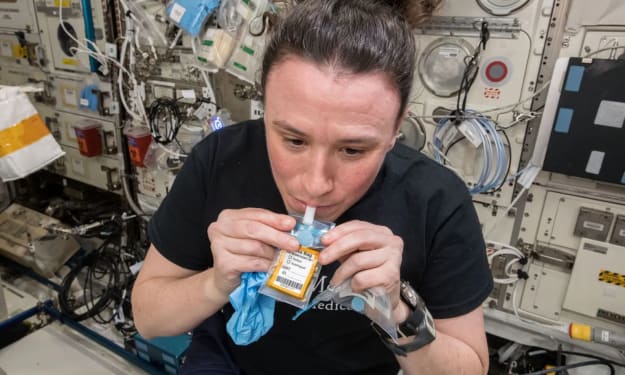
Scientists Probe How Long-Term Spaceflight Alters Immunity
On Earth, a human body with a properly functioning immune system will work to overcome an infection. But in space, that same immune system will have to work a bit harder to overcome the same infection. In the isolated environment of the International Space Station, many factors — physiological stress, disrupted circadian rhythms, radiation, microgravity, and other spaceflight factors — can alter an astronaut’s immune response.
By Voice of Reality5 days ago in Earth
me, me, me
when i read back my poetry it screams “me, me, me” on my screen in bold letters and i can’t shut it up — most days, i cannot make any other words out; i want to throttle a thousand versions of the me gone by, i want to throw myself from a figurative balcony, i want to sink a sword into every pen i’ve held
By angela hepworth7 days ago in Poets



Comments
There are no comments for this story
Be the first to respond and start the conversation.