
NASA rover discovers liquid water ripples carved into Mars rock and it could rewrite the Red Planet's history.
Liquid Water Ripples Carved Into Mars

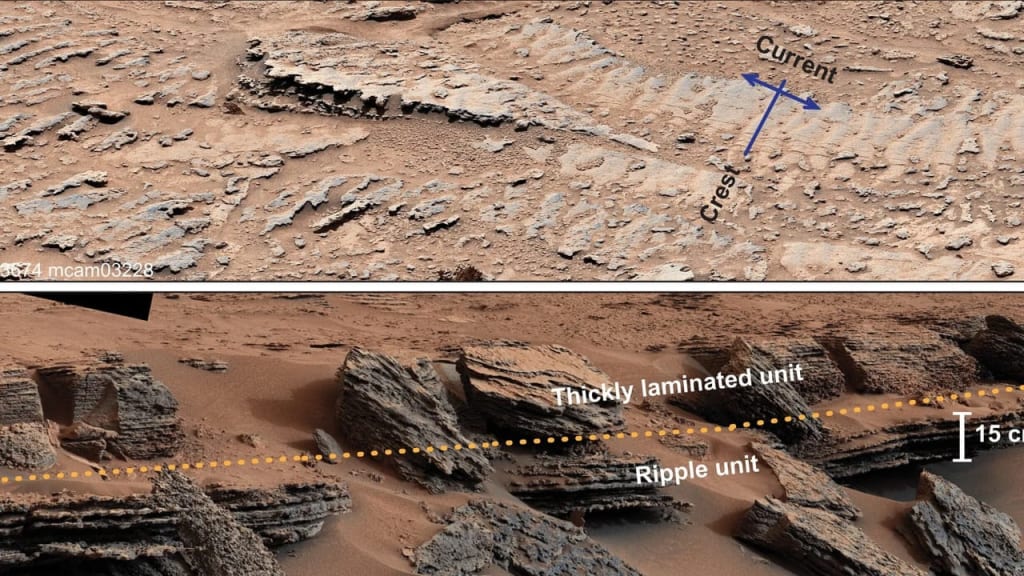
NASA rover discovers liquid water ripples carved into Mars rock and it could rewrite the Red Planet's history.
Mars the enigmatic Red Planet has fascinated scientists and space enthusiasts alike for decades. Its barren dusty landscapes and towering volcanoes paint a picture of a world long past its prime but recent discoveries suggest that Mars may have once been more Earth like than previously thought. A groundbreaking discovery by NASA's Curiosity rover has provided the strongest evidence yet that liquid water once rippled across the Martian surface challenging existing climate models and rewriting the history of our neighboring planet. For years planetary scientists have debated the presence and behavior of water on Mars. While evidence of ancient river valleys lake basins and possible oceanic remnants have been identified many theories suggested that any liquid water on the surface must have been trapped beneath thick ice sheets. However the latest findings published in the journal Science Advances on January 15 2025 tell a different story one that hints at shallow lakes with exposed liquid water interacting with the Martian atmosphere in a way never previously confirmed.
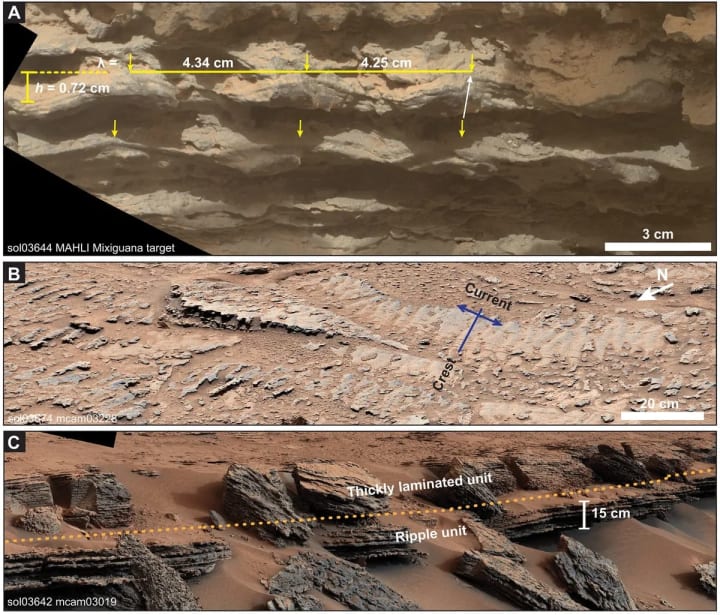
NASA's Curiosity rover which has been traversing the Gale Crater since August 2012 captured detailed images of what scientists call wave ripples. These minute ridge like structures form on Earth when wind or water disturbs a liquid’s surface leading to characteristic patterns in sediments along shorelines. On Mars these ripples provide direct evidence that liquid water unshielded by ice once moved freely across the surface. This revelation suggests that the ancient climate of Mars may have been significantly warmer and wetter than earlier models predicted. To understand the significance of this discovery it's essential to revisit what we know about Mars' watery past. In the 1970s NASA’s Mariner 9 mission sent back images of deep dry gullies and canyon like structures leading scientists to hypothesize that water once flowed across the planet. Subsequent missions including Viking Mars Global Surveyor and the Mars Reconnaissance Orbiter provided additional evidence of past water activity. However the question remained. Was this water ever in liquid form or was it permanently frozen beneath layers of ice.
Recent climate models suggested that due to Mars' thin atmosphere and weak greenhouse effect any water that existed on the surface should have been covered by ice to prevent rapid evaporation. But the presence of wave ripples in two separate ancient lakebeds within Gale Crater contradicts this notion. These patterns indicate that Mars not only had standing bodies of water but that these lakes were open to the air just as lakes and rivers on Earth are today. This discovery also aligns with past evidence of Mars' fluctuating climate. Scientists believe that over billions of years Mars underwent several periods of relative warmth driven by shifts in atmospheric composition and axial tilt variations. The ripples in Gale Crater suggest that at least some of these warm periods lasted long enough for liquid water to persist on the surface without immediately freezing or evaporating. This strengthens the possibility that Mars once had conditions suitable for life.
The presence of exposed liquid water on Mars carries profound implications for astrobiology. Water is a fundamental ingredient for life as we know it and if ancient Mars had lakes that resembled those on Earth microbial life may have once thrived in these environments. Although no direct evidence of Martian life has been found yet these findings provide an encouraging sign that Mars may have supported habitable conditions in its distant past. Future missions including the European Space Agency’s Rosalind Franklin rover and NASA’s Perseverance rover aim to explore potential biosignatures chemical or physical traces of past life within Martian sediments. Beyond its implications for Martian history and the search for life this discovery also sheds light on the broader question of planetary evolution. Mars and Earth were once strikingly similar with evidence suggesting that Mars had rivers lakes and possibly even an ocean billions of years ago. However, while Earth retained its atmosphere and surface water Mars underwent a dramatic transformation. Its atmosphere thinned its magnetic field weakened and its surface water disappeared. Understanding why these two planets evolved so differently could help scientists predict the fate of Earth and other planetary bodies.
Another fascinating aspect of this discovery is its impact on future human exploration. If liquid water existed on Mars for extended periods it could mean that subsurface reservoirs still exist today. Although current surface conditions are too harsh for liquid water to remain stable underground pockets of briny water could persist. These reservoirs if confirmed would be invaluable for future human missions providing a potential water source for astronauts and serving as prime targets for further study. As scientists continue to analyze Curiosity’s findings the story of Mars’ past is becoming increasingly complex. The wave ripples in Gale Crater are just one piece of the puzzle but they mark a significant step forward in our understanding of the Red Planet. The next step will be to investigate similar formations in other regions of Mars potentially using upcoming missions to drill into ancient lakebeds and retrieve samples for analysis.
Despite its current desolate appearance Mars was once a dynamic world shaped by the ebb and flow of water. The evidence captured by Curiosity not only confirms that Mars had lakes but also challenges long held assumptions about its climate. If Mars could sustain liquid water on its surface in the past then perhaps in some hidden corner of the planet or beneath its surface traces of life still linger. This discovery reignites curiosity about the ancient Martian environment and raises new questions about the planet's fate. What caused Mars to lose its water. Could underground reservoirs still host microbial life. And what does this tell us about the habitability of other exoplanets in the universe. As exploration continues we may soon find answers to some of the most profound questions about our solar system and our place within it.
About the Creator
Adnan Rasheed
Author & Creator | Writing News , Science Fiction, and Worldwide Update| Digital Product Designer | Sharing life-changing strategies for success.
Keep reading
More stories from Adnan Rasheed and writers in Earth and other communities.
Something is happening inside the Earth scientists say.
Something is happening inside the Earth, scientists say. The Earth our home is a dynamic and ever changing planet with processes occurring deep within its interior that continue to surprise and intrigue scientists. Recent research has revealed that the Earth’s inner core a solid sphere of iron and nickel located approximately 3,000 miles beneath the surface is undergoing unexpected structural changes. These changes are not only altering the physical nature of the core but may also be influencing the length of our days albeit in subtle ways. This discovery has opened up new avenues for understanding the complex and mysterious workings of our planet’s interior. For decades scientists have been aware that the Earth’s inner core is not static. Most of the research conducted so far has focused on the core’s rotation which is believed to be slightly out of sync with the rest of the planet. However a new study has shifted the focus to other types of activity occurring within the core revealing that it is not just rotating but also undergoing significant structural transformations. These changes are thought to be driven by the immense pressures and temperatures found at such depths as well as the gravitational forces exerted by the surrounding molten outer core.
By Adnan Rasheed11 months ago in Earth
How Much Do You Need in an ISA for a Passive Income That Beats the State Pension?
For many people in the UK, the State Pension is expected to form the backbone of retirement income. But with rising living costs and growing uncertainty about the future, more savers are asking a crucial question: Can I build a passive income that beats the State Pension — and how much would I need in an ISA to do it?
By Aarif Lashariabout 12 hours ago in Earth
Tiny Lion Cubs Struggle To Keep Up With Mom
In the heart of the African savannah, life is a constant lesson for young animals. Few scenes are as endearing — or as heartwarming — as tiny lion cubs trying to keep pace with their mother. These little bundles of fur face a world full of challenges, from learning to hunt to avoiding dangers, all while depending on the guidance and protection of their experienced mom. Watching cubs wobble and tumble as they attempt to keep up with their mother reminds us that growing up, even in the wild, is a journey full of struggle, determination, and adorable missteps. The Early Days of Lion Cubs Lion cubs are born blind and helpless, usually in litters of two to six. For the first few weeks, they rely entirely on their mother for warmth, food, and safety. Even after opening their eyes and beginning to explore, the cubs are far from independent. The first months are crucial. Cubs learn social cues, hunting basics, and survival skills simply by watching their mother and the pride. But as anyone who has observed them knows, there’s often a huge gap between observation and action. Tiny cubs often struggle to match their mother’s pace, especially when she moves through long stretches of savannah or leads the family on patrols. A Mother’s Role in the Wild For a lioness, raising cubs is a full-time commitment. She hunts, defends her territory, and teaches her young, all while staying alert to predators such as hyenas, leopards, and even rival lions. The cubs, meanwhile, attempt to mimic her every move — often with clumsy yet charming results. A mother lion’s patience is remarkable; she frequently slows down, nudges them along, or stops to ensure no cub is left behind. These moments, while stressful for the tiny cubs, are vital learning opportunities. Struggling to Keep Up: Why It’s So Hard There are several reasons why tiny lion cubs have trouble keeping pace with their mother: Short Legs, Big Steps: Lion cubs’ legs are tiny and their coordination is limited, making it difficult to cover the same distance as an adult lioness. Curiosity: Cubs are naturally curious. A single butterfly or rustling bush can distract them, leaving mom to pause repeatedly. Energy Levels: Young lions tire quickly. Even with frequent naps, the cubs’ stamina is far lower than their mother’s. Learning Through Play: Play is not just fun; it teaches hunting, balance, and social skills. Running off to pounce on a sibling or chase an insect is all part of their education. Despite these challenges, the cubs’ determination to keep up demonstrates their resilience and growing understanding of the wild world. Lessons in Teamwork and Survival Every cub struggling to keep up is also learning crucial survival skills. The journey across the savannah is more than a test of speed — it’s a lesson in: Coordination: Cubs learn how to move efficiently across different terrains. Patience: They begin to understand the rhythms of adult life and the pace required for survival. Social Skills: Staying with the group teaches cubs how to interact with siblings and the pride, which is essential for their future roles. Observation: By following their mother, cubs study hunting techniques, territorial behavior, and predator awareness. Even the moments when cubs stumble or lag behind are essential for their development. These experiences prepare them for independence, which comes sooner than many might expect. The Cutest Moments in the Wild Anyone who has watched tiny lion cubs knows that their struggles are often irresistibly cute. Video clips from wildlife reserves frequently show cubs toddling along, tumbling over each other, or getting distracted mid-step. Observers often comment that these little stumbles reveal personality, determination, and playfulness, making them one of nature’s most heartwarming spectacles. While their mother is serious and focused, the cubs inject a sense of humor and lightness into life on the savannah. Why This Matters The struggles of lion cubs aren’t just adorable — they’re vital for understanding wildlife behavior. Conservationists and animal behaviorists use these moments to study growth patterns, social structures, and survival strategies in lion populations. These observations also highlight the importance of preserving natural habitats. Cubs must learn in a safe environment to survive; habitat loss, poaching, and climate change make these early struggles even more dangerous. Protecting the African savannah ensures that future generations of lions can experience the same lessons and playful tumbles. The Road to Independence Within a year, these tiny cubs will be more agile, faster, and more confident. By the time they reach two to three years old, males may begin to leave the pride, while females often stay and become caretakers themselves. Every misstep, tumble, and lagging moment is part of the journey toward strength, coordination, and independence. Watching them now gives us a glimpse of the challenges they will overcome, and the survival skills they will carry for life. A Celebration of Motherhood Ultimately, these scenes remind us of the incredible bond between mother and cubs. Her patience, vigilance, and teaching are the foundations of their future. The cubs’ struggles highlight the trials of growing up, while their determination showcases the resilience and beauty of wildlife. For those observing, it’s a powerful lesson in care, guidance, and perseverance, not just in lions but in the natural world as a whole. Final Thoughts Watching tiny lion cubs try to keep up with their mother is both entertaining and enlightening. It’s a story of growth, struggle, and resilience — a reminder that even the fiercest creatures start small, learning step by step. These little lions capture hearts while teaching life lessons: patience, determination, teamwork, and the importance of guidance. As they tumble and waddle across the savannah, they show us that growth is a process, one adorable misstep at a time. For wildlife enthusiasts, animal lovers, and anyone enchanted by nature, these tiny cubs are proof that even in the wild, love, care, and persistence are universal truths.
By Aarif Lashariabout 12 hours ago in Earth



Comments
There are no comments for this story
Be the first to respond and start the conversation.