
More Than Organic Gardening
An Introduction to Sustainable Permaculture


Permaculture
This phrase was coined by Bill Mollison, one of the pioneers in the practice of designing permanent agriculture ("permaculture") systems. More specifically, it is the integration of specific principles to create an ecosystem which is productive, stable, and diverse...while considering the existing environment and natural ecosystems.
Permaculture is primarily a thinking tool for designing low carbon, highly productive systems but its influence can be very pervasive! What can start as a journey towards living a more ecologically balanced lifestyle can go far deeper, even transforming our worldview and radically altering behavior. This is the inspirational nature of permaculture, it is a means of connecting each of us more deeply to nature’s patterns and wisdom and of practically applying that understanding in our daily lives.
The Three Ethics

- Care for the Planet was the basis of permaculture design, but it was bound to grow and pervade all aspects of permaculture... How can we have organic agriculture or horticulture and manage our landscapes to sustain ourselves over generations on one hand, then consume goods from industries managed in ecologically damaging ways on the other?
Though we can’t all build our own house or grow all our own food, we can make choices about what and how we consume and conserve. Key to this is the understanding that up to one third of our ecological footprint is taken up by the food we buy, so even growing a small amount in a city allotment or container garden can make a difference. Permaculture is all about making a difference.
- Care for People - How can we develop a permaculture if our people are expendable, uncared for, excluded? People Care asks that our basic needs for food, shelter, education, employment and healthy social relationships are met.
At the core of People Care is an understanding of the power of community. If we can change our lives as individuals and make incremental differences: think what we can do as a community.
- Fair Share - The last ethic is a blend of the first two. It acknowledges that we only have one earth and we have to share it with all living things and future generations. There is no point in designing a sustainable family unit, community, or nation whilst others languish without clean water, clean air, food, shelter, meaningful employment, and social contact.
Permaculture aspires to design fairer, more equitable systems that take into account the limits of the planet’s resources and the needs of all living beings. These permaculture ethics are more like moral values or codes of behavior, and they are not enough on their own.
We need the principles of permaculture to provide a set of universally applicable guidelines that can be used in designing sustainable systems; in any perma-culture design, in any climate, and on any scale.
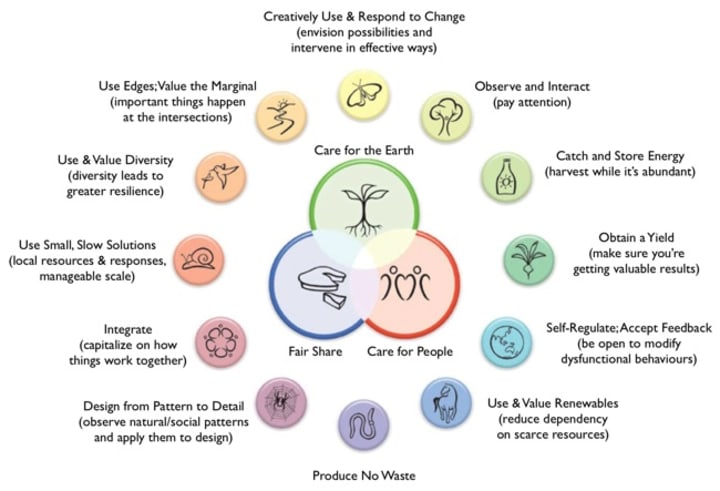
The Twelve Principles
1. Observe and Interact - The icon for this principle, a tree, represents a person “becoming a tree”. This speaks to the psychological and spiritual principle that we become what we behold. In other words, we adopt and imitate that which we give our attention to. While we often place our own values on what we observe, there is no “right” or “wrong” in nature...only perspective.
2. Catch and Store Energy - The icon for this principle is sunshine in a bottle, a reminder that while the earth’s energy is limitless we have a limited time and opportunity to catch and store that energy. Those time limits are seen in the cycle of days and seasons. Learning how to catch and store that energy - whether it be in the plants we grow, renewable infrastructure, or other means - is vital to living a truly sustainable life.
3. Obtain a Yield - The icon for this principle is a vegetable with a bite out of it, bringing our awareness to the reality that there is an element of competition when obtaining a yield. It also reminds us that we must garner a harvest in order to be sustained.
4. Apply Self-Regulation and Feedback - The Earth icon represents the largest scale example we have of a self regulating system that accepts feedback. In order to foster and promote real and lasting change, we must first assess where we have succeeded….and where we have failed. Self-regulation allows us to be empowered by our accountability. It is said that we tell people who we want them to believe we are, but we show them who we really are. Feedback shows us ways in which we can improve, helping us create even more sustainable systems and procedures.
5. Use and Value Renewables - The horse icon represents both a renewable service and a renewable resource. By making the best use of nature’s abundance, we reduce our dependence on non-renewable resources.
6. Produce No Waste - The icon of the worm represents one of nature’s most efficient and valuable recyclers. By valuing and using all the resources that are available to us, nothing goes to waste.
7. Design from Patterns to Details - The spider’s web is the icon for this principle. Each web follows a general pattern of radial spokes, yet each is unique in its details. Whether designing a new garden or restructuring our lives to embrace an entirely sustainable lifestyle, we must first look at the “big picture” before moving into the details.
8. Integrate Rather Than Segregate - The icon represents a group of people from a bird’s eye view. They are depicted as holding hands in a circle. The space in the center represents the concept of the sum being greater than its parts. Plants (and people) work better in diverse systems. Planting polycultures (guilds of plants that benefit each other) is one example of this principle in practice. By putting things in the right place, relationships develop between them for a mutual benefit.
9. Use Small and Slow Solutions - The Snail is the obvious icon for this principle, reminding us that excessive size and growth can be disadvantageous. Every journey begins with a single step.
10. Use and Value Diversity - The remarkable adaptation of the hummingbird to hover and sip nectar from long narrow flowers with their spike-like beaks symbolizes the specialization of form and function in nature. Diversity reduces vulnerability to a of threats, taking advantage of the unique nature in which it abides.
11. Use Edges and Value the Marginal - The icon of the sun rising on the horizon and a river in the foreground depicts a world filled with edges. Sustainability is about using all the resources at our disposal. This entails valuing fringes and utilizing fringe elements.
12. Creatively Use and Respond to Change - The Butterfly, which changes from caterpillar to winged beauty, is the icon of this principle. It represents the positive nature of transformative change. Change is the only constant in life. Permaculture is about the future and how we design for change, understanding that all things will alter over time.
A new way of living, a new way of life, sustainable and permanent, all these are possible.
Namaste!
About the Creator
RavensCraft 9
Sustainable permaculture, agorism, and Magick are my favorite endeavors. Writing about them is not far behind.
Keep reading
More stories from RavensCraft 9 and writers in Earth and other communities.
Moving Towards a New Economy
THE INDUSTRIAL REVOLUTION AND MATERIALISM The Industrial Revolution involved a massive and dramatic shift from a localized agrarian/handcraft economy to one controlled by industry, manufacturing, and the accumulation of wealth...the rise of capitalism.
By RavensCraft 95 years ago in Humans
Man (22) Charged With Murder of English Tourist in Temple Bar
Arrest and Formal Charges A 22-year-old man has been charged with the murder of an English tourist following a fatal incident in Dublin’s Temple Bar area. The charge comes after an intensive Garda investigation into events that unfolded in one of Ireland’s busiest and most popular nightlife districts.
By Aarif Lashari4 days ago in Earth
Flower Bloom 369
FLOWER Bloom 2/25/26 Wednesday By Mariann Carroll Karen had been with Tony for 7 years. Tony started acting strangely after her surgery. He would mow the lawn in the rain and be on his cellphone. He started pushing Karen away. Tony came clean about seeing someone. Karen moved out two months later. Karen moved in with a friend. She felt betrayed.
By Mariann Carroll5 days ago in Fiction




Comments (1)
Hello, I really resonate with the practice of homesteading and permaculture as well as the Earth spirituality that is apart of this way of living. I have been looking for local farms or farmer markets where I can learn how to garden myself using regenerative agriculture; I also was looking for local farms so that me and my family can eat more seasonally and healthier. I’m trying to build a network of places and people near Warner Robins Georgia so I can volunteer and learn. I’m really grateful to know there is a homestead/farm in Middle Georgia that practice permaculture because a lot of the are far away or in Atlanta.:) I hope to someday visit Buckwheat as soon as I can!