
More than 50 million tires piled up in Kuwait town, no one dares to ask for it
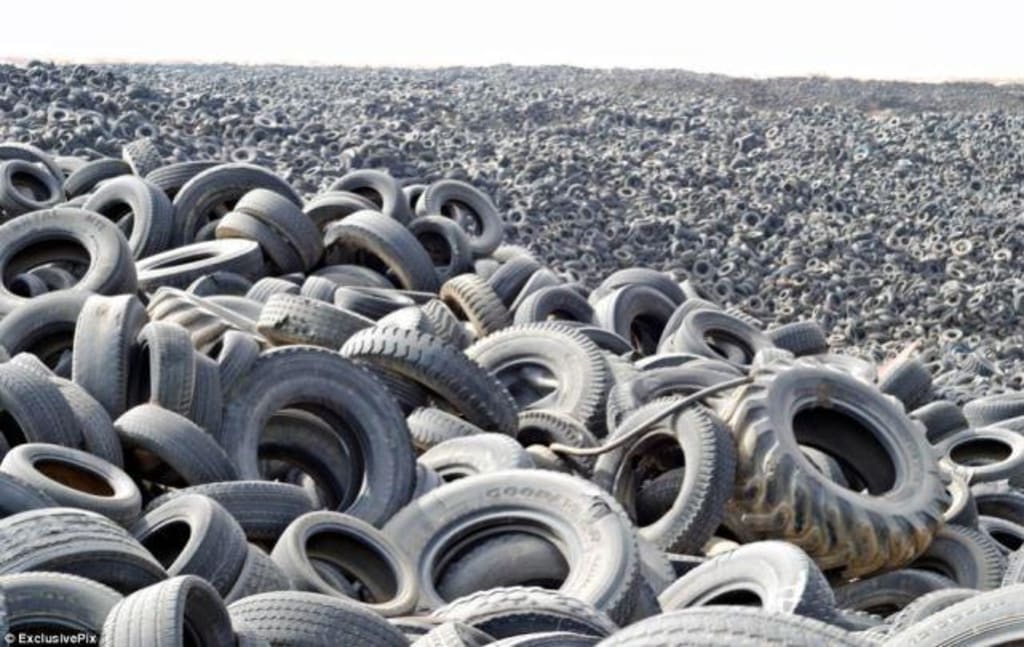
The largest "tire graveyard" in the world.

Kuwait often comes across as rich from oil exports, has a high level of per capita income, and is one of the hottest countries on earth.
In Sulaibiya, a small town in Kuwait's Jahra province, a high temperature of 53.6 °C was recorded, maintaining the record for the highest temperature in Asia and the third-highest temperature in the world.
However, little is known about the high temperature record in Suleibia, which is best known as the world's largest "tire graveyard" covering an area of 2 square kilometers, 7 kilometers away from the residential area.
Since the 1980s, tires from all over the world have been sent to Sulebia for landfill, and after more than 10 years of tire dumping, more than 50 million waste tires have been accumulated here.
These tires are buried in landfill pits, and it looks like a black filled square on the ground when viewed from the air.
However, like we mentioned earlier, Kuwait is very hot throughout the country, and these piles of tires are very fire-prone, and from 2012 to 2020, the spontaneous combustion of tires caused three large fires.
The smoke from the massive fire is believed to have spread to 250 million square metres, visible from space, wreaking havoc on the environment and causing distress for nearby residents.
Because of this, Kuwait had to completely shut down this "tire graveyard" - stop importing tires.
As we all know, even if tires do not spontaneously ignite, they are very difficult to degrade and have a great impact on the environment. So why does Kuwait import so many tires and put them here? Does no one want so many tires?
How did the "tire graveyard" come about?
The main material of tires is rubber, which has good elasticity, wear resistance, and good grip. It is indeed very good as a tire, but it cannot be degraded (the tire can degrade because of the degrading agent), and the rubber products There are many substances that are harmful to the human body and the environment, and it is very troublesome to deal with.
Under normal circumstances, a tire can travel up to 50,000 kilometers, and the 4S shop will let you replace it, and these replaced tires are very difficult to handle.
In general, there are several options:
A more valuable and less polluting option is recycling. Including being used to make rubber runways, adding to asphalt roads and buildings for shock absorption, for docking ships or as flood protection embankments, the best option is to rework and refurbish to continue on the road.
The fastest and easiest way is to burn it directly. In fact, the calorific value of tires exceeds that of coal, and the sulfur content is in the same order of magnitude or even lower, so it is a good substitute for coal.
The third is to bury it and wait for its natural degradation, as of now, at least a quarter of waste tires have chosen this method.
Some of the tires that were buried went to Suleibia, Kuwait. The reason why tires from other countries, mainly European and American countries, also came here. The reason is also very simple. For European and American countries, it is cheaper. how to handle it.
In Europe and the United States, the environmental requirements are very high, and it is basically not allowed to landfill and incinerate such pollutants as tires in their own countries, and the previous tires are not as good as the current tires, and they were basically not considered at the beginning of the design. It is processed after, so recycling is basically impossible.
Of course, they can choose some more complex treatment methods to remove harmful substances from the tires, but the cost will be very high.
In the 1980s and 1990s, 259 million tires were discarded each year, most of which occurred in European and American countries, and these tires were difficult to dispose of.
Therefore, they need to find other relatively backward countries to undertake these pollutants, so there is Kuwait, the world's largest "tire graveyard".
There are four tire processing companies in Kuwait. They will dispose of waste tires generated in their own country, but European and American countries can also export tires to them for disposal as long as they pay a fee.
And what they say is tire disposal, in fact, they are pulled into their own country and buried. It is believed that this business has made them a lot of money.
Why doesn't Kuwait just burn the tires?
In fact, fires in Kuwait's "tire graveyards" are commonplace, and some large fires have even burned a million tires in one go.
Because of this, their country has started to figure out how to deal with tires in the area and try to build a community here.
However, their existing treatment solutions are very inefficient, and may dispose of up to 3 million a year, which is far less rapid than a few fires.
In Kuwait's "tire graveyard", some tires have been piled there for more than 30 years. The main reason why tires are difficult to handle is that their chemical composition is so complex that any single method you use can cause great damage to the environment and human health. affect, especially those old tires.
If Kuwait were to dispose of these tires in an efficient (burning) way now, it would have a huge impact on their country's environment, which is certainly not allowed considering such a large base and possibly even the global environment.
If they're going to minimize the pollution problem, it's going to be very costly, and it's hard to be motivated to do it.
at last
When I changed my tires for the first time, I wondered why the 4S shop took my tires and didn't give me some money to recycle the tires. Now I think it's good that we didn't pay the tire disposal fee.
In fact, in many countries, if you want to change the tires of the car, you have to pay not only the money for the new tires, but also the money for the recycling of the old tires, which is to provide funds for the disposal of the old tires.
Tire is not an ordinary product. It is not only harmful, but also consumes a lot of money. If you handle it casually, it will cause a lot of trouble!
About the Creator
suzanne darlene
Take you to understand scientific knowledge
Keep reading
More stories from suzanne darlene and writers in Earth and other communities.
The release of 100 birds 132 years ago now costs the United States $800 million a year.
In the sky, the most spectacular performance of flying animals may be the "flock of starlings", in which hundreds of thousands of starlings form a group and fly together in the air like an ink painting.
By suzanne darlene3 years ago in Earth
Man Shot Dead by Police After Aiming Bow and Arrow at Officers
A man has been shot dead by police after allegedly aiming a bow and arrow at officers, authorities have confirmed. The fatal encounter has triggered public debate over police use of force, crisis response protocols, and how law enforcement handles situations involving unconventional weapons.
By Aarif Lashari3 days ago in Earth
Wild Card Weekend Recap: What Happens Now?
I think I figured out why I love Wild Card Weekend so much. It's because it's the first playoff anything of the calendar year. The NFL season starts in the fall, and once upon a time, the champion was crowned either on or slightly before New Year's. The evolution of the NFL schedule has resulted in the playoffs starting just into the New Year, and currently, the final week of the season falls on the first weekend of the New Year, with Wild Card Weekend coming a week after that. So yes, chronologically, the NFL's Wild Card Weekend serves as the first playoff anything of the calendar year.
By Clyde E. Dawkins6 days ago in Unbalanced



Comments
There are no comments for this story
Be the first to respond and start the conversation.