
More ruthless than meteorites life killer! Scientists: Creating the largest extinction of life on Earth
A life killer more ruthless than a meteorite

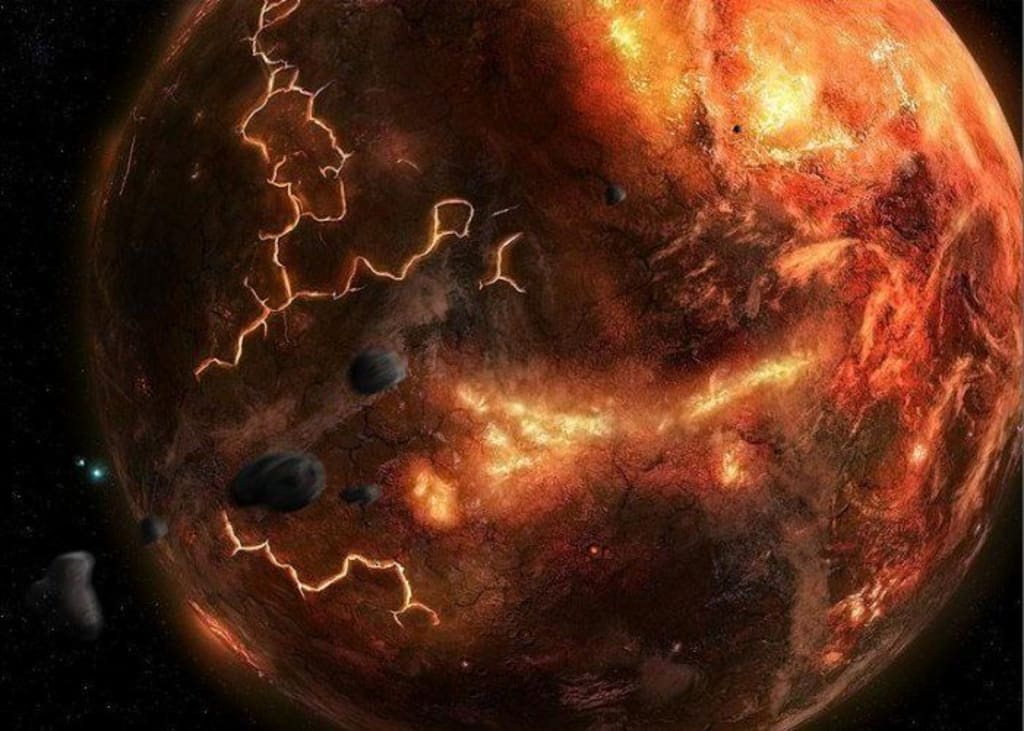
The Earth, from a chance 3.8 billion years ago, began to derive its history of life!
Life, from scratch, has experienced hundreds of millions of years of reproduction, evolution, and change, but for most of them, in the end, can not escape the grand and wonderful after the curtain - biological extinction. This process is no longer a simple cycle of life and death, but rather a sudden restart button for life on earth, in a relatively extremely short geological time, the number of living organisms and populations of the rare dramatic decline occurred.
According to the current scientific community, more generally popular, at least over 98% of the species of life that have ever shown their faces on Earth have become extinct.
And the sea has changed, today we can trace the history, that is, within the Earth nearly 550 million years, because, the geological traces, have left enough evidence to prove that there was a real occurrence of five biological mass extinction events.
For Example the Ordovician extinction (450-440 million years ago), the Devonian extinction (375-360 million years ago), the Permian extinction (251 million years ago), the Triassic extinction (200 million years ago), and the Cretaceous extinction (66 million years ago).
The most ruthless one, of course, occurred in the Permian, the last epoch of the Paleozoic Era. About 95% of the Earth's living species, disappeared in this extinction event! Among them, it includes a large number of familiar remains belonging to that era that we can find in geological rock formations, such as trilobites, planktivorous horseshoe crabs, as well as many fish, a large number of amphibians, and countless reptiles.
The culprit of the extinction event, mainstream academics believe: rising temperatures, a serious imbalance in marine ecology, a large number of anaerobic bacterial organisms multiplying and releasing deadly hydrogen sulfide, coupled with frequent geological movements and massive volcanic eruptions, led to the earliest deterioration of the living environment, eventually driving almost 95% of the creatures to extinction.
Looking back at that time, the Earth, was only a continental land, and the ocean area is also the smallest ever once. And such a geological environment, but also make the Earth extra hot, the average temperature once exceeded 40 degrees Celsius, and the rising temperature seems to be the trigger for all disasters.
So, if scientists are correct in this hypothesis, then this extinction event, is more like a self-cleaning of the Earth!
And also because of the Earth's geological changes, resulting in dramatic changes in climate and environment, and eventually triggering the mass extinction of life, the Ordovician, and Triassic, seem to have the same shadow. Even today, many theoretical schools of thought, also believe that the Earth is experiencing the 6th biological mass extinction event. And we humans, in this process, more become the extinction event, the most dishonorable role - the catalyst, exacerbated the Earth's greenhouse effect, press the key button to let the Earth's life restart, and ultimately create the cycle of life, the biggest suspects of the Great Purge.
If these processes, all belong to the mode of boiling frogs in warm water. Then the Cretaceous extinction and the Devonian extinction, it is more like a flying accident!
The Cretaceous Mass Extinction, or the very familiar Dinosaur Mass Extinction! As the last era of the Mesozoic, from the environmental point of view, the dinosaur era, should not have died so early. Because, at that time, the Earth, the climate is warm and humid, and the seasons change clearly, not only on the land, but even on the sea and sky, as countless creatures flourished, even without dinosaurs, the ground also has a large number of angiosperms appeared, mammals also get their own living space, and the original bird ancestors, also began to soar in the sky.
However, no one expected that life on Earth would be so unfortunate that a giant meteorite comet, with a diameter of well over 10 kilometers, would come from the sky and smash down on Earth brutally and unreasonably. The arrival of this extinct meteorite triggered sudden global geological movements: massive volcanic eruptions, massive earthquakes, tsunamis, and for countless large creatures, it was the end of the world. And more terrible than the natural disaster is that the meteorite impact generated by the dust, countless volcanic eruptions ejected volcanic ash, completely obscured the entire Earth's atmosphere, no sunlight, plants lost nutrients, animals have no rations, the collapse of the food chain, has become a natural thing. An extinction event is not difficult to imagine!
Even today, people are still very worried that humans will not be in the special one day, encounter the former ruler of the Earth - dinosaurs, the same unfortunate encounter? Therefore, when people learned of the tragedy of the dinosaurs, always like to bet the concern of the eyes on outer space.
But from August 2020, published in the Proceedings of the National Academy of Sciences, a piece of an academic research paper, or a wider concern. Had created the Earth, about 82% of the extinction of marine life event, before that, people have debated, some people think that this catastrophic event of about 15 million years, is similar to the Ordovician period, is the result of environmental change; some people think that it could be as the dinosaur era, by an untimely meteorite or comet, and some people think that the ecosystem imbalance. But an American scholar, at the University of Illinois, Professor Brian Fields, gave the supernova extinction hypothesis.
They came up with the evidence that plutonium 244 and samarium 146, are two isotopes that are not supposed to be naturally present on Earth, and the only way they could reach Earth is, through a cosmic event - a supernova explosion. According to current astronomical research, such an astronomical event, often refers to a massive star that is on its way to death, when it emits its last glorious light, these distant exploding stars, through a possible combination of transient and long-term effects, can have harmful effects on life on Earth.
Under such an astronomical event, it is bound to produce extreme ultraviolet, x-rays, and gamma rays. Upon reaching Earth, they would also collide with the Earth's atmosphere over a longer time frame, creating vibrations that drive particle acceleration. These high-energy cosmic rays, charged particles, will also be magnetically confined by the Earth, continuing to "soak" the planet for about 100 to 100,000 years.
This theoretical hypothesis makes them firmly believe that perhaps, 359 million years ago, an exploding star 65 light-years away from Earth, triggered the mass extinction of species!
Of course, to argue this theory, they need to come up with more than enough evidence. For example, if they can prove that both plutonium 244 and samarium 146, can be found in the Devonian and Carboniferous divide, perhaps they will have more conclusive evidence. This, in turn, would be one of the most crucial chains of evidence to prove that the real trigger behind the Earth's mass extinction originated from the depths of space.
But it has to be said, if this theory is proven to be true, when we humans look up at the stars again, do not underestimate the brightly shining stars, they may sometimes than that silent arrival of meteorites, have a stronger killing power.
Fear the universe, fear nature, and keep exploring the unknown scientific truth! Perhaps, it is the right attitude that we can understand the most real side of the world, don't you think?
About the Creator
Lane
Explore the mysteries of the earth with me
Without Democracy, Donald Trump’s Venezuelan Oil Quest Will Fail
Donald Trump’s renewed interest in Venezuelan oil may seem, on the surface, like a hard-nosed geopolitical calculation. Venezuela holds the world’s largest proven oil reserves, and amid global energy uncertainty, access to those resources is undeniably tempting. But history, economics, and politics all point to the same conclusion: without democratic reform in Venezuela, any attempt by a Trump-led US administration to secure reliable Venezuelan oil will ultimately fail.
By Aarif Lashari4 days ago in Earth



Comments
There are no comments for this story
Be the first to respond and start the conversation.