
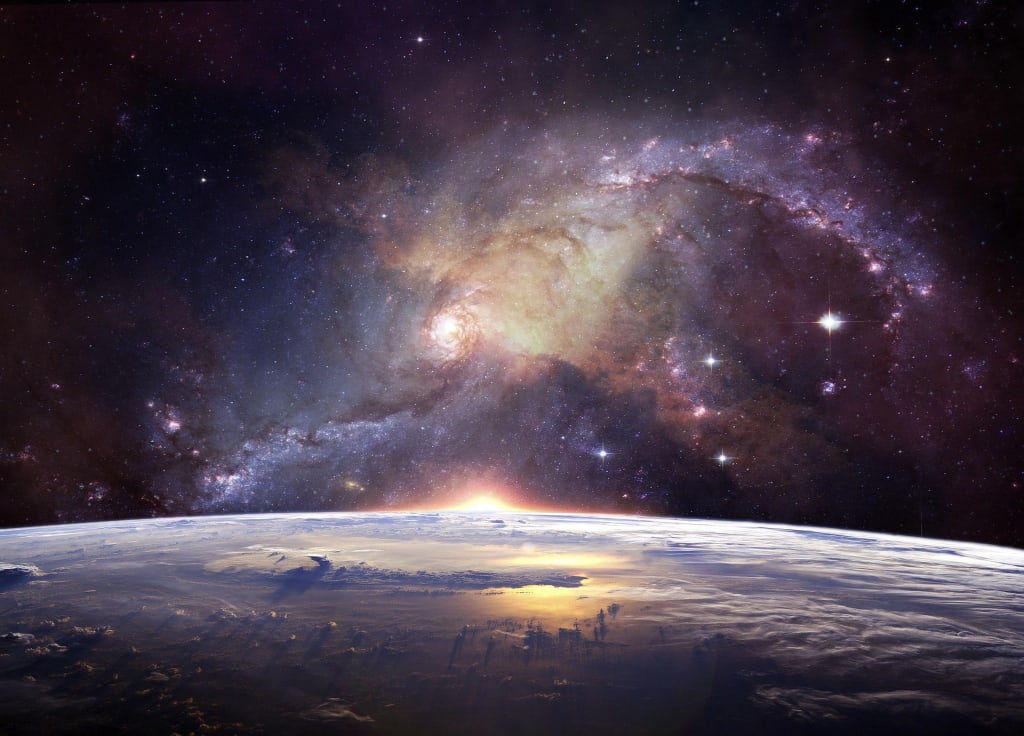
**The Milky Way Galaxy: Our Cosmic Home**
The Milky Way Galaxy is a vast, swirling collection of stars, planets, gas, dust, and dark matter that serves as our cosmic home. Spanning approximately 100,000 light-years in diameter, it is a barred spiral galaxy, characterized by its distinctive spiral arms that radiate from a central bar-shaped structure. The Milky Way is just one of billions of galaxies in the observable universe, yet it holds a special place in our understanding of the cosmos, as it is the galaxy in which our solar system resides.
### Structure and Composition
The Milky Way is composed of several key components:
1. **The Galactic Center**: At the heart of the Milky Way lies a supermassive black hole known as Sagittarius A* (pronounced "Sagittarius A-star"). This region is densely packed with stars, gas, and dust, and it emits intense radiation. The black hole, with a mass equivalent to about 4 million suns, exerts a powerful gravitational influence on its surroundings.
2. **Spiral Arms**: The Milky Way has four major spiral arms—Perseus, Sagittarius, Norma, and Scutum-Centaurus—along with smaller arms and spurs. These arms are regions of active star formation, where dense clouds of gas and dust collapse to form new stars. Our solar system is located in a smaller spur called the Orion Arm, about 27,000 light-years from the galactic center.
3. **The Disk**: The disk of the Milky Way is a flattened region that contains most of the galaxy's stars, gas, and dust. It is about 1,000 light-years thick and is where the spiral arms are located. The disk rotates around the galactic center, with stars closer to the center orbiting faster than those farther out.
4. **The Halo**: Surrounding the disk is the galactic halo, a spherical region that contains older stars, globular clusters, and dark matter. The halo is less dense than the disk and extends far beyond the visible boundaries of the galaxy. Dark matter, which does not emit light but exerts gravitational forces, makes up a significant portion of the Milky Way's mass.
5. **The Bulge**: The central bulge is a dense, roughly spherical region surrounding the galactic center. It contains older stars and is thought to have formed early in the galaxy's history.
### Stars and Planetary Systems
The Milky Way is home to an estimated 100 to 400 billion stars, ranging from massive, luminous giants to small, dim red dwarfs. Among these stars are countless planetary systems, including our own solar system. Since the 1990s, astronomers have discovered thousands of exoplanets (planets outside our solar system) orbiting stars in the Milky Way, suggesting that planets are common throughout the galaxy.
### Formation and Evolution
The Milky Way formed approximately 13.6 billion years ago, not long after the Big Bang. It began as a cloud of gas and dust that collapsed under its own gravity, forming stars and star clusters. Over billions of years, the galaxy grew through mergers with smaller galaxies and the accretion of gas from intergalactic space. These processes continue today, shaping the Milky Way's structure and composition.
One of the most significant events in the Milky Way's history was its collision with a smaller galaxy, known as Gaia-Enceladus, about 10 billion years ago. This merger added stars and gas to the Milky Way and influenced its evolution.
### The Milky Way in the Universe
The Milky Way is part of a larger collection of galaxies called the Local Group, which includes the Andromeda Galaxy, the Triangulum Galaxy, and about 50 other smaller galaxies. The Local Group, in turn, is part of the Virgo Supercluster, a massive structure containing thousands of galaxies.
In about 4.5 billion years, the Milky Way is expected to collide with the Andromeda Galaxy, its nearest large neighbor. This collision will dramatically reshape both galaxies, eventually forming a new, larger galaxy often referred to as "Milkomeda."
### Observing the Milky Way
From Earth, the Milky Way appears as a faint, milky band of light stretching across the night sky. This band is the combined light of billions of stars in the galactic disk. However, light pollution and atmospheric interference make it difficult to see the Milky Way in urban areas. To fully appreciate its beauty, one must venture to dark-sky locations.
Modern telescopes, both on Earth and in space, have allowed astronomers to study the Milky Way in unprecedented detail. Missions like the Hubble Space Telescope, the Gaia spacecraft, and the James Webb Space Telescope have provided insights into the galaxy's structure, composition, and history.
### Conclusion
The Milky Way Galaxy is a dynamic and ever-evolving system that has fascinated humanity for centuries. As our understanding of the galaxy grows, so too does our appreciation for its complexity and beauty. From the birth of new stars in its spiral arms to the mysteries of dark matter in its halo, the Milky Way continues to inspire awe and curiosity, reminding us of our place in the vast expanse of the universe.
About the Creator
Keep reading
More stories from Taiyab Ahmed and writers in Earth and other communities.
The Invisible Revolution: How Quantum Computing Will Redefine Reality
# The Invisible Revolution: How Quantum Computing Will Redefine Reality In the quiet labs of tech giants, startups, and academic institutions, a revolution is brewing—one that promises to transform the very fabric of our reality. This revolution, in contrast to the flashy advancements in artificial intelligence and the rapid expansion of smartphones, is not visible to the naked eye. It operates at the subatomic level, harnessing the bizarre and counterintuitive laws of quantum mechanics. This is the era of quantum computing, and it is poised to redefine everything we know about computation, science, and the limits of human ingenuity.
By Taiyab Ahmed12 months ago in Earth
Writing To Succeed
If you want to find something that will help readers find your writing, possibly expand your audience, and maybe even get you noticed for other things, then you’re not alone. But how can you get it done in a world full of want-to-be writers? Look less at what you’re writing now, and more at what other writers have used to boost their views and reads.
By Jason Ray Morton 4 days ago in Writers



Comments
There are no comments for this story
Be the first to respond and start the conversation.