
Microgreens: An emerging food innovation for the 21st century
Written by: Jasper Barlongo, 2023
According to the World Food Program, one out of every ten Filipino households are food insecure. That is 10,866,704 households out of the 108,667,043-household population based on (CPH, 2020). The Philippines ranks 69th out of 121 nations with enough data to compute 2022 GHI rankings in the 2022 Global Hunger Index.
Around 925 million people worldwide do not have enough food to consume, which is more than the combined populations of the United States, Canada, and the European Union. With the world's population forecast to reach 9 billion by 2050, maintaining food security would necessitate considerable improvements in agricultural production and competitiveness.
Agriculture is vital to establishing regional food security and promoting sustainable agriculture. However, shifting consumer demand, demographics, inefficient value chains, climate change, and water scarcity all pose problems to agriculture in developing Asia.
Efforts to improve agriculture and increase food security contribute to the Millennium Development Goals through enhancing food production and diversity, providing solutions to environmental degradation, and facilitating the creation of partnerships at all levels to sustain agricultural gains in the future.
According to Francesco Di Gioia, an assistant professor of vegetable crop science in the College of Agricultural Sciences at Penn State. Microgreen production have the potential to help provide global nutrition security. These vegetables can be grown in a variety of soilless production systems in small spaces indoors, with or without artificial lighting. With microgreens, people can produce fresh and nutritious vegetables even in areas that are considered food deserts.
HOW DO WE GROW OR PRODUCE MICROGREENS?
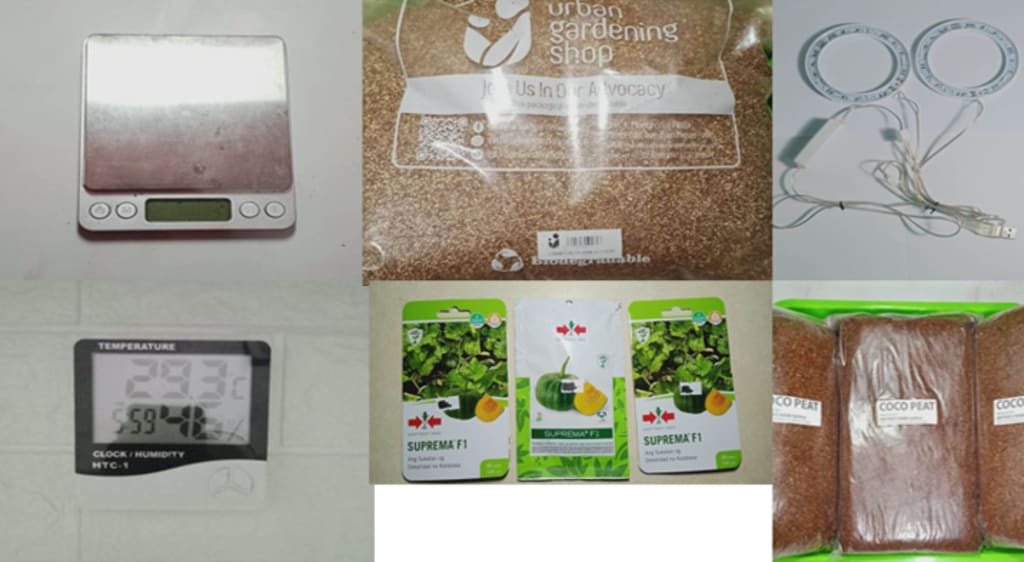
First you will need a Microgreen tray, crop seeds, an artificial light which is optional, and a growing medium or water only.
Next, you need to apply a desirable amount of water on the tray system and cover it with the second tray. In this tray, you can either place the seeds already or apply a growing medium first and manually sow the seeds on it. But at this point we’re going to use a growing medium, specifically coconut coir.
After sowing, you can now place the tray on a shelf, water it twice a day, cover it for the first 3 days, then expose it to an LED light in the 4th day, wait for 7-14 days then you can now have a vegetable that is more nutritional than it mature type.
Based on the study of Wieth,2019, Microgreens are young plants that are consumed at seedling stage with heights of 5-10 cm. They are generally harvested after 7-21 days of growth from seed. Stems and cotyledons are harvested and the root is left behind in the growing medium. According to Treadwell 2020, after germination, trays should be sub irrigated to avoid excess moisture in the plant canopy Microgreens are highly perishable and should be washed and cooled as soon as possible after harvesting in accordance to the study of Sharma 2020.
Microgreens have a high potential to deliver critical nutrients and antioxidants due to their short growing cycle and low fertilizer requirements, according to Di Gioia.
Microgreens contain a higher amount of phytochemicals, minerals, and vitamins in comparison to their mature counterparts. Although their concentrations vary in small amounts, several varieties are high in potassium, iron, zinc, magnesium, and copper (Xiao et al., 2016). According to Choe (2018), consuming 25 grams of microgreens each day may provide our bodies with health benefits.
It is conceivable to generate micro vegetables using basic agronomic approaches that could solve specific nutritional demands or micronutrient deficiencies, as well as nutrition-security challenges in emergency scenarios or hard environmental conditions.
Furthermore, depending on the number and type of crop, the price of microgreens seeds can range from 50 to 90 pesos.
About the Creator
Keep reading
More stories from writers in Earth and other communities.
I've Just Realized
The President doesn't understand music. There. It felt very good to write that; it's some thing I just realized today. Oh , yes; he plays it. He TRUMPets it in rallies and meetings, pumps it across the airwaves when he gathers up our minutes waiting for his late arrival.
By Judey Kalchik 5 days ago in Beat




Comments
There are no comments for this story
Be the first to respond and start the conversation.