
Making Waves: The Power of Swimming
How One Sport Builds Strength, Confidence, and Lifelong Skills in and out of the Water

Making Waves: The Power of Swimming
How One Sport Builds Strength, Confidence, and Lifelong Skills in and out of the Water
When Mia first dipped her toes into the water at age eight, she clung to the pool’s edge with wide eyes and a pounding heart. She wasn’t afraid of water exactly—but the idea of letting go, floating, and trusting herself in something so vast was overwhelming.
Fast-forward six years, and Mia now swims laps with confidence, helping teach younger kids during summer swim camp. What changed? A lot—but mostly, swimming itself.
Swimming is more than just a way to cool off on hot days. It’s a skill that builds resilience, improves health, and opens doors to personal growth. Whether you're learning at five or fifty, it offers powerful benefits—both physically and mentally.
The Physical Power of Swimming
From the outside, swimming might look like graceful strokes and splashes. But under the surface, it’s one of the most complete full-body workouts available. Nearly every muscle group is engaged—arms, legs, back, and core. Plus, because water provides resistance without impact, it’s ideal for people of all fitness levels.
According to the Centers for Disease Control and Prevention (CDC), swimming can improve heart health, build endurance, tone muscles, and help maintain a healthy weight. It’s also one of the few physical activities that people with injuries or disabilities can safely do with minimal stress on joints.
“My doctor recommended swimming after my knee surgery,” says Jordan, 42. “I started just to recover, but I fell in love with how it made me feel—stronger, calmer, and more in control of my body.”
Mental Benefits Beneath the Surface
But swimming isn’t just about physical health—it has surprising mental health benefits too. Being in water can trigger a calming, almost meditative state, especially during steady lap swimming. The rhythmic motion, steady breathing, and gentle sound of splashing can quiet the mind and relieve anxiety.
Studies have shown that swimming can help reduce symptoms of depression, improve mood, and even sharpen focus. Many people say swimming is their “reset button” after a stressful day.
“I call it my therapy,” says Priya, a college student who swims three times a week. “The pool is the only place where I can really disconnect from everything—phones, deadlines, distractions—and just be present.”
Building Confidence and Life Skills
Learning to swim is also a huge confidence booster, especially for kids. It teaches persistence, trust in oneself, and how to overcome fear—a lesson that sticks.
“It’s about more than swimming,” says Coach Luis, a swim instructor of 20 years. “When kids conquer the deep end, they feel like they can conquer anything.”
Swimming also teaches responsibility, discipline, and goal setting—especially for those who join swim teams or take lessons regularly. From setting personal best times to simply mastering a new stroke, swimmers constantly push themselves to improve.
For young swimmers, these lessons often ripple into other areas of life—school, friendships, and even future careers.
A Lifesaving Skill for Everyone
Perhaps most importantly, swimming is a vital life skill that everyone should learn. According to the World Health Organization, drowning is one of the leading causes of unintentional injury deaths worldwide. Learning to swim—no matter your age—can literally save lives.
“I didn’t learn until I was 35,” says Elena, a mother of two. “But once I did, I made sure both my kids were in swim lessons as soon as possible. It gives me peace of mind, especially during summer.”
Many community centers and schools now offer affordable or free swim programs, aiming to make lessons accessible to all. Initiatives like “Swim Safe” and “Everyone In the Pool” are working to close the gap and bring water safety education to underserved areas.
Making a Splash That Lasts a Lifetime
Back at the pool, Mia lines up with a group of younger swimmers, showing them how to streamline their bodies for a strong push-off. She’s calm, confident, and clearly having fun.
“Swimming helped me find my voice,” she says. “It taught me not just how to swim, but how to believe in myself.”
That’s the power of swimming—it’s not just about moving through water. It’s about finding strength, calm, and courage you didn’t know you had.
Whether you're diving in for the first time or returning to the pool after years away, it’s never too late to make waves.
About the Creator
Keep reading
More stories from Muhammad Saad and writers in Earth and other communities.
Wanderlust Wonders
For Mia Torres, the day she left her office job in Chicago for a one-way ticket to Lisbon wasn’t just a leap of faith — it was the beginning of a new life. One suitcase, one camera, and a restless sense of curiosity were all she carried. That was three years ago. Since then, Mia has traveled to 27 countries, across four continents, and has redefined what “home” means. “The world is my home now,” she says, sipping Turkish tea on a rooftop in Istanbul, her laptop balanced on her knees. “And every day is different — unpredictable, beautiful, and often humbling.” Mia is part of a growing wave of digital nomads and long-term travelers — people who’ve embraced life on the move, trading routine for the richness of cultural immersion. Her life as a global tourist is not a permanent vacation, though it may appear that way on Instagram. It’s a lifestyle built on flexibility, planning, and a deep respect for the places and people she encounters. Morning in Motion Each morning, Mia starts her day not with a commute, but with a walk — whether it’s through the cobblestone streets of Porto or the rice terraces of Bali. She says it helps her ground herself in a new place. Then she finds a café with strong Wi-Fi and spends a few hours working remotely as a freelance content writer. This balance of work and exploration funds her travels and keeps her connected. Afternoons are for adventure: joining cooking classes in Vietnam, hiking in Patagonia, or learning snippets of local languages wherever she goes. “I’ve become an expert in the basics — hello, thank you, how much? Those few words can open doors.” The Heart of Travel: Connection Mia says the most rewarding part of tourist life isn’t the sights — though the Northern Lights in Norway and Petra in Jordan were unforgettable — it’s the people. From an elderly couple in Kyoto who shared their homemade miso soup, to a street artist in Mexico City who painted her portrait, it’s the human connections that linger. “It’s not about collecting stamps in your passport,” she says. “It’s about collecting stories.” Those stories often find their way into her blog, Wanderlust Wonders, where she shares travel tips, cultural insights, and honest accounts of life on the road. Her posts are refreshingly real — highlighting not just the beauty, but also the difficulties of her nomadic lifestyle. The Not-So-Instagrammable Side “Travel fatigue is real,” she admits. “Sometimes you just want your own bed, or to not have to figure out a new public transit system every week.” There are missed flights, lost luggage, and moments of loneliness. Mia also points to the emotional toll of constantly saying goodbye — to new friends, cities that felt like home, and fleeting connections. She’s also deeply aware of the impact tourism can have on local communities and the environment. “Being a responsible tourist is part of the job. That means supporting local businesses, being respectful of customs, and treading lightly — physically and culturally.” Lessons from the World Three years on the road have made Mia more adaptable, empathetic, and resilient. She’s learned that you don’t need much to be happy — just curiosity, kindness, and a decent travel pillow. “I used to think travel was about escape,” she reflects. “But now I see it’s about engagement — with the world, with others, and with yourself.” When asked how long she plans to keep traveling, Mia laughs. “There’s no end date. I’ll stop when I stop learning.” For now, her next destination is Georgia — the country, not the state — where she plans to volunteer at a vineyard during harvest season. “Every place teaches me something new. And there’s always more to discover.” A Life Less Ordinary Mia’s story isn’t about luxury or fame. She doesn’t stay in five-star hotels or chase bucket-list bragging rights. It’s about embracing uncertainty, living intentionally, and finding meaning in everyday moments far from home. Tourist life, as she’s discovered, isn’t about escape — it’s about expansion. Of horizons, of perspectives, and of the heart.
By Muhammad Saad 5 months ago in Earth
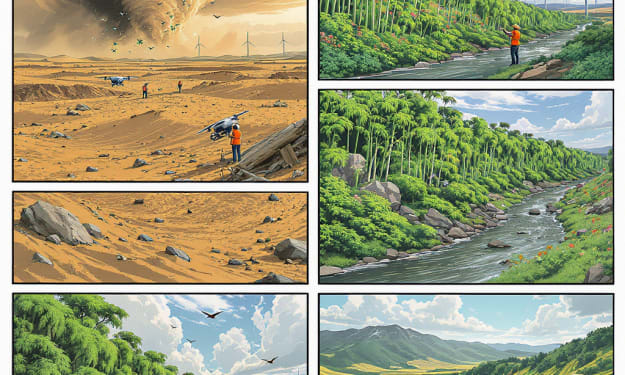
Chinese Planetary Engineering: The Great Green Wall and the Reclamation of Climate
There are junctures in history where a civilization no longer chooses between comfort and progress, but between adaptation and extinction. At the dawn of the new millennium, China hit one of those silent thresholds where geography ceases to be a backdrop and becomes an adversary. The desert was advancing, not as a metaphor for decay, but as a physical, methodical, and relentless force. Sand was devouring the horizon, winds grew heavy with dust, and the soil lost its fertile memory, taking with it the promise of social stability.
By Laurenceau Portea day ago in Earth


Comments
There are no comments for this story
Be the first to respond and start the conversation.