
Los Angeles Ablaze: A City Grappling with One of Its Worst Wildfires
As fierce winds fan the flames, residents and firefighters face a relentless battle against destruction and displacement.

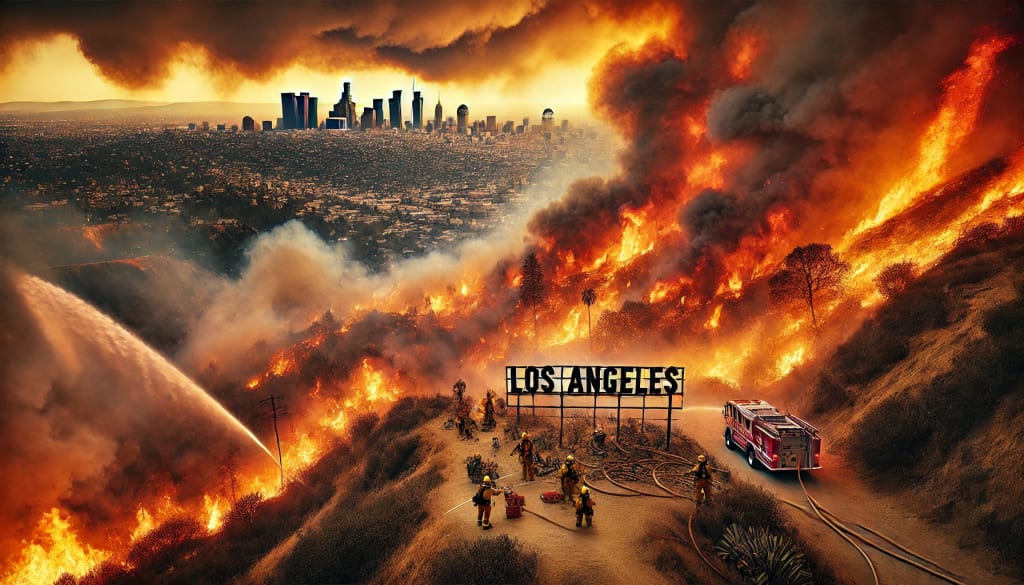
LOS ANGELES — The City of Angels is battling one of the most destructive wildfires in its history, as flames fueled by powerful Santa Ana winds continue to ravage vast areas, leaving devastation in their wake.
The inferno, which erupted in the Pacific Palisades on January 7, 2025, has spread at an alarming rate, scorching over 17,000 acres and destroying countless homes and businesses. As residents grapple with displacement and loss, firefighters are locked in a desperate battle to bring the blaze under control.
A Disaster Unfolds
The wildfire began as a small brush fire in Pacific Palisades, but strong winds and dry vegetation quickly transformed it into a catastrophic event. Within hours, the fire leapt across neighborhoods, reaching Altadena and threatening northern Los Angeles County.
The Santa Ana winds, which at times exceeded 100 miles per hour, created conditions that firefighters described as "unmanageable." Helicopter water drops and aerial firefighting efforts were hampered by the winds, leaving ground crews to face the inferno with limited resources.
Human and Material Toll
Authorities have confirmed 24 fatalities, with hundreds more injured or missing. Over 5,000 structures have been damaged or completely destroyed, and more than 200,000 people have been forced to evacuate their homes.
One evacuee, Maria Lopez, described her escape: "The sky turned orange, and the heat was unbearable. I left with just my kids and our dog. We don’t know if there’s anything to return to."
Firefighting Efforts and Challenges
The Los Angeles Fire Department (LAFD) has deployed 3,000 personnel, including mutual aid from surrounding states. Crews are working tirelessly to create fire breaks and protect critical infrastructure, but limited water supplies in some areas and damaged fire hydrants have hampered their efforts.
"We’re facing the perfect storm of conditions," said Fire Chief Kristin Crowley. "High winds, low humidity, and dense, dry vegetation have created an almost impossible situation."
A City on Lockdown
To prevent looting in evacuated neighborhoods, authorities have imposed a citywide curfew from 9 PM to 5 AM. Los Angeles County Sheriff Robert Luna has vowed to enforce strict measures to maintain order.
"There will be zero tolerance for criminal behavior during this crisis," said Luna.
Public Outcry and Criticism
The wildfire has sparked widespread criticism over the city’s preparedness. Residents and public figures alike have voiced frustration. Actress Sarah Michelle Gellar lamented the lack of traffic management during evacuations, while actor James Woods took to social media to criticize state leadership for "years of neglect and mismanagement."
Experts have pointed to the impact of climate change, with rising temperatures and prolonged droughts creating ideal conditions for such disasters.
Economic Devastation
Early estimates suggest economic losses from the wildfire could exceed $50 billion. The damage is expected to strain California’s already fragile property insurance market, with some companies refusing to insure homes in high-risk areas.
Economist Dana Schwartz warned, "This is not just a local crisis—it has national implications for housing markets and disaster recovery funding."
Resilience and Support
Despite the grim reality, the disaster has also showcased remarkable acts of resilience and generosity. Companies like Netflix and Comcast have pledged millions in aid, while local volunteers have mobilized to provide food, clothing, and shelter for evacuees.
Hollywood star Leonardo DiCaprio, an outspoken advocate for environmental causes, announced a $5 million donation to wildfire relief efforts, urging others to support those affected.
Preparing for the Future
As firefighters continue their uphill battle, attention is shifting to the broader implications of the crisis. Calls for increased investment in wildfire prevention and better urban planning have intensified.
"This fire is a wake-up call," said climate scientist Dr. Andrea Matthews. "We need to rethink how we prepare for and mitigate these disasters, especially as climate change continues to escalate the risks."
The Los Angeles wildfire is a stark reminder of the delicate balance between nature and urban sprawl. As the city mourns its losses, it also stands at a crossroads—one where resilience, innovation, and collaboration will shape the path forward.
About the Creator
Ahmet Kıvanç Demirkıran
As a technology and innovation enthusiast, I aim to bring fresh perspectives to my readers, drawing from my experience.
Keep reading
More stories from Ahmet Kıvanç Demirkıran and writers in Earth and other communities.
Witnessing Darkness at Noon: The Rare Total Solar Eclipse of April 8th
Witnessing Darkness at Noon: The Rare Total Solar Eclipse of April 8th On April 8th, 2024, a celestial spectacle unfolded across North America, captivating millions as a rare total solar eclipse traced its path of totality across the continent. This extraordinary event transformed daytime into an eerie twilight, casting vast regions into darkness in the middle of the day.
By Ahmet Kıvanç Demirkıran2 years ago in Earth
Why Greenland Matters for a Warming World
Greenland, the world’s largest island, often conjures images of endless ice, rugged landscapes, and isolation. Yet in the era of climate change, Greenland has become far more than a frozen wilderness—it is a critical player in understanding global warming, rising seas, and even geopolitical strategy. As scientists, policymakers, and nations increasingly focus on Greenland, the island offers a stark lesson: what happens in the Arctic does not stay in the Arctic. Its ice sheets, ecosystems, and resources affect the planet in ways that are profound, urgent, and far-reaching. Greenland’s Ice Sheets and Global Sea Levels The most visible and alarming aspect of Greenland’s global impact is its melting ice sheets. Greenland contains roughly 8% of the world’s fresh water, stored in massive ice sheets covering more than 1.7 million square kilometers. Over the past two decades, studies have shown that Greenland is losing ice at accelerating rates. According to NASA and the European Space Agency, Greenland’s ice loss contributes about 0.7 millimeters per year to global sea level rise. That might seem small, but every millimeter counts. If Greenland’s ice sheets were to melt completely—a scenario scientists consider extreme but possible under prolonged warming—sea levels could rise by over 20 feet, inundating coastal cities and displacing hundreds of millions of people worldwide. The ice melt also affects ocean currents and weather patterns. Freshwater from Greenland flows into the North Atlantic, disrupting the Atlantic Meridional Overturning Circulation (AMOC), a crucial component of the global climate system. Changes here could mean more severe storms in Europe, shifting monsoons in Asia, and hotter summers in North America. A Rapidly Warming Arctic Greenland is warming twice as fast as the global average. Scientists attribute this to Arctic amplification, where ice and snow loss reduce the Earth’s reflectivity (albedo), causing more heat absorption. The resulting feedback loop accelerates melting and affects local wildlife, indigenous communities, and global climate systems. Polar bears, Arctic foxes, seals, and migratory birds all face habitat changes, while Greenlandic communities see challenges in fishing, hunting, and infrastructure. Roads, airstrips, and settlements are increasingly vulnerable to permafrost thaw, floods, and landslides. For climate scientists, Greenland acts as a bellwether of global change, providing early warnings of trends that could eventually affect all continents. Greenland’s Geopolitical Significance Beyond climate, Greenland is gaining strategic attention from nations worldwide. Its location between North America and Europe, combined with its ice-free ports emerging in summer, makes it a hub for shipping, scientific research, and military strategy. The United States has historically maintained a military presence at Thule Air Base and monitors Greenland’s importance in Arctic defense. China has expressed interest in Arctic shipping lanes and mining opportunities, signaling potential economic and strategic competition. Denmark and Greenlandic authorities are navigating autonomy, resource development, and environmental protection, balancing sovereignty with global pressures. The melting ice, paradoxically, opens opportunities for mineral exploration, shipping, and scientific access, even as it poses serious environmental risks. Greenland has large deposits of rare earth minerals, uranium, and iron, all increasingly valuable in the global transition to clean energy and technology. Local Communities and Indigenous Voices The Greenlandic Inuit and other local communities are directly experiencing climate change. Traditional hunting and fishing practices are affected by shifting ice patterns, changing animal migration, and unpredictable weather. While global attention often focuses on ice melt and global impact, local voices emphasize sustainability, cultural preservation, and adaptive strategies. Many communities are exploring renewable energy, eco-tourism, and sustainable fisheries as ways to protect livelihoods while mitigating climate risks. Greenland and Global Climate Policy Greenland’s situation highlights the urgency of global action on climate change. The island illustrates several key lessons: Mitigation Matters: Reducing greenhouse gas emissions is critical to slowing ice loss and protecting sea levels. Adaptation Is Essential: Coastal cities worldwide must prepare for rising waters and changing weather patterns driven by Arctic changes. Scientific Research Is Vital: Greenland serves as a natural laboratory for studying climate, ice dynamics, and ocean circulation. Understanding its trends allows for more accurate modeling and forecasting worldwide. International collaboration, including research partnerships and climate agreements, is essential to ensure that Greenland’s ice sheets do not become a catastrophic tipping point. The Global Ripple Effect It’s easy to think of Greenland as distant, but its fate touches everyone: Rising seas threaten cities from New York to Tokyo. Ocean currents shifting from ice melt influence global climate patterns. Economic implications arise from shipping routes, resource access, and disaster mitigation costs. Greenland is not just an Arctic concern—it’s a global responsibility. How countries respond to its changes will influence the world for decades to come. Conclusion: Why the World Should Watch Greenland Greenland matters because it is a microcosm of our planet’s challenges. Its melting ice sheets remind us that climate change is already here. Its mineral wealth and strategic position show that human interests will increasingly collide with environmental imperatives. Its communities illustrate the human cost of warming and the resilience needed to adapt. For a warming world, Greenland is both a warning and a guidepost. Protecting its environment, respecting its people, and monitoring its ice are not just Arctic issues—they are global imperatives. The world cannot afford to ignore Greenland. Its future is inextricably linked to the health of our planet and the security, prosperity, and safety of populations everywhere.
By Muhammad Hassan4 days ago in Earth
Europe Hydro Turbine Market Size and Forecast 2025–2033
Introduction The Europe Hydro Turbine Market is projected to grow from US$ 542.44 million in 2024 to US$ 840.78 million by 2033, registering a compound annual growth rate (CAGR) of 4.99% during 2025–2033. This expansion is being powered by Europe’s accelerating investments in renewable energy, the modernization of aging hydropower infrastructure, and strong regulatory backing for low-carbon electricity generation across key countries such as Norway, France, Austria, and Switzerland.
By Marthan Sir4 days ago in Earth
Miss Persephone's Manual to a Seemingly Ordinary Life
Miss Persephone was found at the dining table, her blue eyes swollen, her tears arriving and retreating like the tides of the ocean. Earlier that day, her family had visited her in the retirement home where she had lived for eight years. It was her eightieth birthday.
By Imola Tóth4 days ago in Fiction


Comments
There are no comments for this story
Be the first to respond and start the conversation.