
Light Bulbs, iPhones and your Right to Repair
In the mid-1920s, the then leading light bulb manufacturers including Philips, General Electric, and Osram came together and founded the infamous Phoebus Cartel. This was one of the first truly international corporate cartels which was successful in raising prices, stifling innovation, and reducing quality - by putting an expiry date on products that shouldn't have expired.


A booming international light bulb market forced the market leaders to negotiate and restrict their activities to not interfere with each other’s businesses. Apart from splitting the market among themselves, the cartel also reduced the permissible life expectancy (yes, that’s a thing) to 1000 hours from 2500 hours. Manufacturers who produced light bulbs with a greater than permissible life were actually fined for having violated the cartel’s norms. Quite obviously, this was done to sell more light bulbs and increase revenues. Among other things, the cartel, one of the first truly international ones, was successful in raising prices, stifling innovation, and reducing quality.
I came across this story for the first time a few years back and quite honestly, I had dismissed it for another conspiracy theory. I mean, why would any government let a cartel of big corporations run a whole damn market without any intervention? Isn’t that like illegal or something? *Enter free-market capitalism*
Anyways, the cartel, which was originally supposed to run for 30 years till 1955, ironically burnt out well in advance, due to World War II. Today we don’t have to worry about expensive short-lived light bulbs thanks to technological advancement and innovations (that wouldn’t have happened had the cartel stayed by the way). What’s interesting to note here are two things-
- Companies can make actual cartels, stifle innovation, drive up prices, reduce product life, all to mint more money
- Consumers have little idea about how products work and are perhaps, not educated enough to call out the companys’ bluffs
Now if you had been thinking that these cartels are a thing of the past, I have bad news for you. Monopolies and oligopolies still exist and they are perhaps stronger than ever.
The technical term for this kind of business strategy is called ‘planned obsolescence. It essentially forces you to buy a new product or upgrade to a newer model of the same product by rendering your existing product useless, slow or unreliable within a set timeframe. There are multiples of carrying out this business strategy -
- Using low-quality, short-lasting mechanical parts, so the product automatically fails at some point, relatively early in its lifetime. One of the most relatable examples of this is fast fashion. Brands produce low-quality cheap clothes that lose their quality right after the first few washes.
- Using software to build products that automatically become non-functional after a set number of runs or duration of time, even if the product is mechanically and structurally functional. Sometimes, even if the mechanics of a product fail, the product is built in such a way that it is impossible for a consumer to repair their product. An example could be a printer that is programmed to fail after printing a certain number of times.
- Perceived obsolescence or using clever marketing strategies to make consumers believe that they need an upgrade, even when they don’t. An example of this could be a minor upgrade in the design or look of a smartphone, meant to make the customer feel like their existing smartphone is outdated.
While perceived obsolescence only plays on the typical consumer psychology but still gives the consumers a choice as to whether or not they wish to upgrade, the other two don't. Using cheaper quality products with poor mechanical strength helps cut down prices and in principle, can still be considered the consumer’s choice. The 3rd strategy of planned obsolescence, however, where pre-programmed software is used to tamper with a consumer’s product, is the concerning one. These products are built to get discarded and any attempt at repairing the product is made next to impossible.
In 2017, Apple came under fire for intentionally slowing down the earlier versions of iPhones in order to force consumers to upgrade to the newer versions. Recently, the company came under fire yet again for fusing solid-state drives to the logic board in its mac book pros. These drives, upon expiration, will render the whole system useless and consumers will be left with no choice but to buy a new device. A majority of electronic devices these days are impossible to dismantle. This means that even the smallest issue would force the customer to run to a company-authorized repair store. These stores enjoy all the monopoly and hence drive up the repair prices, sometimes, making the cost of repair just as much as the cost of a new product. Several car companies keep upgrading their car models annually. More often than not, these upgrades are only marginal improvements but they end up making spare parts almost inaccessible to the common person, making it impossible for them to carry out repairs.
Not only do such practices end up forcing the customers to pay more, but the environmental costs of planned obsolescence are also significant. Electronic waste is one of the fastest increasing waste categories across the developing world. These countries have little infrastructure to handle e-waste, most of which get contaminated and hence further difficult to repair or resume. The fact that companies make their products difficult to dismantle, implies that high-value materials, which could have compensated for the cost of waste handling and disposal, get further difficult to extract. Upon contamination, these wastes enter the landfill, from where they leach heavy metals and other hazardous chemicals into soil, water, and the air. Expensive materials get discarded unscientifically further straining the available raw material resources.
The right to repair movement is aimed at mandating original equipment manufacturers (OEMs) to provide consumers and independent repair businesses equal access to repair documentation, diagnostics, tools, service parts, and firmware as their direct or authorized repair providers. Companies claim that these could risk copyright security and cybersecurity of a consumer’s device but activists say that these fears are unfounded and only an attempt at shifting the focus. More information about the movement can be found here
About the Creator
Rishi Rathi
Musing over sustainability and technology and ways to make the world better than we inherited. I'm learning while I write and I'd love to hear your thoughts on my stories!
Instagram - rishirathi_
Keep reading
More stories from Rishi Rathi and writers in Earth and other communities.
News Flash - We Are Not Doomed!
We’ve all seen enough images of forest fires, floods, droughts, and turtles dying of plastic pollution and at this point, these images have started to lose their shock value. As an ex-climate activist myself, I can tell that climate activism (not slacktivism) is not ill-intentioned, in fact, those peers are some of the most passionate folks I’ve ever worked with. But that short stint as an activist made me realize that there is something wrong with the way we sell climate change.
By Rishi Rathi4 years ago in Earth
The Reality of the Illusion of Time
Recently, as I strolled along the short stretch to my strength training session, I aimlessly took in the row of tatty shops and shabby buildings along the route and passed an off-street, in which one of my sisters used to live, around thirteen years ago.
By Chantal Christie Weiss4 days ago in Earth
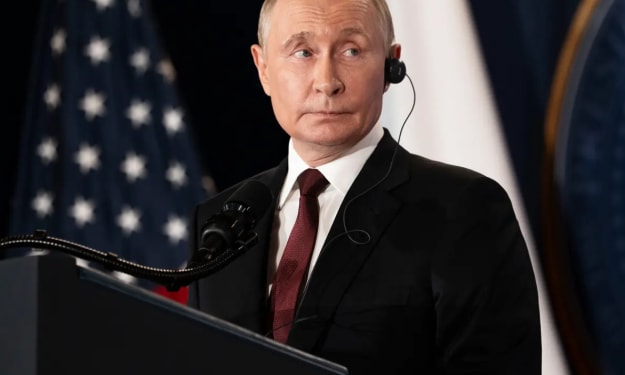
Why Putin Went Quiet When Challenged by Trump Over Venezuela
When U.S. forces captured Venezuelan President Nicolás Maduro in early January 2026, the world was stunned. Venezuela has long been a Russian ally, yet Russian President Vladimir Putin remained almost completely silent when challenged directly by U.S. President Donald Trump. Why would a leader so often outspoken on the world stage hold back in such a dramatic moment? Let’s unpack the story and explore what it means for global politics. A Bold Move That Shocked the World On January 3, U.S. forces executed a daring operation in Venezuela, taking Maduro into custody in New York to face charges including drug trafficking and narco‑terrorism. The operation was framed by the U.S. as a step to enforce justice, but critics saw it as an extraordinary overreach of power. Venezuela is no ordinary country for Russia. Since the days of Hugo Chávez, Moscow has cultivated close ties with Caracas, offering military support, energy deals, and diplomatic backing on the global stage. Past actions included Russian bombers visiting Venezuela and high-profile defense agreements. Given this history, many expected a fiery response from Putin. Yet, the Kremlin remained calm, issuing measured statements rather than sharp threats. Why Silence Was Strategic Experts suggest there are several reasons for Putin’s muted reaction, each revealing the careful calculation behind the Kremlin’s foreign policy. 1. Focus on the War in Ukraine Russia’s primary priority remains Ukraine. Engaged in a high-stakes military and diplomatic battle, Putin cannot afford distractions or new confrontations far from home. Escalating tensions with the United States over Venezuela could jeopardize Moscow’s position in Europe. A New York Times report highlighted that Russia is “subordinating all other interests to the war in Ukraine,” suggesting that even a high-profile ally like Venezuela takes a back seat to Moscow’s strategic goals. 2. Limited Military Options While Russia’s alliance with Venezuela is longstanding, much of the support has been symbolic rather than operational. Defense systems and military cooperation exist on paper, but Russia lacks the immediate ability to counter a U.S. operation thousands of miles away. Putin may have recognized that responding aggressively would be both ineffective and costly, potentially risking military and economic consequences that Moscow cannot afford. 3. Maintaining Diplomatic Channels with Washington With Donald Trump back in the White House since 2025, there has been cautious optimism in Moscow about recalibrating U.S.–Russia relations. Avoiding a dramatic confrontation over Venezuela keeps diplomatic channels open, allowing Russia to negotiate on other high-priority issues like Ukraine and sanctions relief. In other words, silence can be a calculated strategy, signaling restraint rather than weakness. 4. Russia’s Global Influence Is Waning The Maduro episode also highlights a broader geopolitical reality: Russia’s global reach has limits. Since the 2022 invasion of Ukraine, Moscow’s influence in regions like the Middle East and parts of the former Soviet Union has weakened. Venezuela remains one of its few high-profile allies outside Europe, but even there, Russia’s power is largely symbolic. By not escalating, Putin is acknowledging a practical truth: Russia cannot be everywhere at once, and some battles are not worth fighting. 5. Choosing Battles Wisely Some analysts emphasize that Putin’s quiet response is more about strategic prioritization than capitulation. In a world dominated by nuclear powers and volatile global politics, direct confrontation with the United States over Venezuela could spiral into a far larger crisis. By staying silent, the Kremlin may be signaling that it picks its battles carefully, focusing resources on Ukraine, where the stakes are highest. What This Means for the World Putin’s silence sends several messages: Russia is currently stretched, economically and militarily. Moscow is prioritizing Ukraine over symbolic allies. Strategic restraint is sometimes more powerful than public confrontation. The limits of Russian influence are becoming more visible to the world. This episode reflects a new reality in geopolitics: power is as much about choosing when not to act as when to assert force. The Bigger Picture The capture of Maduro is a defining moment not just for Venezuela, but for global politics. It shows the United States asserting power in a way not seen for decades, while Russia’s quiet reaction underscores its current limits and priorities. For observers, Putin’s silence is a lesson in modern geopolitics: even the most assertive leaders exercise restraint when stakes are high and risks are global. In the end, the Maduro affair reminds us that in today’s world, the loudest response is not always the most effective one — sometimes, quiet calculation speaks volumes. Sources and Further Reading The US capture of Maduro reveals Russia’s weakness – Atlantic Council ‘It sends a horrible signal’: US politicians react to capture of Nicolás Maduro – The Guardian Russia slams 'neocolonial threats' against Venezuela – Reuters
By Muhammad Hassan7 days ago in Earth
How to Succeed at the Benson Directory®
Congratulations and welcome to the Benson Directory® employee #22391! As our newest call handler, you will have the privilege of speaking with dozens of unique and interesting people on a daily basis as well as the opportunity to earn bonuses for high performance. Contained within this handbook you will find a set of ease to follow instructions designed to help you settle in to your new role and begin paving the way to success.
By S. A. Crawfordabout 24 hours ago in Fiction



Comments
There are no comments for this story
Be the first to respond and start the conversation.