
Life-giving or highly toxic
Bringing Martian soil back to Earth

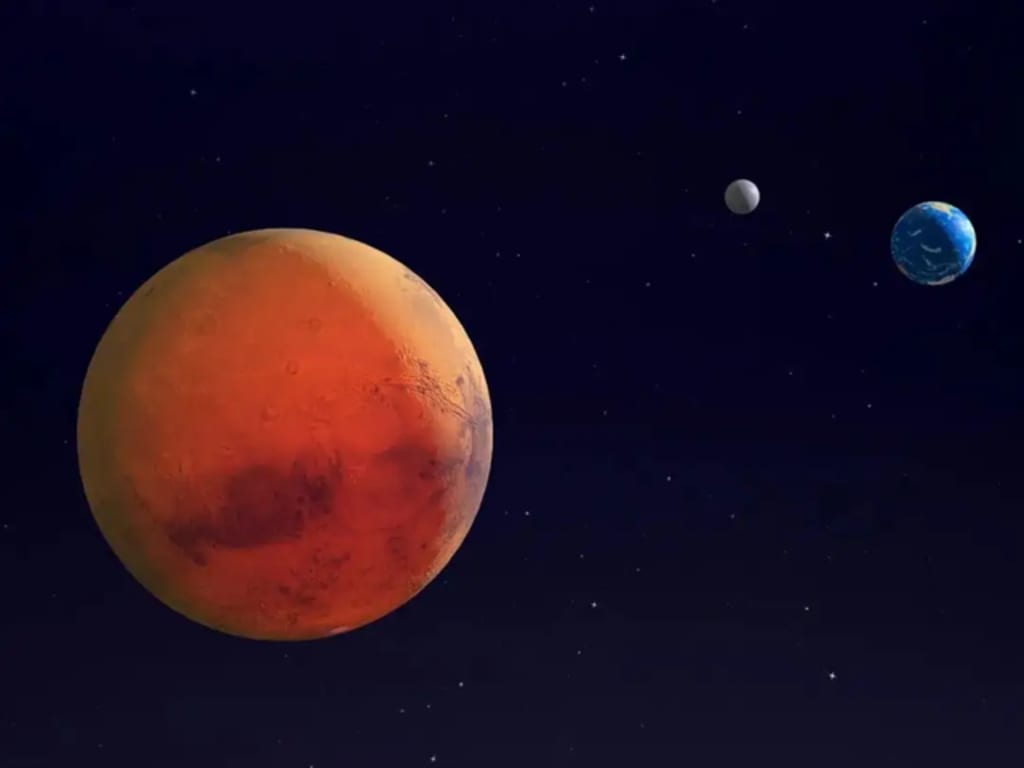
As the space industry continues to advance, humans are gradually opening up "planet exploration projects" in interstellar space. Mars, which is highly suspected of having a life, has naturally become a key object of exploration.
Although mankind has not yet reached the distant planet Saturn, the Mars probe invented by mankind has launched many explorations of this strange planet instead.
To explore a planet, one of the most important projects is to understand the soil on the planet. For humans, the Martian soil may not be so simple, if the Martian soil back to Earth, it is likely to cause us unpredictable disasters.
The dangerous Martian soil
Mars, as we can see it from the universe, is a planet with a "fiery red coat". There is no life here, and everywhere you look, there is a fiery red desert.
For humans, the only special presence on Mars is the Mars rovers that we send. Regardless of the generation of Mars rover reports, the Martian soil seems to be an extremely dangerous existence, the fire-red soil also hides a secret that we do not know.
Why do you say that Martian soil is dangerous? The main reason is that the Martian soil contains a large number of chlorine-based compounds, this discovery was fed by the U.S. Mars Rover Phoenix.
In the process of studying the Martian soil, Phoenix found a large amount of calcium perchlorate within the soil, which is a chemical that can seriously harm plants as well as humans. Through detailed testing, Phoenix found that the Martian soil contained more than 0.5% of calcium perchlorate.
Faced with such high concentrations, the chlorophyll in plants is likely to be rapidly reduced under the "attack" of chlorine-based compounds. This also means that the photosynthetic skills of the plant will be greatly weakened.
In addition, the presence of chlorine-based compounds is also likely to cause the plant's root system to lose its oxidative capacity, making the plant's ability to survive greatly impaired.
For humans, calcium perchlorate is generally used as a raw material for industrial products and is not edible by humans. If we accidentally inhale calcium perchlorate, our lungs and thyroid gland will be greatly damaged.
Thus, Martian soil is extremely dangerous for both humans and plants. The high concentration of chlorine-based compounds makes Mars have a deadly "damage function", if we are not careful to contact such soil, then the consequences will be unthinkable.
Is there life in Martian soil?
As our neighbor, Mars has been highly suspected of having a life. Even on Earth, many people have claimed to be "Martians". With the Mars rover landing on the surface of Mars, there have been many people expecting the rover to discover life on Mars and unveil a new secret of the universe for us.
The soil of Mars seems to be able to reveal the truth about "life on Mars" to us. As we all know, the existence of life cannot be separated from liquid water, if we can find traces of liquid water on a planet, then the possibility of life on this planet will be greatly increased.
As humans continue to launch probes to Mars, Mars rovers seem to have begun to gradually discover clues to the existence of "liquid water" on Martian soil, from the Mars rover images back to Mars, people found the "canyon" this feature exists.
Scientists believe that the existence of canyons on Mars can not be separated from the erosion of water, the appearance of Mars canyons, but also likely to represent the presence of liquid water. In 2011, scientists named the flow trail on the canyon the "circulation slope line".
Through the scientists' research, it was tentatively concluded that the circulating ramp lines were formed by the action of water and perchlorate, and this discovery has certainly increased the possibility of life on Mars.
Perhaps deeper in the Martian soil, there is still frozen liquid water, Mars may also appear in the future traces of life, and become a planet like Earth.
Mars' Future Outlook
As such a mysterious and full-of-life possibility of the planet, mankind naturally will not let go of the opportunity to explore Mars. Many countries have started to be excited about the "Mars landing plan". For many countries, exploring Mars is a challenging process, and if successful, the rewards will likely be more valuable than people can imagine.
The Mars One Institute from the Netherlands has announced plans to land volunteers on Mars in 2023, and even to build a human settlement on Mars in the future.
NASA has also confessed that exploring Mars will be an important plan in future space projects, and in 2040, the United States will most likely send the first astronauts to Mars.
For humans, Mars is a must-see exoplanet, both in terms of size and environment, Mars is to some extent similar to Earth. Perhaps in the future, Mars will become the second home for human beings, and there will be more "treasures" on Mars that we will be able to dig.
As a member of the solar family, Mars is still very important to us. Through the analysis of the Martian soil, we can also find that although Mars is dangerous, there is no lack of life on Mars.
Perhaps the secrets of Mars will have to be uncovered when we set foot on the planet ourselves. We also look forward to the future, we can be in the universe to make a wonderful "trip to Mars".
About the Creator
Karen Gillanah
The aggravation that can be told is not aggravation; the lover that can be snatched away is not a lover.
Keep reading
More stories from Karen Gillanah and writers in Earth and other communities.
How bizarre is the double slit interference experiment
With the continuous development of human science and technology, more and more scientists throughout history have started to try brand-new scientific experiments. Physics, as an important "weapon" for the development of human civilization, contains theories that have refreshed the human view of the world many times.
By Karen Gillanah4 years ago in Earth
Guard Your Battery
Why are some people so attractive just by standing there? It’s not because they are "likable," but because they don’t need everyone to like them. I realized later that truly charismatic people allow themselves to be criticized, but they never criticize themselves. They never try to please the world; instead, the world stops to watch them.
By Emily Chan - Life and love sharing7 days ago in Poets


Comments
There are no comments for this story
Be the first to respond and start the conversation.