Latest Stories
Most recently published stories in Earth.
World Post the Covid Pandemic-Nature’s Reclamation
While the ongoing global crisis engulfs humans, nature seems to be healing itself, rare animals being spotted, cleaner air and marine water, marine life reviving, Ozone layer fixing, and animals freely strolling the empty streets. It seems highly likely that the post-pandemic world will also have a shift towards nature and that the world will never be the same again.
By Sana Anwer5 years ago in Earth
Reducing is the Transition
I’m not interested in “small steps to sustainability,” because those steps fall short. What I am interested in is a complete overhaul of human life and behaviour, and that is what I’ve dedicated my life to. I am committed to looking past the shallow solutions that are being offered to us, to live a life that I choose for myself.
By Maeple Fourest5 years ago in Earth
Tree or Not Tree?
The dictionary defines it as a woody plant with a trunk from which branches grow. So the main shoot must be dominant and grow steadily upward or the plant is classified as a shrub, which has many smaller trunks—or rather branches—that originate from a common rootstock. But what about size? Personally, I’m always bothered when I see reports about Mediterranean forests that look to me like a collection of bushes. Trees are, after all, majestic beings, under whose crowns we seem as insignificant as ants in the grass. But then again, on a journey to Lapland, I stumbled upon completely different ambassadors of the tree family that made me feel like Gulliver in Lilliput. I’m talking about dwarf trees on the tundra, which are sometimes trampled to death by travelers who don’t even know they are there. It can take these trees a hundred years to grow just 8 inches tall. I have to say that science doesn’t recognize them as trees, and it doesn’t accord tree status to the Arctic shrubby birch, either (as you can tell by its name). The latter can grow little trunks up to 10 feet tall, but mostly they remain below eye level and, therefore, are clearly not taken seriously. But if you were to apply the same measure to other trees, then small beeches or mountain ash wouldn’t count as trees either. These two are often browsed on so heavily by large mammals such as deer that they grow multiple shoots like bushes and hold out at a height of 20 inches for decades.
By Rainbow Tree5 years ago in Earth
restART: The ART of rest
We constantly make strategic moves throughout the day. How often do we consider how far those moves get us towards our goal? There is a saying, the only thing constant in life is change. How often are we assessing and aligning with our goals? Sometimes going backward and making a few u-turns gets you right where you need to be. How often do we acknowledge success is NOT linear? I believe success is infinite with a little restART.
By Lukey Loose Leaf5 years ago in Earth
How My Love Story Made Me Earth Conscious
Many would classify me as someone who "lives with their head in the clouds". Maybe they are right. Although, I can't say I mind the stereotype. One that many get labeled for the mere fact they have actual hope for life. I can find hope in just about any situation, and once I finally got introduced to what a carbon footprint is there was no going back. My hope had already grown attached to the idea of bettering the Earth and deepening my connection to it. Seeing everything as a “we” instead of an “I” changed my perspective forever.
By Stephanie Bojanek 5 years ago in Earth
Full Heart. Created with: Untamed Photographer.
View print sizes for Full Heart by Melissa Groo: Story Behind the Photograph: Full Heart Late one autumn afternoon in Jackson, Wyoming, I was driving with a friend along a quiet backcountry road, searching for a Great Gray Owl. We’d gotten a tip that one had been seen earlier in the day on this road, hunting rodents from a fencepost. I was very excited, as I had never before seen this owl, the largest of North America’s species, measuring up to three feet tall. It was nearing dusk and a blue blanket of light enveloped the fields and far off mountains. I intensely scrutinized near and far fenceposts as the landscape scrolled by. Suddenly I noticed that one fencepost looked taller than the others, with an odd shape at the top. And then I realized it was most likely an owl perched there! I asked my friend to back up so we could get a better look. We both looked through our binoculars and realized much to our delight that it was indeed a Great Gray Owl. He was oblivious to us, focused on looking and listening for voles to pursue on the ground before him.
By Melissa Groo5 years ago in Earth
Bobcat Love. Created with: Untamed Photographer.
View print sizes for Bobcat Love by Melissa Groo: Story Behind the Photograph: Bobcat Love This shot took place only two miles from my home in upstate NY, and for me is a wonderful reminder that grace, beauty, and the wild are all around, even close to home.
By Melissa Groo5 years ago in Earth
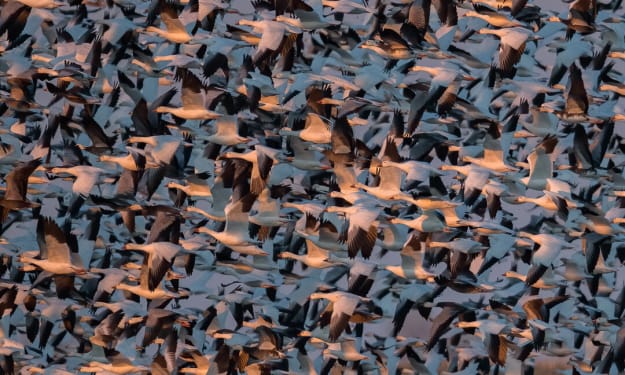
What We Need Is Here. Created with: Untamed Photographer.
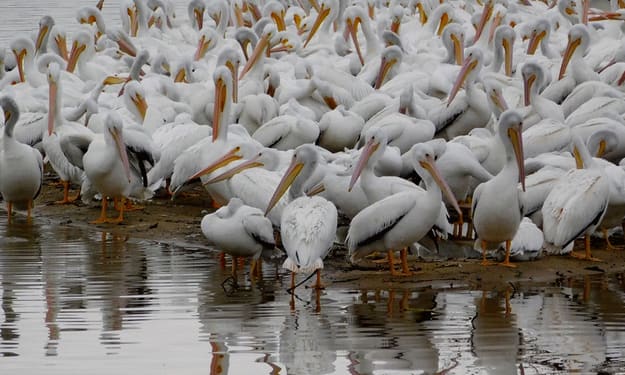
View print sizes for What We Need Is Here by Melissa Groo: Story Behind the Photograph: What We Need Is Here I don’t know if you’ve ever been to Nebraska, or even imagined what Nebraska might look like. The land stretches out as far as the eye can see, with a few trees dotting the landscape. No hills, or mountains, or even swells of rolling green, it’s the perfect, if unexpected, landing strip and runway for millions of birds.
By Melissa Groo5 years ago in Earth
In It Together. Top Story - May 2021. Created with: Untamed Photographer.
View print sizes for In It Together by Melissa Groo: Story Behind the Photograph: In It Together The Pantanal is the world's largest tropical wetland, straddling the borders of Brazil, Paraguay, and Bolivia--with Brazil containing the lion's share. This tropical wetland soaks up the rainfall of the rainy season, turning from a purely terrestrial setting into a snaking waterway dotted with land masses. The dry season takes this overfilled-sponge of land and provides water when the rains are long gone, slowly using up and eventually squeezing just about all the water out of the land. The Pantanal’s biodiversity is vast; the bird diversity alone of the Pantanal is staggering: 700 species.
By Melissa Groo5 years ago in Earth