
Is Your Wardrobe Costing the Earth?. Fashion's Dirty Secret
How Your Clothes are Polluting the Planet

Ever wonder what that trendy new shirt *really* costs? I'm not just talking about the number on the price tag. The true cost is a tapestry woven with environmental degradation, resource depletion, and ethical compromises. The fashion industry's colossal footprint is rapidly morphing into a planet-sized problem, demanding our immediate attention.
In this exploration, we'll dissect the major arteries through which our clothes are polluting the planet, tracing the historical evolution of fashion's filth. We'll navigate the labyrinth of water consumption, toxic chemicals, and overflowing landfills, and finally, we'll consider the fixes.
From Handmade to High Street: A Brief History of Fashion's Filth
Before the Industrial Revolution, clothes were local artifacts, crafted laboriously and designed to endure. Each garment carried the weight of time and skill, a far cry from today's fleeting trends.
The Industrial Revolution ushered in an era of mass production, birthing factories and the ominous whispers of widespread pollution. The textile mills of the 19th century, while marvels of engineering, also dumped "waste dye stuff and filth" into rivers, a crude foreshadowing of the environmental havoc to come. Toxic chemicals were part of the production and waste was a problem.
The late 20th century witnessed the rise of "fast fashion," an insidious paradigm shift. The 1970s saw outsourcing become the norm and "quick response" manufacturing took hold. Brands like Zara epitomized the trend with turnaround times as short as 15 days. Then came the 2000s, an era of social media dominance and e-commerce explosion, which spawned brands like Shein and Temu. The result has been a culture of disposability and an unquenchable thirst for the new. Now, we're buying 60% more clothes than we did two decades ago, yet wearing them for only half as long.
The Fabric of Our Destruction: Where Fashion Gets Dirty

Consider water. The fashion industry is a glutton, particularly when it comes to thirsty fibers like cotton. It takes thousands of gallons of water to produce just one shirt, depleting freshwater resources in already stressed regions. This thirst is rivaled only by the industry's affinity for toxic dyes and finishes. Fashion contributes approximately 20% of global industrial wastewater, often discharged untreated and laced with lead, mercury, and arsenic. These chemicals seep into our rivers, poisoning ecosystems and, ultimately, us. And let's not forget the microplastic mayhem: synthetic clothes shed millions of plastic fibers with every wash, polluting our oceans and infiltrating the food chain.
Then there are the piles of problems, the mountains of textile waste that grow higher each year. We generate 92 million tons of textile waste annually. By 2030, that figure is projected to reach 134 million tons. Synthetic fabrics, the backbone of many fast-fashion garments, can take up to 200 years to decompose, releasing harmful gases and chemicals as they slowly break down. The very nature of fast fashion—cheap, trendy clothes designed for obsolescence—fuels this endless cycle of consumption and disposal.
The fashion industry also douses us in chemical cocktails. From the pesticides used in cotton farming to the petroleum-based origins of polyester and the thousands of chemicals involved in dyeing and finishing, our wardrobes are a hazardous landscape. Formaldehyde, heavy metals, and other toxins linger in our clothes, posing potential health risks to both garment workers and consumers.
Fashion accounts for a staggering 8-10% of global carbon emissions. The industry's reliance on fossil fuels for energy-intensive production processes, especially for synthetic materials, contributes significantly to its carbon footprint. And the global journeys of raw materials and finished goods further exacerbate the problem. If left unchecked, fashion emissions are projected to increase by over 50% by 2030, and potentially account for 26% of global emissions by 2050.
Who Cares? Unpacking Opinions and Controversies
A growing number of consumers express concern about fashion's environmental impact, yet this awareness often clashes with ingrained habits and desires. The "attitude-behavior gap" is a chasm between our stated values and our actual purchasing decisions. Price, style, and convenience often trump sustainability, even for those who profess to care. However, younger generations like Gen Z and Millennials are increasingly willing to pay a premium for sustainable and durable items, rejecting the throwaway culture of their predecessors. The booming second-hand fashion market is a testament to this shift.
Many brands tout their sustainability efforts, showcasing organic cotton collections, recycled polyester garments, and circular economy initiatives. However, greenwashing is rampant. Major players like H&M, Zara, Adidas, and Shein have faced accusations of misleading claims. "Conscious collections," for instance, often represent a minuscule fraction of their overall production. Opaque supply chains, low wages, unsafe working conditions, and even forced labor continue to plague the industry, undermining consumer trust and raising ethical concerns.
Experts and activists, on the other hand, call for radical change, urging a fundamental shift in consumption patterns. Environmental NGOs like Fashion Revolution and the Ellen MacArthur Foundation advocate for greater transparency, circularity, and systemic reform. They stress that true sustainability necessitates producing and buying less. Moreover, these groups emphasize the social justice implications of fashion's pollution and labor exploitation, highlighting how vulnerable communities disproportionately bear the brunt of these negative impacts.
Stitching a Better Future: Innovations and Solutions

The path forward requires a multifaceted approach, encompassing innovative materials, circular economy models, technological advancements, and policy interventions.
We must explore alternatives to synthetic fabrics, embracing materials like hemp, linen, TENCEL™ lyocell, and organic cotton. Innovative companies are pioneering nature-based leather alternatives, such as mycelium (mushroom leather), Piñatex (pineapple leaf fiber), and Desserto (cactus leather). We can also transform waste into new resources, recycling plastic bottles and textile scraps into materials like rPET and Econyl.
Embracing the principles of the circular economy is crucial. This involves designing clothes for longevity, repairability, and recyclability; promoting repair services, clothing rental platforms, and second-hand markets; and developing advanced recycling technologies to break down complex fabric blends and create new raw materials.
Technology offers further hope. Digital IDs can track a garment's entire journey, enhancing transparency and facilitating easier recycling. Waterless dyeing technologies, such as supercritical CO2 dyeing, drastically reduce water and chemical consumption. 3D printing and AI can minimize waste, optimize supply chains, and even create custom garments on demand.
Policy interventions are essential to drive systemic change. The EU is leading the way with plans to end fast fashion by 2030, mandating the use of recycled fibers, and banning the destruction of unsold goods. US states like New York and California are proposing legislation to require transparency and establish textile recycling systems. Extended Producer Responsibility (EPR) schemes can hold companies accountable for the end-of-life management of their products. Tax credits and other incentives can further encourage circular business models and promote the adoption of sustainable practices.
Reweaving Our Relationship with Fashion
The future of fashion hinges on a fundamental shift in our collective consciousness. Every purchase is a vote, a declaration of our values. We have the power to demand better, to support ethical brands, and to transform our consumption habits.
Even small changes can have a significant impact. Repairing clothes, buying second-hand, and choosing quality over quantity are all steps in the right direction.
Let us all embrace the challenge of creating a cleaner, greener, and fairer fashion future.
Is Amazon's Green Leaf Truly Green? Decoding Their "Sustainability Features" Label
We all aspire to tread lightly on this Earth, and in the labyrinthine world of online shopping, that little green leaf offered by Amazon can feel like a reassuring signpost. This is the "Sustainability Features recognized by trusted certifications" label, prominently displayed on numerous Amazon products, a key element of their "Climate Pledge Friendly" program.
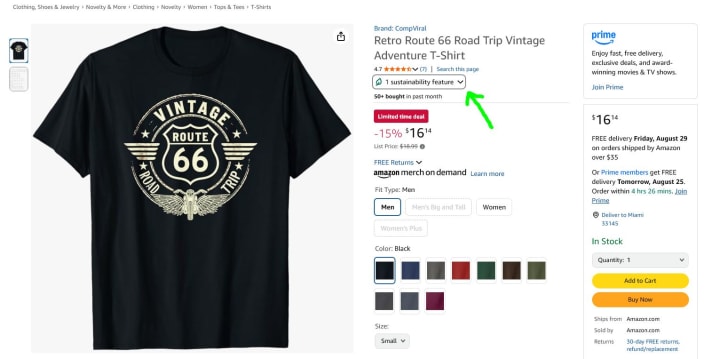
Do you like the t-shirt? Buy it on Amazon.
Amazon pledges to simplify our quest for eco-conscious products, underpinned by genuinely verified environmental credentials. But does this verdant symbol always signify true sustainability, or is it merely a veneer? Let's delve beneath the surface to explore the true meaning of this label – the commendable, the questionable, and the areas shrouded in ambiguity.
The Green Leaf Unveiled: Amazon's Vision of a Sustainable Cart
What precisely does this badge represent? It signifies the "Climate Pledge Friendly" initiative, characterized by its distinctive green leaf icon. The label highlights products boasting eco-attributes, varying from recycled materials to safer chemical compositions. The overarching purpose? To empower shoppers like you to make informed choices that benefit the planet.
But how do products earn these coveted "stripes," or rather, leaves? Amazon employs a dual verification system. The first pillar rests on reputable third-party certifications. These organizations, numbering over 50, conduct independent assessments based on their rigorous standards (think Energy Star, Fairtrade, Rainforest Alliance, Global Recycled Standard, FSC).
The second pillar? Amazon's own certifications. Among these is "Compact by Design," which rewards products with reduced air space and water usage in packaging, leading to more efficient shipping. "Plant-Based Fiber Blended" acknowledges textiles incorporating sustainable plant-derived materials, while "Pre-Owned Certified" promotes a circular economy by giving products a second life.
This label isn't an isolated initiative. It's interwoven with Amazon's broader "Climate Pledge," unveiled in 2019, with the audacious goal of achieving net-zero carbon emissions by 2040. The label debuted in September 2020 with over 25,000 products. By 2024/2025, it encompasses a staggering 2.2 million products! This ambition is further exemplified by initiatives like "Frustration-Free Packaging" (2008) and "Amazon Day" (2019).
The Shopper's Perspective: Why We Gravitate Towards Green
Why are we, as consumers, so drawn to this verdant emblem? There's a growing demand for sustainable options, with many consumers willing to pay a "green premium." The labels are designed to cut through the confusing clutter of eco-claims, fostering confidence in our purchasing decisions. Data show that products bearing the green leaf experience significant increases in sales and visibility. This is particularly true among younger demographics (Gen Z and Millennials), for whom sustainability is a critical factor in their purchasing decisions.
The Road Ahead: Amazon's Future in Green
Amazon continues to incorporate new third-party certifications, broadening the spectrum of recognized eco-friendly attributes. Stricter rules for sellers are expected in 2025, including packaging requirements, detailed reporting on materials and carbon footprints, and enhanced search filters for "Sustainable Materials." A greater emphasis will be placed on "Ships in Product Packaging" to minimize waste.
Beyond the badge, Amazon has made broader commitments. It achieved 100% renewable energy in 2023. It's deploying thousands of electric vehicles, with a goal of 100,000 by 2030. Plastic air pillows are being replaced with recyclable paper filler, and AWS aims to be water positive by 2030. Emission reporting and reduction goals are being mandated for suppliers. Furthermore, Amazon is leveraging AI to optimize logistics and energy consumption.
The green leaf is expanding to more countries
As consumers, we must actively examine the specific certifications underpinning the green leaf. Ask questions. Demand transparency. Our choices hold power.
Amazon is making strides, but, like any corporate behemoth, it faces formidable challenges and intense scrutiny in its pursuit of genuine sustainability. The journey continues.
About the Creator
Francisco Navarro
A passionate reader with a deep love for science and technology. I am captivated by the intricate mechanisms of the natural world and the endless possibilities that technological advancements offer.
Keep reading
More stories from Francisco Navarro and writers in Earth and other communities.
Can Nuclear Bombs Save the Planet?
A Midnight Thought Experiment Do you ever lie awake at night, staring at the ceiling, your mind spiraling into impossible solutions for problems too big to ignore? I do. Sometimes I imagine some kind of cosmic eraser—something that could just wipe away all our mistakes in one clean sweep. Like nanobots programmed to devour carbon dioxide molecule by molecule, or trees engineered to grow skyscraper-tall and breathe in smog like it’s fresh air. Or maybe… just maybe… there’s a way to pull infinite energy from the fabric of reality itself. (Yeah, right.) Then again, dreams are free.
By Francisco Navarroabout a year ago in Earth


Comments
There are no comments for this story
Be the first to respond and start the conversation.