
Is it true that Jakarta is experiencing subsidence?
Simultaneously, the levels of the sea are increasing. Presently, the metropolis is endeavoring to combat the advancing tide, and to secure its very existence.

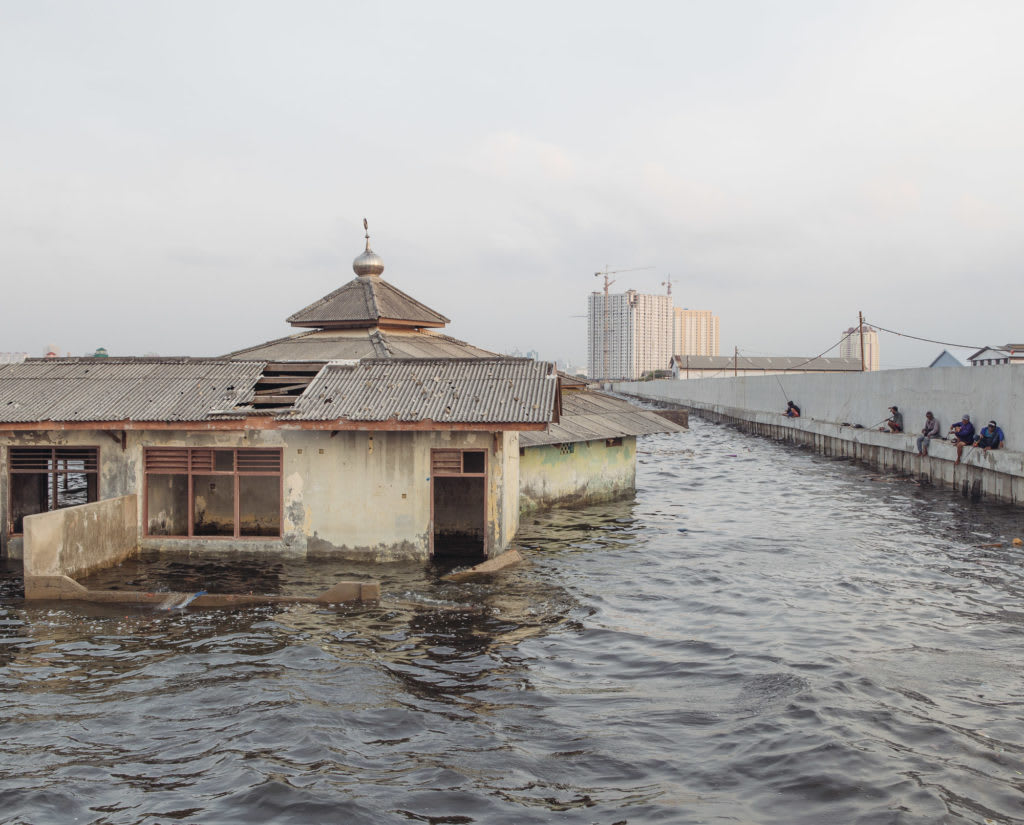
This is the Waladuna Mosque located in Jakarta, which currently exhibits a dilapidated roof, walls covered in moss, and inundation of seawater in every corner. The last instance of prayer within its walls dates back to 2001, when it was still above ground. Presently, it serves as a warning sign, indicative of the potential fate of Indonesia's capital city if prompt action is not taken. Despite facing similar rising sea levels as other coastal cities worldwide, Jakarta's situation is unique. The city has been sinking for several decades, as evidenced by the blue areas that depict the extent of its descent since the 1970s.
The darker the area, the greater the drop. The majority of sinking occurs in the north coast, where Jakarta meets the Java Sea, with the land sinking by approximately 25 cm annually. This destabilizes the area, causing damage to homes and disrupting the lives of residents, particularly those who rely on fishing for their livelihoods. However, even those residing further inland, among Jakarta's population of over 10 million, are at risk. By 2050, a significant portion of Jakarta, including the residences of millions of individuals, may be submerged underwater. This is due to the fact that Jakarta is situated on a low-lying coastal area on a swampy plain, with 13 rivers flowing through it. However, the primary reason for the city's sinking is the lack of access to sufficient water for its inhabitants.
The majority of Jakartans do not have access to clean, piped water, and instead rely on wells for their water supply. These wells extract water from aquifers, which are underground rock layers that hold groundwater. The porous spaces within the rock are filled with water, and the constant extraction of this water by millions of individuals has caused the soil to compact and collapse, resulting in the sinking of the ground above it.
While aquifers are typically replenished naturally through rainfall, this is becoming increasingly rare in Jakarta due to the city's rapid development and extensive concrete coverage. This has resulted in flooding in coastal areas, such as the fishing community of Muara Baru, where makeshift bridges have been constructed to navigate the flooded neighborhoods. The combination of sinking ground and rising sea levels has made floods during high tide and rainy seasons even more dangerous.
Jakarta has experienced devastating floods in the past, such as in 2007, when a storm and high tide caused rivers and canals to overflow, resulting in the loss of 80 lives. The sinking ground has already caused individuals like Maksim to lose their homes, and Nondho has had to rebuild his home multiple times.
The survival of Jakarta is at risk due to the excessive pumping of groundwater. However, to understand how the city arrived at this situation, one must look back centuries to the Dutch colonization of the area in the 1600s. The Dutch razed the original port town of Jayakarta and built Batavia, a city in the Dutch style, displacing the indigenous Indonesian, Chinese, Indian, and Arab populations who had lived there for centuries.
The canals of Batavia served multiple purposes, including trade, defense, and the creation of a Dutch atmosphere. However, upon observing the city from an aerial perspective, it becomes apparent that the city grid was also designed to serve a more sinister purpose. A closer examination reveals a lack of bridges connecting the various sections and blocks of the city, a deliberate strategy employed by the outnumbered Dutch to control the local population. This resulted in the confinement of different groups to their respective city quarters, a system that persisted for over a century until the mid-1700s.
The deterioration of the canals due to poor maintenance and sediment blockages from earthquakes led to the spread of disease and the migration of wealthier Dutch to the south of Batavia, where a new colonial administrative center was established. Despite the deadly consequences of the stagnant water, the Dutch continued to neglect the canals and instead focused on developing a centralized water supply system with iron pipes to distribute clean drinking water and indoor bathrooms. However, this system was concentrated in areas where the Dutch had relocated, leaving the indigenous population in informal settlements known as "kampongs" far from the piped water.
This created a new division in the city, with native residents forced to rely on street vendors or the neglected canals for water. It took several decades before pipes were finally installed in these communities, and even then, only a few public standpipes were provided. The year 1949 marked the continuation of a significant event in Indonesia's history. Following an armed conflict, the Dutch eventually acknowledged Indonesia's independence and withdrew from the country. However, their departure left behind a sprawling city constructed on marshland and segregated by water access, which the Jakartans had to contend with. Over the ensuing decades, Jakarta's population grew exponentially, necessitating more housing, stores, and streets, resulting in rapid expansion. Despite this, the city's water infrastructure still fails to serve the majority of its inhabitants. A chart depicting the percentage of Jakarta's population with piped water reveals that it was a mere 12% in the 1950s and remains below 50% to this day.
Consequently, many individuals without access to piped water have no alternative but to rely on roundwater pumping to survive, exacerbating the city's sinking problem. The Indonesian government has even contemplated relocating the capital from Jakarta to the neighboring island of Borneo, but this would not benefit the millions of people residing in Jakarta. To rescue the city, the government announced a project in 2014, in collaboration with a Dutch architecture firm, to construct and reinforce 120 km of seawalls to prevent water from flooding the land as it sinks. However, only 10 kilometers of the seawall, such as the one in Muara Baru, have been reinforced thus far. The issue is that, like the rest of Jakarta, the seawall is sinking.
The project encompasses a grandiose $40 billion initiative to erect a 38 km wall, fashioned in the likeness of a colossal bird, with the aim of safeguarding the coast from inundation. However, the completion of this project may require up to three decades. By that time, Jakarta may have relinquished the majority of its coastal terrain. The subsidence of Jakarta will persist until the extraction of groundwater is terminated. The government must provide an alternative to the extraction of groundwater, as has been accomplished in the past. Tokyo, Taipei, Shanghai, and Bangkok are among the cities in the region that have successfully halted their subsidence by supplying piped water. Nevertheless, time is of the essence. Jakarta has been independent of Dutch rule for slightly over 70 years. However, the Dutch's method of constructing and dividing the city, as well as restricting its water supply, continues to plague it to this day. Jakarta is sinking into the ocean, and this will remain its reality until the government devises a plan to provide its citizens with clean, piped water. This will persist for as long as Jakarta endures.
About the Creator
Meera's AULOSS
Welcome to Meera's A U LOSS: Your Ultimate Weight Loss ...Explore our engaging articles that provide honest reviews, tips, and inspiring success stories about popular weight loss products' Resource! join us
Keep reading
More stories from Meera's AULOSS and writers in Earth and other communities.
Is it true that Jakarta is experiencing subsidence?
This is the Waladuna Mosque located in Jakarta, which currently exhibits a dilapidated roof, walls covered in moss, and inundation of seawater in every corner. The last instance of prayer within its walls dates back to 2001, when it was still above ground. Presently, it serves as a warning sign, indicative of the potential fate of Indonesia's capital city if prompt action is not taken. Despite facing similar rising sea levels as other coastal cities worldwide, Jakarta's situation is unique. The city has been sinking for several decades, as evidenced by the blue areas that depict the extent of its descent since the 1970s.
By Meera's AULOSS2 years ago in Earth
“Are You Dead?”: A New App Reflects the Loneliness of Young Chinese Living Alone
In China’s rapidly changing cities, living alone is no longer unusual—especially among young adults pursuing education, careers, and independence. But as solo living increases, so do concerns about isolation, safety, and what happens when no one is around to check in. Against this backdrop, a new app with a blunt, unsettling question—“Are you dead?”—has captured public attention and ignited debate. Despite its shocking name, the app is not designed to provoke fear. Instead, it aims to address a practical and emotional gap in modern urban life: how to ensure the well-being of people who live alone, and how technology is stepping in where traditional community networks have weakened. The Rise of Solo Living in China China has witnessed a dramatic shift in household structures over the past two decades. Urbanization, delayed marriage, rising housing costs, and changing cultural values have contributed to a growing number of single-person households, particularly among people in their 20s and 30s. For many young Chinese professionals, living alone represents freedom and self-reliance. It allows flexibility, privacy, and independence from family expectations. Yet this independence often comes with trade-offs: fewer daily social interactions, weaker neighborhood ties, and limited support in emergencies. In megacities like Beijing, Shanghai, and Shenzhen, it is increasingly common for neighbors not to know each other at all. In this environment, concerns about what happens if someone becomes ill, injured, or simply disappears from daily routines have become more pronounced. What the App Actually Does Despite its provocative name, the app’s purpose is surprisingly simple. It functions as a digital check-in system. Users set regular times to confirm they are okay—by tapping a notification or completing a brief check-in. If the user fails to respond after a certain period, the app automatically alerts designated contacts, such as friends, family members, or emergency responders. The stark question, “Are you dead?”, is intentionally designed to grab attention and prompt action. Developers argue that softer language is often ignored, while blunt phrasing cuts through digital noise and encourages consistent use. In essence, the app acts as a safety net, especially for people who live alone and may not have daily contact with others. Why Young People Are Downloading It The app’s popularity reflects deeper anxieties among young adults navigating modern life. Many users say they downloaded it not because they fear the worst every day, but because it provides peace of mind—both for themselves and for loved ones. For parents living far from their children, the app offers reassurance without constant phone calls. For users, it creates a sense of being quietly watched over, without sacrificing independence. Some users have also described the app as a form of emotional comfort. Even a routine notification can feel like a reminder that someone, somewhere, would notice if they vanished from daily life. A Name That Sparked Debate The app’s name has been its most controversial feature. Critics argue that the phrase “Are you dead?” is unnecessarily harsh and reflects a growing desensitization in digital culture. Others worry that such language could amplify anxiety rather than reduce it. Supporters, however, see the name as a reflection of reality rather than a provocation. In densely populated cities where people can go unnoticed for days or weeks, the question is uncomfortable—but relevant. They argue that avoiding blunt language does not eliminate the underlying problem of isolation. The debate highlights a broader tension in tech design: Should apps prioritize emotional sensitivity, or practical effectiveness—even if it makes people uncomfortable? Technology Filling a Social Gap The rise of this app points to a larger issue: technology increasingly compensates for weakened social structures. In the past, extended families, close-knit neighborhoods, and workplace communities naturally checked in on individuals. Today, those informal safety nets are often absent. Apps like this one are not just tools; they are symptoms of a society where digital solutions are replacing human presence. While convenient, this raises questions about whether technology is addressing the root causes of loneliness—or simply managing its consequences. Still, for many users, the app is not a replacement for relationships, but a supplement to modern life realities. Living Alone Does Not Mean Wanting to Be Alone An important takeaway from the app’s success is that living alone is not the same as wanting isolation. Many young Chinese adults value independence but still crave connection, security, and acknowledgment. The app’s routine check-ins, though minimal, provide a structured moment of contact. In a fast-paced, high-pressure environment, even small gestures of recognition can matter. This trend also reflects changing attitudes toward mental well-being and personal safety. Younger generations are more open to discussing vulnerability and using tools that previous generations might have dismissed. What This Says About Modern Urban Life The popularity of an app that asks such a stark question speaks volumes about the realities of contemporary urban living—not just in China, but globally. As cities grow larger and lives become more individualized, people are searching for new ways to ensure they are seen, remembered, and protected. The app’s success suggests that people are willing to engage with uncomfortable ideas if they address real needs. It also underscores the importance of designing technology that is honest about modern challenges, rather than masking them with euphemisms. Conclusion: A Wake-Up Call, Not a Warning While the phrase “Are you dead?” may sound alarming, the app behind it is less about fear and more about care. It reflects a generation navigating independence in a world where traditional support systems no longer function as they once did. Rather than signaling a morbid obsession, the app serves as a quiet reminder of something deeply human: the need to be noticed. In that sense, its blunt question is not about death at all—but about presence, connection, and the reassurance that someone would check if you were gone. As solo living continues to rise, tools like this app may become less shocking and more commonplace—symbols of how society adapts to changing ways of life in the digital age.
By Muhammad Hassan4 days ago in Earth



Comments
There are no comments for this story
Be the first to respond and start the conversation.