
Ice Cap Melting Affects Global Timekeeping Systems
Ice cap melting is one of many adverse results of global warming and climate change. Find out how the flow of meltwater from Earth’s poles to its equator is affecting our planet’s rotation rate and how our atomic clocks measure time.

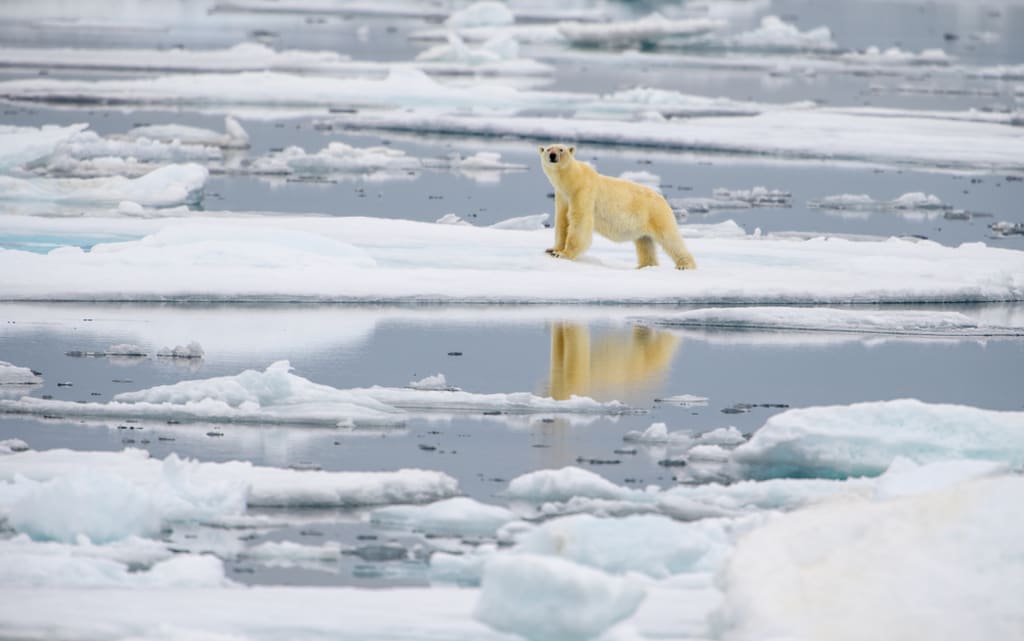
Ice cap melting is one of many adverse results of global warming and climate change. Find out how the flow of meltwater from Earth’s poles to its equator is affecting our planet’s rotation rate and how our atomic clocks measure time.
An old friend of mine has an issue with celebrating annual or seasonal events. He insists that time is linear, not circular, and that milestones like birthdays, anniversaries, holidays and seasons are meaningless.
In a sense, he’s right, of course. After all, a clock only runs one way.
Even so, we humans are adapted to the planet on which we evolved. So, cyclical events like sunrise and sunset, the moon’s phases, the seasons, and the year are all engrained into our subjective sense of time.
Pythagorus Suggested Earth’s Rotation
Humans have suspected that the Earth was round and spinning on its axis since the dawn of civilization. Pythagorus suggested the Earth rotated back in the 6th century BCE.
After Copernicus, Kepler and Galileo realized that the Earth revolved around the Sun, people also began to grasp that Earth’s rotation was what made the Sun seem to move across the sky. Finally, in 1851, Léon Foucault conducted his famous pendulum experiment.
A swinging pendulum gradually develops a rotation that traces out a pattern on the ground consistent with Earth’s rotation. It’s a handy trick, by the way, if you happen to come across an argumentative flat earther.
Dr. Duncan Agnew Studies Earth Sciences and Geophysics
Dr. Duncan Agnew is a geophysicist. He’s been a professor of earth sciences and geophysics at the University of California, San Diego’s Scripps Institution for more than four decades.
Professor Agnew is the author of a research paper that the journal Nature published this week. The study found that, as global warming melts our polar ice caps, it changes our planet’s rotation rate.
The Earth’s rotation has been naturally slowing down very gradually. It’s nothing anyone would notice, but our hyper-accurate atomic clocks enable scientists to measure it.
Scientists Add a ‘Leap Second’ Every Once in a While
Every once in a while, usually on New Year’s Eve, or sometimes at the end of June, scientists will add a “leap second” to their atomic clocks to keep them in sync with the Earth.
This is essential now that our instruments are more accurate than the natural cycles to which we’re all attuned. Our smartphones and GPS systems wouldn’t be accurate if satellites didn’t know precisely what time it is, for instance.
Since 1972, the International Earth Rotation and Reference Systems Service has added leap seconds to Universal Coordinated Time on 27 occasions. However, this new study suggests that the earth’s rotation is naturally speeding up and that climate change is countering that acceleration.
‘Things Are Happening That Have Not Happened Before’
As Professor Agnew told the Washington Post, “Global warming is managing to actually measurably affect the rotation of the entire Earth. Things are happening that have not happened before.”
The Earth isn’t perfectly round. It’s slightly flatter at the poles and it bulges a bit at the equator.
Now that our ice caps are melting, the meltwater shifts toward the equator, increasing that equatorial bulge. At the same time, land near the poles isn’t as weighed down by the ice, so it gets rounder.
Earth’s Molten Iron Liquid Core
As we’ve discussed in a previous Dare to Know story, there’s another factor that influences our planet’s rotation rate. The Earth’s molten iron liquid core is always churning, generating our magnetic field.
This fluid motion causes the solid mantle of the Earth to spin at different rates. The liquid core’s rotation has been slowing down, which speeds up the solid part of the Earth’s rotation.
It it weren’t for global warming, Earth’s natural geology would be speeding up our planet’s overall rotation rate. Climate change is countering that natural process.
‘Getting the Time Wrong Could Lead to Huge Problems’
“Even a few years ago, the expectation was that leap seconds would always be positive, and happen more and more often,” Professor Agnew explained. "But if you look at changes in the Earth's rotation, which is the reason for leap seconds, and break down what causes these changes, it looks like a negative one is quite likely. One second doesn't sound like much, but in today's interconnected world, getting the time wrong could lead to huge problems.”
The net result of all these effects is that scientists will probably have to subtract a second from their atomic clocks over the next few years. Professor Agnew expects that we’ll need what scientists are starting to call a “negative leap second” in 2008.
“There’s never been a negative leap second before, and leap seconds themselves have always been a problem for people running computer networks,” Professor Agnew told Scientific American. “Having to include a negative leap second would be a bigger problem because they’ve never had to do it.”
Humans Affecting Our Planet In Unprecedented Ways
If it weren’t for global warming, we’d be needing to subtract a second from our atomic clocks next year. It’s another example of how human activity is affecting our planet in unprecedented ways.
What underlies all this discussion is the discrepancy between my friend’s linear conception of time, as measured by mechanical clocks, and the cyclical time to which living things respond in natural cycles.
In the past, humanity couldn’t measure that difference, but we’ve progressed beyond that. Even so, that same progress means that we’ve become a sort of invasive species that’s altering its own global habitat.
And Another Thing…
Adding or subtracting a second every few years may seem trivial, but it’s similar to the one to two degree difference in global average temperature that humanity is also causing. These subtle differences affect the balance and harmony of our entire ecosphere.
We’re having an unprecedented effect on the world around us, while at the same time, we’re striving to gain a grasp of that world and our place within it. We’re also struggling to define ecology and how the laws of nature really work.
Professor Agnew concluded by saying, “This is another one of those ‘this has never happened before’ things that we’re seeing from global warming: the idea that this effect is large enough to change the rotation of the entire Earth”
We always have more to learn if we dare to know.
Learn more:
Global Warming Is Influencing Global Timekeeping
Global Warming Is Slowing Earth’s Rotation
Climate change is altering Earth’s rotation enough to mess with our clocks
A global timekeeping problem postponed by global warming
Earth's Inner Core Falling Behind Planet's Rotation
About the Creator
David Morton Rintoul
I'm a freelance writer and commercial blogger, offering stories for those who find meaning in stories about our Universe, Nature and Humanity. We always have more to learn if we Dare to Know.
Keep reading
More stories from David Morton Rintoul and writers in Earth and other communities.



Comments
There are no comments for this story
Be the first to respond and start the conversation.