
Hydrologic Cycle
"Important Steps Involved in Water Cycle"


Water Cycle
Introduction
Water is very essential material to support life on Earth. If we can say that the life would end if the water disappears from the Earth then there is no lie. 70% of the total Earth surface is covered with water while only 30% left for other landscapes. From this estimated we easily determine the importance of water in life. It helps to maintain the temperature of the Earth, support life and eliminate some toxic material from the Earth. Infect, it helps us in every day to day activities. So, this water should be replaced and circulated again and again on Earth to properly form its functions. The process in which water returns back to the Earth from the atmosphere and then again become part of the atmosphere called water cycle or simply known as hydrologic cycle (“Hydro” meaning “Water”). In this process water circulated between two bodies through its different stages (Solid, Liquid and Gas) and makes a full water cycle. There are four different spheres on Earth called atmosphere, lithosphere, hydrosphere and biosphere. Let’s explain this water cycle step by step in those spheres. How it behaves and functions in every different sphere.
Effects of Water Cycle
• It helps to maintain the temperature of its surroundings
• It usually regulates the weather and climate and brings rain on Earth
• To a surprise, it also helps to convert hard rock into soil by erosion process
• Through this process, minerals easily circulates throughout the spheres
• Last but not the least, it also regulates and perform important role in the formation of some geological feature of the World like Glaciers, snow ice-caps, mountains, plateaus and some major plains
Steps involved in Water Cycle:
Some of the important steps that are involved in hydrologic process are discussed below;
Step 1: Evaporation
Evaporation is a process in which the water turns into gas by the process of heating. This is the first and foremost step of water cycle. Water from the Oceans turned into water vapors and become part of the atmosphere. But ever you think how this water turns into vapors without any force? The answer to this question is that the water present in Oceans, lakes, river or any other kind of water body absorbs heat that comes from Sun. This heat turns the liquid water into vapors (gas). When this water converges into vapors, they react with the air present in the atmosphere and helps in cloud formation. When rain happen this water ultimately return back to the Earth.
Step 2: Condensation
The process by which a gas turns into a liquid by applying high pressure is called “Condensation”. When vapors reach at higher altitude, the temperature starts decreasing. This decrease in temperature helps the vapors to turns into droplets. These droplets returns back in the form of rain. This whole phenomenon is called condensation.
Step 3: Sublimation
Sometimes a solid material converts into a gas without changing into a secondary state (Liquid). This happens in sublimation process. It is the third and most interesting process in water cycle. In this process the ice directly converts into water vapors without converting into liquid. Similarly the water vapors molds into ice without liquid formation. It happens in most cold areas like areas located at the North and South poles of the Earth. These areas are located at higher altitudes. When water evaporates and moves towards the atmosphere, there they face a low temperature and they directly convert into ice. That is why Polar Regions are always covered with snow.
Part 4: Transpiration
This is the last step and very similar to evaporation. In transpiration water turns into vapors by the help of plants without absorbing any heat from the Sun.
About the Creator
Fatima Jamil
In a world where you can be anyone, be yourself.
Keep reading
More stories from Fatima Jamil and writers in Earth and other communities.
Water Sources
Major Source of Water on Earth and in Pakistan If we talk about water sources, there is no doubt that the Earth contains 70% water. It covers the area more than dry land. So in order to consider this term we easily say that there are large number of water sources present on Earth. Some are located underground and some are part of the Earth surface that we easily can see. Here we discuss some major sources of water thoroughly along with their importance and water level.
By Fatima Jamil3 years ago in Earth
No Written Document Memorializes the Future Deal Framework for Greenland, Sources Say
In a development that has caught global attention, sources close to the matter confirm that no formal written document currently exists to memorialize any deal framework concerning Greenland between the United States, Denmark, and NATO partners. Although discussions between U.S. President Donald Trump and NATO Secretary-General Mark Rutte focused on Arctic security and strategic cooperation, officials acknowledge that what emerged from the talks is strictly a verbal understanding, not a signed treaty or legally binding text. This lack of documentation has generated confusion and speculation among allies and observers. Without a formal written record, questions remain about what was actually agreed upon, what commitments have been made, and how this impacts sovereignty, defense coordination, and international trust. For Greenland, Denmark, and NATO members, clarity is critical, given the island’s growing strategic significance in the Arctic. Diplomatic Discussions Without a Document The discussions at the center of this story involved President Trump and NATO Secretary-General Rutte and were reportedly aimed at updating the 1951 U.S.–Denmark agreement governing U.S. military presence in Greenland. This meeting followed earlier tensions, when Trump’s comments suggested a desire for increased access — and even partial control — over the territory. Officials say the talks resulted in a verbal understanding of the next steps for cooperation but did not produce a written or signed framework. According to insiders, the leaders agreed to explore updates to the 1951 agreement, particularly in response to modern Arctic security concerns and the need to coordinate NATO efforts in the region. The verbal agreement reportedly touched on several broad points, including potential measures to limit Russian and Chinese investment in Greenland and the reinforcement of NATO’s role in Arctic security. While these points outline the direction of discussions, the lack of formal documentation has left key details ambiguous. Allies are unsure how far agreements extend, whether all parties fully concur, and how such understandings might be interpreted internationally. Why No Document Was Produced Sources indicate that confidentiality and caution were major reasons for avoiding a written record. Secretary-General Rutte reportedly preferred not to create formal documentation at the meeting, fearing leaks or public exposure. Past experience, including incidents where private diplomatic messages were shared publicly by President Trump, likely heightened these concerns. This scenario highlights a recurring dynamic in diplomacy: preliminary negotiations often begin verbally, with written agreements drafted only after parties are confident in mutual understanding. However, this approach carries risks, especially in matters involving national sovereignty and strategic defense, where clear records are essential to avoid misunderstandings. Historical Context: The 1951 U.S.–Denmark Agreement The Greenland discussions are grounded in a decades-old framework. Since 1951, the United States and Denmark have maintained an agreement permitting U.S. military access to Greenland, primarily to support NATO operations and regional defense. The recent talks were framed as a potential update to this longstanding agreement rather than a replacement or attempt to transfer sovereignty. Denmark and Greenland have consistently emphasized that their sovereignty is non-negotiable, and any discussions on security or investment must involve Greenlandic authorities. This principle is central to the diplomatic balance and was reiterated throughout recent negotiations. Uncertainty About Commitments Despite the verbal understanding, the specifics of the agreement remain undefined. Sources confirm that discussions included: Modernizing the 1951 defense agreement to reflect contemporary Arctic security needs. Addressing the potential influence of Russia and China in Greenland. Strengthening NATO roles in Arctic defense coordination. Potential U.S. strategic access to Greenland’s natural resources, including minerals. Without a signed document, these points are subject to interpretation, leaving allies and observers uncertain about future obligations. Analysts note that while verbal understandings can guide diplomacy, formal documentation is critical for legal, political, and strategic clarity. Responses From Allies and Greenlandic Authorities The absence of formal documentation has raised concerns across NATO and European capitals. Written agreements are foundational to diplomacy, providing clarity, accountability, and mutual reassurance. Without them, coordination between allies becomes more challenging, and misunderstandings are more likely. Danish and Greenlandic authorities have been particularly vocal about the importance of sovereignty. Both have stated that any future deal must explicitly involve Greenland and cannot compromise its authority or democratic processes. Greenland’s leadership has emphasized that it will not be treated as a bargaining chip, and Denmark has reinforced that sovereignty remains non-negotiable. Strategic Importance of Greenland Greenland’s significance extends far beyond its size. The Arctic is becoming increasingly central to global strategy due to climate change, emerging shipping routes, and natural resources. Russia and China have increased their presence in the region, making cooperation between the U.S., Denmark, and NATO allies more crucial than ever. Without a written framework, the alliance faces challenges in presenting a unified stance on Arctic security. Formal agreements are not only legal instruments but also symbols of political commitment, demonstrating the seriousness of cooperation to allies and potential rivals alike. Next Steps in Negotiations Officials indicate that the next step is a working-group meeting involving the U.S., Denmark, and Greenland. At this session, negotiators aim to draft a formal document that will memorialize discussions and define the scope of cooperation on defense, investment, and strategic operations. As negotiations continue, allied governments will watch closely. Ensuring that Greenlandic sovereignty and local participation are respected will be paramount. For NATO, the priority will be clarity and coordination, ensuring that all member nations understand the commitments and strategic direction emerging from these talks. Conclusion The fact that no written document currently memorializes the Greenland framework highlights both the fluidity and complexity of high-level diplomacy. While President Trump and Secretary-General Rutte may have reached a verbal understanding, the absence of a formal record leaves uncertainties that will need to be resolved through future meetings and eventual documentation. For the world, Greenland remains a critical strategic territory. The upcoming working-group discussions and eventual formal agreement will define not only the future of Arctic security but also the nature of cooperation between the U.S., Denmark, Greenland, and NATO members. Diplomacy in the 21st century often begins verbally, but clarity, legality, and trust depend on what is ultimately written down.
By Muhammad Hassan5 days ago in Earth
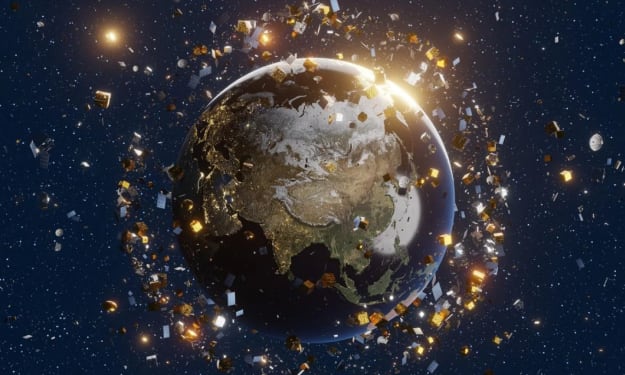
2.8 Days to Disaster: Low Earth Orbit Could Collapse Without Warning
When we think about the future of space exploration and satellite technology, one of the most critical and often overlooked aspects is Low Earth Orbit (LEO). This region, just above the Earth’s atmosphere and extending up to 2,000 kilometers above the surface, has become increasingly crowded. It's home to a vast array of satellites that power everything from communications to weather monitoring and global navigation systems. Yet, this essential zone could be on the brink of a catastrophic collapse, potentially putting all of these vital systems at risk.
By Muhammad Hassan6 days ago in Earth



Comments (1)
Share you reviews on this article!