
Humans fall into the sea from a height of 10,000 meters, can they still survive?
Survivor of the 10,000-meter fall

In the history of human spaceflight, someone did fall from a height of 10,000 meters without a parachute and survived, but her luckiest place was that she did not fall into the sea.
Survivor of the 10,000-meter fall
On January 26, 1972, a bomb exploded in a suitcase on international flight JAT 367, which ultimately caused the plane to crash over Czechoslovakia.
There were 23 passengers and five crew members on the flight, but only one flight attendant survived, her name was Vesna Vulovic.
According to a later accident investigation, the plane was at an altitude of 10,160 meters when it crashed. As we all know, civil airliners do not have parachutes, so Vesna Vulovic fell from a height of 10,000 meters and survived without any protective measures. She was also rated by Guinness World Records as falling from the highest place and surviving people.
According to Vesna Vulovic's recollection, experts determined that she survived because she fell with her seat on a snow-covered, tree-covered hillside.
The seat of the plane provided protection for Vesna Vulovic, the branches provided a first round of deceleration before she fell to the ground, then the snow provided a second round of cushioning after she touched the ground, and finally she fell to the point It happened to be on the uphill, and the third roll of the landing dissipated the impact, and finally allowed her to survive.
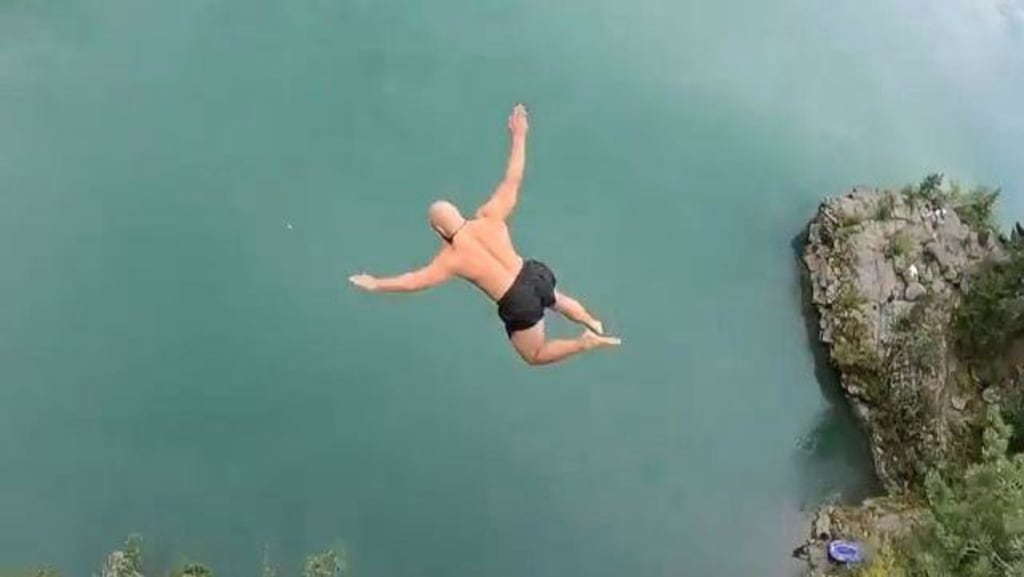
If it is replaced by water, she will not have any deceleration and buffering, and dispersion. At the same time, due to the surface tension of water, people who fall from a height of 10,000 meters basically have no chance.
The faster it hits the water surface and the larger the contact area, the greater the force of the water's tension will bounce back. In fact, if you fall from a height of 10,000 meters, if you are still sitting on the plane seat, it will fall on the concrete floor. There is no difference.
So, there is another interesting question, what happens when a person falls from a height of 10,000 meters?
terminal velocity of a person falling from a height
In fact, people don't keep accelerating, because the speed of our fall is provided by the earth's gravity, but the faster the speed, the greater the resistance provided by the air. When the resistance and gravity are equal, it will no longer accelerate. This speed is called the terminal speed.
If the density of the atmosphere is constant, the size of the resistance when falling is determined by the contact area between the person and the air. The larger the contact area, the greater the resistance, so the terminal speed of the person is not fixed.
An adult's terminal speed is about 198 kilometers per hour when he stretches his body as far as possible, and if he is as tight as a diver, the terminal speed will exceed 320 kilometers per hour.
We can simply use the free fall formula (v=gt) to calculate, and we can reach this speed (198 km/h) in about 6 seconds.
What's interesting is that when we reached the terminal speed, we actually only fell about 180 meters, in other words, if it was a 10,000-meter drop, we would fall at the terminal speed for a long time and height.
Through some simple conversions, it can be obtained that if we fall from a height of 10,000 meters, we have about 3 minutes of falling time.
Well, there is still plenty of time, and we may be able to complete some self-help during this time.
Self-rescue guide for falling from heights
First and foremost, we should lower the terminal speed threshold as much as possible. Of course, the method is to make our contact area as large as possible, so that we can spread out like some skydivers.
Secondly, we have to identify early on what the place where we fell - mountain, grassland, or water. Of course, most landing materials are fatal to us, but there are some ways to minimize the impact of landing.
The most likely surviving landing ground is the same as Vesna Vulovic, which happens to fall on the hillside and has snow. If this is the case, then shrink yourself into a ball a moment before landing, so that you can Better spread the impact by rolling.
But this practice will increase the terminal speed of the landing, so be sure to do this immediately before landing.
If it is on the water, although it is almost impossible to survive, there is a way to increase the possibility of escape - that is to reduce the area of contact with the water, you can stretch yourself and land like a diver.
However, some researchers have tested it with dummies. If an adult crashes into the water at terminal speed, even if it hits vertically (with the smallest contact area), the impact force is enough to break the bones of our whole body.
If it is other surfaces, then only enjoy the last three minutes.
at last
There is an extreme sports event - high-altitude diving (or cliff diving), although it does not belong to the Olympic Games, but because of its excitement, it is very popular and has received widespread attention.
There is an important assessment indicator for this project, that is, the height of diving. The current highest record is only 58.8 meters, which was completed by athlete Lasso Schaller in 2015.
58.8 meters is basically the limit for a human to fall into the water, and only professionally trained people can complete it.
About the Creator
suzanne darlene
Take you to understand scientific knowledge
Keep reading
More stories from suzanne darlene and writers in Earth and other communities.
TODAY’S WEATHER NEWS ACROSS THE UNITED STATES WHAT AMERICANS SHOULD EXPECT RIGHT NOW
TODAY’S WEATHER NEWS ACROSS THE UNITED STATES WHAT AMERICANS SHOULD EXPECT RIGHT NOW Weather conditions continue to be one of the most discussed daily topics across the United States, especially as seasonal transitions bring noticeable changes in temperature, storms, and regional weather patterns. Today’s weather reflects a mix of warming trends, lingering cold pockets, and active systems affecting different parts of the country. From the West Coast to the East Coast, Americans are paying close attention to how temperatures will feel, whether rain or snow is expected, and how conditions may impact daily routines.
By America today about 24 hours ago in Earth
The Reality of the Illusion of Time
Recently, as I strolled along the short stretch to my strength training session, I aimlessly took in the row of tatty shops and shabby buildings along the route and passed an off-street, in which one of my sisters used to live, around thirteen years ago.
By Chantal Christie Weiss5 days ago in Earth



Comments
There are no comments for this story
Be the first to respond and start the conversation.