
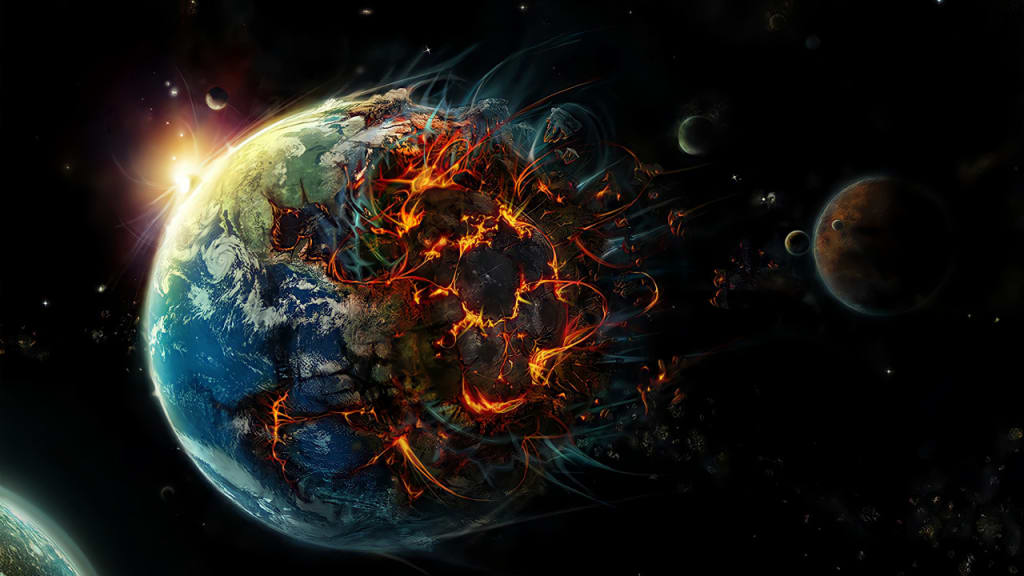
The Big Bang is the event that started our universe. Most people have heard of it, but what do you know about the Big Crunch? And now I'm not talking about a candy bar. I'm talking about scientists' beliefs about how our universe will one day come to an end. There is a range of theories, such as the Big Fries and the Big Rip, but the one that's considered most likely is the Big Crunch.
The Big Crunch Theory is rooted in Einstein's theory of general relativity. Everything in life follows an ebb and flow, when one event occurs the reverse is likely to occur after hitting the extreme. If the Big Bang caused the expansion of the universe then eventually the opposite will become true, once the universe has reached its largest size. As determined by the amount of energy that's present, it will begin to be collapsed in on itself and in the end form a massive black hole that contains all matter due to the conditions that are present in the singularity of its size. So probably not great news for those who are a class or bacon lovers - it's good news for you!
The math suggests that the Big Crunch is possible and even probable. However, there is a problem for those who dedicate their careers to understanding questions like this: we don't yet fully comprehend everything in the universe. There are a couple of unknowns that will affect our ultimate fate. First, the universe's expansion appears to be the interplay of two factors: density and outward momentum. Density has a direct correlation with the amount of gravity that is present, so the denser the universe is, the more gravitational forces that take place. This on its own would mean that everything will eventually gravitate towards everything else and the final Big Crunch becomes an inevitability. Although there's no friction in space, the effect of gravity would be more than enough to counteract the initial outward momentum caused by the Big Bang and all matter would essentially return to where come from--the problem with this is that observations of the universe have shown that things aren't behaving as simply as we would expect. For example, outer reaches appear to be expanding at a faster rate than those closer to us, and galaxies are moving further apart from each other. Scientists don't know why this is happening, but they have given a name to this unknown entity: dark energy.
The extra element in the expansion of the universe means that there are two possible outcomes - either the universe will continue to expand forever and objects will be so far apart from each other that everything will freeze, or it will eventually contract back together again. If there is enough dark energy present, some scientists believe it could mean the universe will continue to expand indefinitely. Otherwise, gravity will eventually overcome and bring everything back together again.
When reading a page, its layout can distract a reader from its readable content. In contrast to using 'Content here, content here', Lorem Ipsum has a more-or-less normal distribution of letters, making it look like readable English. Lorem Ipsum is now used as the default model text in many desktop publishing packages and web page editors, and a search for lorem ipsum will reveal many still in their infancy websites. However, a report released in 2015 suggests that the current increase in rates of expansion is the last gasp of the expanding universe - and that within tens of billions of years, the contraction will begin so that there won't be enough dark energy and that the Big Crunch does take place then it won't be as spectacular as the Big Bang was. The universe will begin to contract evenly over time due to matter's more or less consistent distribution; it would be a slow process for what begins to gradually pick up in speed as galaxies get closer to one another and gravity has more of an effect in about 100 billion years from now. And at some point, temperatures would significantly increase, resulting in stars exploding and everything being broken down into their constituent atoms which themselves will begin to break apart in the final stages. In the end, all matter from the universe will compact into a small space and things will become chaotic - to such an extent that some predictions suggest space-time might shatter into droplets meaning all concepts of time distance, and direction might become meaningless. No living organism would have been able to survive this far - let alone make it through the final stages.
We don't fully understand the universe's process, so we can't predict how it will end. One possibility is the Big Crunch, where all matter returns to its origin and leaves a massive black hole. What happens next is unknown, and it could lead to a new universe. This cycle may have already happened multiple times. Only those living for billions of years need to worry about this.
About the Creator
Keep reading
More stories from writers in Earth and other communities.
Magnetic Magma earth
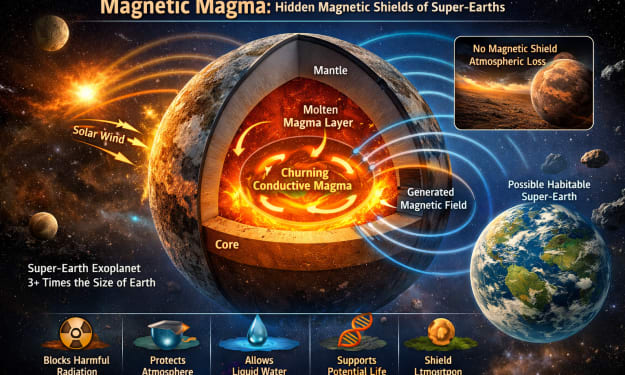
Super-Earths are rocky exoplanets more than three times the size of our planet, with far greater internal pressures and temperatures. For years, scientists assumed that if these worlds had magnetic fields, they would form the same way Earth’s does — through movement in a molten iron core. However, new laboratory experiments suggest something very different may be happening deep inside these massive planets. Under extreme pressure, certain molten rocks become electrically conductive. When these materials churn and circulate between the core and the mantle, they can generate magnetic fields on their own. This means a super-Earth might not rely solely on its core for protection. Instead, a thick, dynamic layer of magma could act as a natural magnetic shield, powered by internal heat and motion.
By USA daily update 6 days ago in Earth
Media: The Amplifier of Injustice
Media does not report reality. It selects, compresses, and amplifies fragments of it according to incentives largely unrelated to truth. What reaches the public is not an account of events; it is an engineered sequence designed to capture attention, provoke reaction, and sustain engagement.
By Meridian Vox3 days ago in Earth



Comments
There are no comments for this story
Be the first to respond and start the conversation.