
How to Breathe on Mars
A metaphorical piece about learning to adapt to life’s impossible circumstances — using space imagery as emotional language.
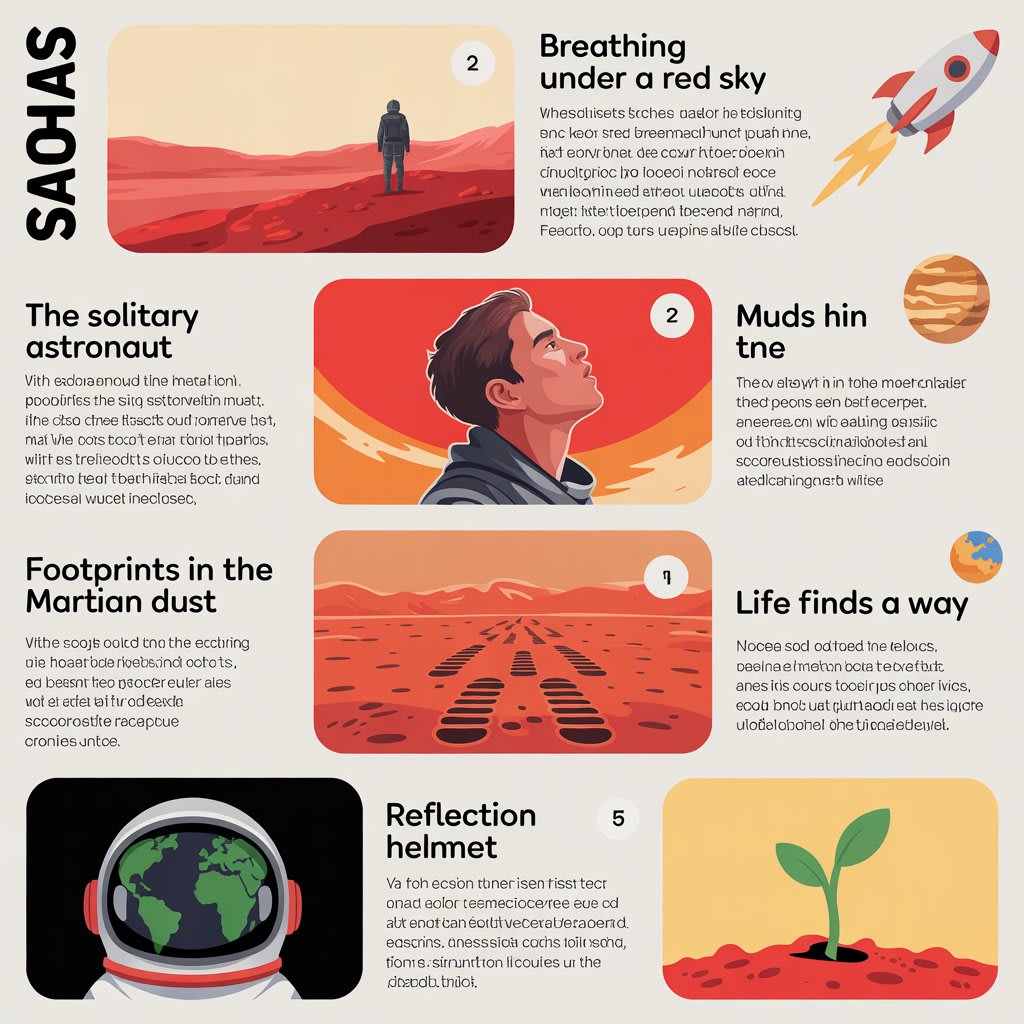
How to Breathe on Mars
When I first landed on Mars, no one told me how quiet it would be.
Not the kind of quiet that soothes, but the kind that presses against your chest until you start counting your own breaths just to prove you’re still there.
The textbooks called it “the soundless frontier.” They wrote about dust storms, oxygen ratios, and solar radiation, but they never mentioned how loneliness echoes when there’s no air to carry it. They never told me that the hardest part of surviving here wouldn’t be the thin atmosphere — it would be learning how to breathe again when everything familiar has been stripped away.
On Earth, I used to wake up to the sound of cars, coffee machines, and my neighbor’s dog barking at invisible things. I used to breathe without thinking — fast, shallow breaths between meetings and traffic lights. I used to think breathing was simple: in, out, done.
But now, on this planet where air itself feels borrowed, I’ve learned that breathing isn’t a reflex. It’s an act of faith.
When I arrived, the airlock hissed open like an exhale from some ancient god. My suit’s oxygen levels blinked red for a moment before stabilizing, and I thought, this is it — this is what it feels like to start over. The landscape stretched endlessly: a burnt sienna horizon smeared with dust, mountains that looked like the skeletons of forgotten giants, and a sky the color of diluted rust.
I felt small.
Smaller than I’d ever been.
Smaller even than my regrets.
They say Mars has no sound, but that’s not true. You can still hear things if you listen long enough — your own pulse, the hum of your oxygen recycler, the distant crunch of your boots against powdered rock. Sometimes, I imagine those sounds as a heartbeat for the planet itself. Maybe Mars isn’t lifeless. Maybe it’s just holding its breath, waiting for someone to notice.
In the beginning, I couldn’t sleep. Every time I closed my eyes, I dreamed of drowning in thin air. I’d wake gasping, clawing at my helmet, my lungs begging for something they couldn’t name. That’s when I started writing.
I wrote letters to no one:
Dear Earth, I miss your gravity. I miss the way it held me down when I was falling apart.
Dear Past Me, you were never running out of air — you were just afraid to inhale.
Dear Future Me, if you’re still breathing, that means you survived this.
Each word became a breath I didn’t know how to take. Each sentence, a lungful of meaning in a place that had none.
After a while, I learned how to make my oxygen last longer. Not by changing the tanks — by changing myself. I slowed down. I stopped fighting the silence. I learned to match my breathing to the rhythm of the dust storms, to feel their slow, cyclical power instead of fearing it.
You can’t rush survival here. Mars punishes impatience. If you try to inhale too quickly, the air bites back, and your lungs ache with the reminder that you’re a foreigner in your own skin.
So I practiced stillness. I watched how the sun crawled across the rocks, how shadows stretched like elastic, reaching for warmth. I realized that life doesn’t need much to exist — just enough space to expand. Maybe that’s what breathing really is: making space for yourself in a world that doesn’t know how to hold you.
Sometimes, I think of you.
Back on Earth, you used to tell me I held my breath when I was anxious. You’d place your hand over my heart and whisper, “Breathe, love. There’s room for you here.”
I didn’t understand it then. I thought you meant oxygen, comfort, safety. But now, I know what you meant. You were teaching me how to live somewhere that doesn’t want me — even if that place was my own mind.
Mars feels like that sometimes. A body that rejects you but can’t quite push you out.
Still, every morning, I wake up and tell myself: breathe anyway.
They’ll send others after me — explorers, dreamers, the lonely ones who believe that survival is a kind of poetry. Maybe they’ll build domes and gardens, fill them with laughter and oxygen, and call it progress. But for me, the real discovery was quieter.
I learned that breathing isn’t just about air.
It’s about permission.
It’s about saying, I deserve to exist here, even when every molecule around you disagrees.
And maybe that’s what it means to live — on Mars, on Earth, or anywhere in between. To wake up in an impossible place, lungs aching, heart uncertain, and whisper into the silence:
“I’m still here.”
And then, slowly, gently — inhale.
About the Creator
Tatt~Master
— Assembly Line Tatt Machine ~ Impressions to Impress — As I begin to understand more about the Tattoo Phenomenon. I've written silly, yet verbatim, dating site anecdotes in 'Frazzled.' So let me ask you: Would you be More attracted to someone slathered with tattoos, or Less?
By Jay Kantor2 days ago in Humor


Comments
There are no comments for this story
Be the first to respond and start the conversation.