
How submarines Navigate underwater.
Submarines are remarkable engineering marvels designed to operate beneath the ocean’s surface for extended periods.

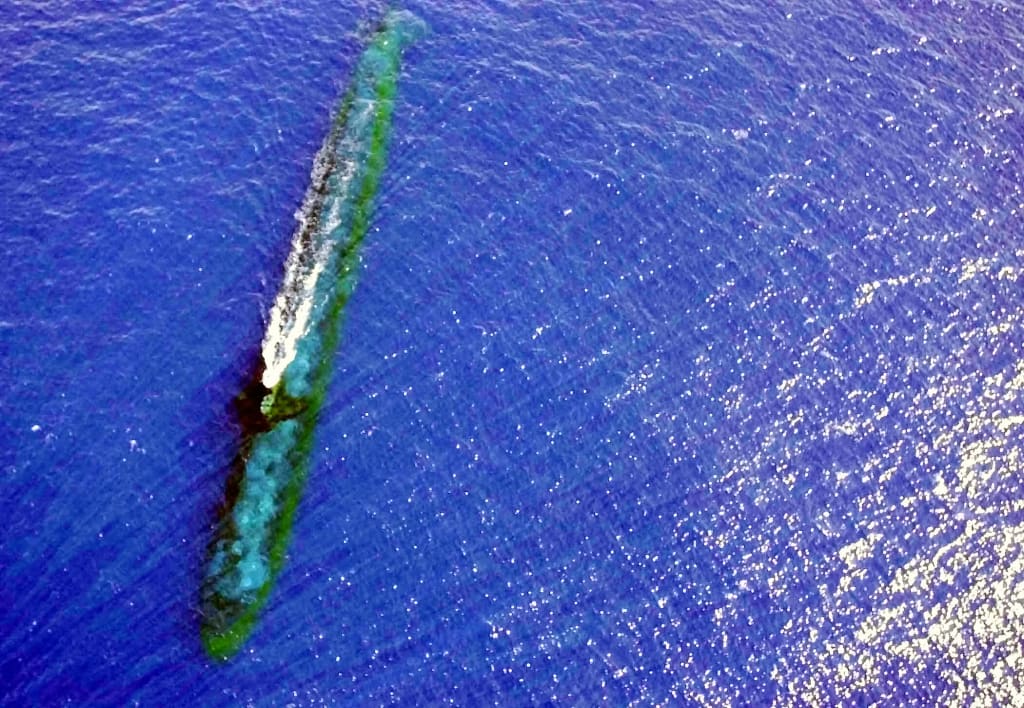
Surface vessels, they cannot rely on landmarks, celestial navigation, or GPS (which has limited underwater functionality). Instead, submarines utilize a combination of advanced technologies, sensors, and manual techniques to determine their position and safely navigate through the depths. This article explores the key navigation methods used by submarines, including inertial navigation systems (INS), sonar, dead reckoning, and communication with external sources.
(I)Inertial Navigation System (INS)
One of the primary methods submarines use for underwater navigation is the Inertial Navigation System (INS). INS relies on accelerometers and gyroscopes to measure the submarine’s movement from a known starting position. Since these systems do not rely on external signals, they provide a crucial advantage by allowing continuous navigation even when GPS or other external positioning methods are unavailable.
How INS Works:
- At the start of a mission, the submarine’s initial position is determined using GPS or other surface-based methods.
- Once submerged, accelerometers measure changes in velocity along different axes, while gyroscopes track the direction of movement.
- A computer processes this data to update the submarine’s position over time.
Since minor errors can accumulate over long periods (a phenomenon known as drift), submarines periodically correct their position using other navigation methods.
(II)Sonar (Sound Navigation and Ranging)
Sonar is essential for detecting obstacles, mapping the seafloor, and determining the submarine’s position relative to known underwater features.
Types of Sonar:
- Active Sonar: The submarine emits sound waves and listens for the echoes that bounce off objects. By calculating the time taken for the sound waves to return, the system determines the distance and shape of obstacles.
- Passive Sonar: Instead of emitting sound, passive sonar listens for sounds produced by other vessels or natural underwater phenomena. This method is stealthier since it does not reveal the submarine’s position to potential adversaries.
- Sonar is particularly useful for submarines navigating through complex underwater environments where other navigation methods may be less effective.
(III)Dead Reckoning
Dead reckoning is a traditional navigation technique that estimates position based on previously known locations, speed, time, and direction of travel.
Dead Reckoning Process:
The submarine begins from a known location.
The direction of movement (measured using a compass or gyroscopes) and speed (measured using a Doppler velocity log) are recorded over time.
Using these values, the new estimated position is calculated.
Although dead reckoning is simple and does not require external signals, it is prone to errors over time. Factors like ocean currents and inaccuracies in speed measurements can lead to significant deviations, making it necessary to correct the estimated position using other navigation aids periodically.
(IV)Doppler Velocity Log (DVL)
A Doppler Velocity Log (DVL) is a sonar-based instrument used to measure a submarine’s velocity relative to the ocean floor. It helps improve the accuracy of dead reckoning and inertial navigation by providing precise speed measurements.
How DVL Works:
The DVL emits sound waves toward the ocean floor and measures the frequency shift in the returned signal (Doppler effect).
By analyzing this shift, the submarine determines its speed and direction of movement relative to the seabed.
The velocity data is then fed into the navigation system to refine position calculations.
DVL is highly effective in shallow and mid-depth waters but becomes less useful in very deep waters where the ocean floor is too far away for reliable readings.
(V)Satellite and Radio Navigation (When Near the Surface)
While submerged, submarines cannot access GPS signals directly because water blocks radio waves. However, when near the surface, submarines can briefly extend a periscope or an antenna to receive GPS signals and update their navigation systems.
Additionally, submarines can use Very Low Frequency (VLF) and Extremely Low Frequency (ELF) radio waves, which penetrate water to some extent, allowing limited communication with external sources. These signals can be used to receive positioning updates from friendly naval assets.
(VI)Magnetometers and Gravity Anomaly Maps
Some advanced submarines utilize magnetometers to detect variations in Earth’s magnetic field, helping to refine their navigation. Additionally, gravity anomaly maps, which show variations in the Earth’s gravitational field due to underwater terrain differences, can be used to aid positioning.
(VII)Navigating in Different Environments
Shallow Waters:
In coastal and shallow areas, submarines face greater risks of collision with the seafloor, underwater structures, or other vessels. They rely more heavily on sonar, charts, and careful maneuvering.
Deep Ocean:
In deep waters, submarines primarily depend on INS, dead reckoning, and occasional DVL readings to maintain accurate positioning. Since there are fewer obstacles, deep-sea navigation is generally safer, but positional errors can accumulate over long journeys.
Conclusion
Submarines navigate underwater using a combination of advanced technologies and traditional techniques. The Inertial Navigation System (INS) serves as the backbone, supplemented by sonar, dead reckoning, Doppler Velocity Logs, and occasional surface GPS updates. These methods work together to ensure submarines can operate effectively, whether patrolling shallow waters, deep oceans, or executing complex military operations.
About the Creator
Badhan Sen
Myself Badhan, I am a professional writer.I like to share some stories with my friends.
Keep reading
More stories from Badhan Sen and writers in Earth and other communities.
The history of the pyramids.
The pyramids of Egypt structures, built thousands of years ago, continue to capture the imagination of historians, archaeologists, and tourists alike. The history of the pyramids is a story of architectural innovation, religious beliefs, and the powerful rulers who commissioned them. From the early step pyramids to the magnificent Great Pyramid of Giza, the evolution of pyramid construction reflects the ingenuity and ambition of the ancient Egyptians.
By Badhan Sen12 months ago in Earth
Denmark and Greenland Prepare for US Talks as Trump Says Territory’s PM Has a ‘Big Problem’
Denmark and Greenland are preparing for crucial talks with the United States amid renewed diplomatic tension, after former US President Donald Trump claimed that Greenland’s prime minister has a “big problem.” The remarks, reported as part of ongoing European political coverage, have drawn attention to the fragile balance between diplomacy, sovereignty, and strategic interests in the Arctic. As delegations ready themselves for discussions in Washington, the episode underscores how Greenland has once again become a focal point in global geopolitics.
By Aarif Lashari4 days ago in Earth



Comments (1)
What a great article on the science behind and of submarines. Good job.