

During long plane flights, I often find myself gazing at the vast mountains and deserts, trying to comprehend the immense size of our Earth. In those moments, I am reminded of the sun, an object we see daily, which could contain one million Earths within it. The sun's enormity is staggering, yet in the grand scheme, it is just one of around 400 billion stars in the Milky Way galaxy. On clear nights, we can observe the Milky Way as a pale, white mist stretching across the sky. The magnitude grows even more astonishing when we consider that there are approximately 100 billion detectable galaxies in the universe. If each star were akin to a grain of sand, the Milky Way alone could fill a 30-foot by 30-foot stretch of beach, three feet deep with sand. Such is the scale of the cosmos that the entire Earth cannot represent the multitude of stars it holds. A beach symbolizing all the stars in the universe would extend for hundreds of millions of miles.
These mind-boggling numbers, however, only scratch the surface of the unfathomable vastness of reality. Physicists, including the late Stephen Hawking, now contemplate a reality that surpasses our comprehension. The 100 billion galaxies within our telescopic range likely constitute a minuscule fraction of the total number. Space itself is expanding at an accelerating pace, causing most galaxies to drift away from us at such velocity that their light may never reach our eyes. Yet, despite their distance, these distant galaxies are intricately connected to our physical
During long plane flights, I often find myself gazing at the vast mountains and deserts, trying to comprehend the immense size of our Earth. In those moments, I am reminded of the sun, an object we see daily, which could contain one million Earths within it. The sun's enormity is staggering, yet in the grand scheme, it is just one of around 400 billion stars in the Milky Way galaxy. On clear nights, we can observe the Milky Way as a pale, white mist stretching across the sky. The magnitude grows even more astonishing when we consider that there are approximately 100 billion detectable galaxies in the universe. If each star were akin to a grain of sand, the Milky Way alone could fill a 30-foot by 30-foot stretch of beach, three feet deep with sand. Such is the scale of the cosmos that the entire Earth cannot represent the multitude of stars it holds. A beach symbolizing all the stars in the universe would extend for hundreds of millions of miles.
These mind-boggling numbers, however, only scratch the surface of the unfathomable vastness of reality. Physicists, including the late Stephen Hawking, now contemplate a reality that surpasses our comprehension. The 100 billion galaxies within our telescopic range likely constitute a minuscule fraction of the total number. Space itself is expanding at an accelerating pace, causing most galaxies to drift away from us at such velocity that their light may never reach our eyes. Yet, despite their distance, these distant galaxies are intricately connected to our physical
During long plane flights, I often find myself gazing at the vast mountains and deserts, trying to comprehend the immense size of our Earth. In those moments, I am reminded of the sun, an object we see daily, which could contain one million Earths within it. The sun's enormity is staggering, yet in the grand scheme, it is just one of around 400 billion stars in the Milky Way galaxy. On clear nights, we can observe the Milky Way as a pale, white mist stretching across the sky. The magnitude grows even more astonishing when we consider that there are approximately 100 billion detectable galaxies in the universe. If each star were akin to a grain of sand, the Milky Way alone could fill a 30-foot by 30-foot stretch of beach, three feet deep with sand. Such is the scale of the cosmos that the entire Earth cannot represent the multitude of stars it holds. A beach symbolizing all the stars in the universe would extend for hundreds of millions of miles.
These mind-boggling numbers, however, only scratch the surface of the unfathomable vastness of reality. Physicists, including the late Stephen Hawking, now contemplate a reality that surpasses our comprehension. The 100 billion galaxies within our telescopic range likely constitute a minuscule fraction of the total number. Space itself is expanding at an accelerating pace, causing most galaxies to drift away from us at such velocity that their light may never reach our eyes. Yet, despite their distance, these distant galaxies are intricately connected to our physical
About the Creator
Microbiota, microbiome or microflora: how to speak correctly and why it is for health.
You've probably heard the phrase, "We are what we eat." But modern science says more precisely: we are also those who live in us. Until 2016, it was believed that there are many times more bacteria in our body than our own cells. The latest calculations by mathematicians show that we divide the body with our microorganisms by about 50/50: about 30 trillion of our cells versus 38 trillion bacterial ones.
By Yaroslav Gorohov3 days ago in Earth
Chinese EVs Closing In on America After Canadian Tariffs Deal
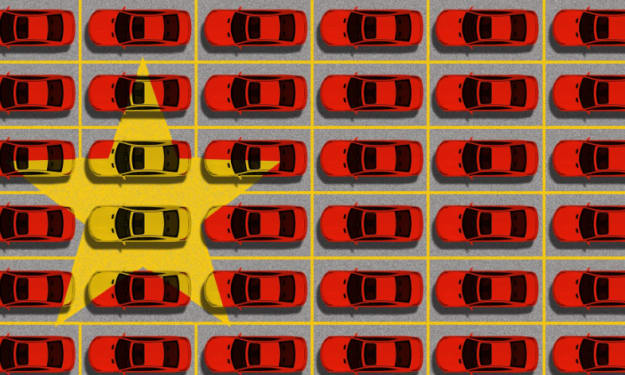
The electric vehicle race is no longer just about climate goals or consumer choice — it has become a geopolitical contest. And in early 2026, a subtle but powerful move by Canada may have tilted the board. By agreeing to sharply reduce tariffs on Chinese electric vehicles, Canada has opened a door that the United States has worked hard to keep shut. While Chinese EVs are still largely barred from the American market, they are now edging closer than ever — not by crossing the border directly, but by entering through Canada. This development raises a pressing question: Are Chinese EVs closing in on America, and what does that mean for the future of North American auto markets? The Deal That Changed the Game Canada’s new agreement with China allows up to 49,000 Chinese-made electric vehicles per year to enter the Canadian market at a tariff rate of just over 6%, a dramatic drop from the previous 100% tariff that effectively blocked them. On paper, the quota seems small. In reality, it carries enormous symbolic and strategic weight. For years, both Canada and the United States aligned closely on keeping Chinese EVs out, citing concerns over unfair subsidies, national security, and the protection of domestic auto industries. This new deal marks a clear shift — and a divergence from U.S. policy. Canada didn’t make the decision in isolation. The EV tariff reduction was part of a broader trade reset with China, tied to agricultural exports such as canola and efforts to stabilize a strained economic relationship. Why Chinese EVs Matter So Much China is the undisputed leader of the global electric vehicle industry. Its manufacturers produce EVs at scale, often at prices Western automakers struggle to match. Brands like BYD, Nio, and Xpeng have already expanded aggressively into Europe, Southeast Asia, and parts of the Middle East. North America has remained one of the final fortified markets — until now. Chinese EVs are appealing not just because they’re cheaper, but because they’ve rapidly improved in quality, range, and technology. For consumers priced out of North American and European EV models, Chinese vehicles offer something rare: affordability without sacrificing features. Canada’s decision gives Chinese automakers their first legitimate foothold in North America — and footholds tend to grow. Why the U.S. Is Nervous The United States still enforces a 100% tariff on Chinese EV imports, making them effectively unsellable in the American market. But Canada’s move has triggered concern in Washington. U.S. officials argue that Chinese EVs entering Canada could indirectly pressure American markets, influence supply chains, and weaken Washington’s leverage in future trade negotiations. There’s also a political dimension. Both major U.S. parties have framed Chinese dominance in EVs as a strategic threat — not just to auto jobs, but to technological leadership. Modern EVs collect vast amounts of data, and lawmakers have raised concerns about cybersecurity and foreign data access. While Chinese EVs aren’t rolling onto American roads yet, their presence just across the border changes the conversation. Canada’s Risk — and Opportunity Inside Canada, the reaction has been mixed. Automotive hubs like Ontario worry that opening the market could undermine domestic manufacturing and strain relations with the U.S., Canada’s largest trading partner. Some leaders have called the deal “lopsided,” warning it could cost jobs if American retaliation follows. Others see opportunity. A more competitive EV market could lower prices for Canadian consumers and accelerate EV adoption. It may also attract Chinese investment into Canada itself — including factories, battery plants, and supply chain partnerships. If Chinese automakers choose to build in Canada rather than simply export to it, the country could position itself as a bridge between Chinese EV innovation and North American demand. That balancing act — between economic opportunity and political risk — defines Canada’s strategy. Are Chinese EVs Really ‘Closing In’ on America? For now, the answer is: not directly — but strategically, yes. Chinese EVs sold in Canada won’t automatically flood the U.S. market. Regulations, trade rules, and tariffs still stand in the way. But proximity matters. Supply chains overlap. Consumer awareness spreads. Manufacturing footprints expand. There’s also the possibility of a workaround: Chinese companies could eventually build EVs in North America to bypass tariffs altogether. This idea has already been floated — but it faces fierce resistance from U.S. lawmakers and unions. Still, history shows that once a global industry leader gains regional access, momentum often follows. What This Means for Consumers For Canadian buyers, the impact could be immediate: more choice and lower prices in an EV market that has long been criticized for being expensive and limited. For American consumers, the effect will be indirect — at least at first. But increased competition could eventually pressure U.S. automakers to reduce prices, improve features, and accelerate innovation. The larger question is whether North America wants competition or insulation — and how long insulation can realistically last in a globalized EV economy. The Bigger Picture: A Global EV Power Shift Canada’s tariff deal reflects a broader reality: China’s dominance in electric vehicles is reshaping global trade, whether governments like it or not. Europe is already grappling with an influx of Chinese EVs. Emerging markets are embracing them. And now, North America has its first real crack in the wall. This isn’t just about cars. It’s about who controls the future of clean transportation, supply chains, and industrial policy. Final Thoughts Chinese EVs aren’t driving down American highways yet — but after Canada’s tariff deal, they’re closer than ever. This move doesn’t spell immediate disruption, but it does signal a shift. One country has decided that economic pragmatism outweighs political alignment. And in doing so, Canada may have opened the door to a new phase of EV competition in North America. Whether that door swings wider — or slams shut — will depend on how the U.S., automakers, and consumers respond. One thing is certain: the EV race just entered a new chapter.
By Muhammad Hassana day ago in Earth



Comments
There are no comments for this story
Be the first to respond and start the conversation.