
How animals adapt to their environment.
Animals have evolved a diverse range of adaptations to survive and thrive in their respective environments.

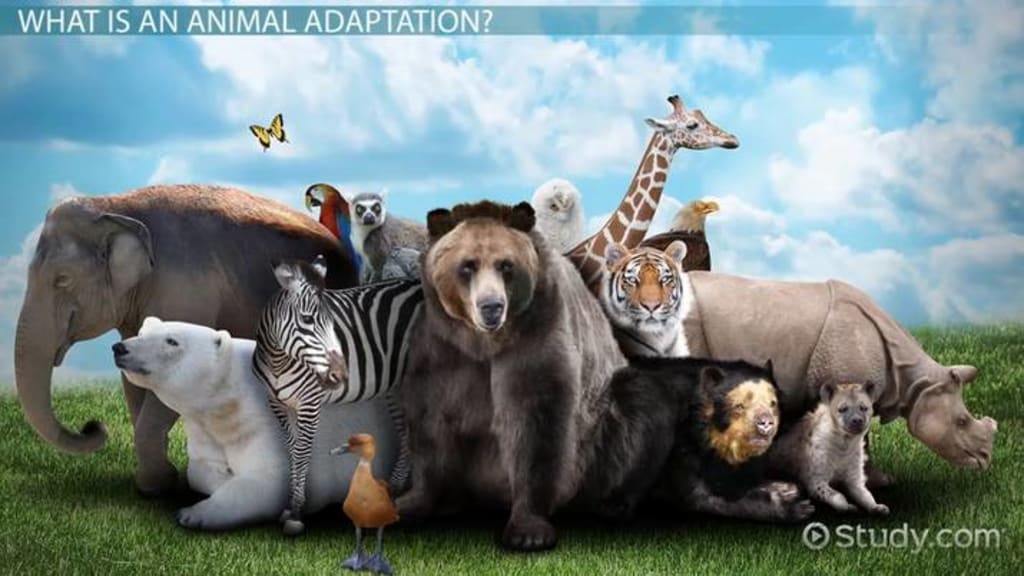
Animal adaptations can be structural, behavioral, or physiological, allowing animals to obtain food, avoid predators, reproduce, and cope with changing conditions. This essay explores the various ways in which animals adapt to their environments, providing examples across different habitats, including deserts, polar regions, forests, and aquatic ecosystems.
Structural Adaptations
Structural adaptations refer to physical features that enhance an animal's survival. These include body coverings, specialized limbs, and other morphological traits that aid in movement, feeding, and protection.
Camouflage and Mimicry: Many animals develop coloration that helps them blend into their environment. For example, the Arctic fox changes its fur color from brown in summer to white in winter to match the snowy landscape. Similarly, stick insects resemble twigs, making them less visible to predators.
Body Coverings: Fur, feathers, scales, and skin help animals adapt to different climates. Polar bears have thick fur and a layer of blubber to insulate against extreme cold, while desert reptiles have scales that minimize water loss.
Specialized Limbs: Animals living in specific environments often have unique limb structures. For instance, webbed feet help aquatic animals like ducks and frogs swim efficiently, while tree-dwelling primates have prehensile tails for grasping branches.
Behavioral Adaptations
Behavioral adaptations involve changes in the way animals act to survive in their environment. These can include migration, hibernation, hunting techniques, and social behaviors.
Migration: Some animals travel long distances in response to seasonal changes.
Hibernation and Estivation: To survive extreme temperatures, some animals enter a state of dormancy. Bears hibernate during winter to conserve energy, while desert amphibians like the spadefoot toad estivate underground during dry periods.
Social Structures: Many animals form groups for survival advantages. Wolves hunt in packs to take down large prey, while meerkats live in communities where individuals take turns standing guard for predators.
Physiological Adaptations
Physiological adaptations involve internal body processes that help animals survive in their environment. These include temperature regulation, water conservation, and metabolic adjustments.
Thermoregulation: Some animals regulate their body temperature through physiological means. Jackrabbits, for example, have large ears that dissipate heat in hot desert climates.
Water Conservation: Desert animals like camels can survive long periods without water by storing fat in their humps, which can be metabolized for hydration. Kangaroo rats obtain moisture from their food, reducing their need for drinking water.
Oxygen Adaptation: Animals living at high altitudes, such as snow leopards and Andean condors, have adapted to low oxygen levels by having larger lungs and more efficient blood circulation.
Adaptations in Different Environments
Different habitats present unique challenges, and animals have evolved specific adaptations to overcome them.
Desert Adaptations: In arid regions, animals have adapted to extreme heat and water scarcity. The fennec fox has large ears for heat dissipation, and nocturnal habits help many desert species avoid daytime temperatures.
Polar Adaptations: Animals in icy habitats need to conserve heat. Seals have thick blubber for insulation, and penguins huddle together to retain warmth.
Forest Adaptations: Rainforest animals often exhibit adaptations for climbing, such as the prehensile tails of monkeys and sticky pads on frog feet. The bright coloration of poison dart frogs serves as a warning to predators about their toxicity.
Aquatic Adaptations: Marine animals have streamlined bodies to reduce water resistance. Dolphins and whales have blowholes for breathing at the surface, while fish use gills to extract oxygen from water.
Conclusion
Animals have developed a vast array of adaptations that allow them to survive in their respective environments. These adaptations can be structural, behavioral, or physiological and are crucial for finding food, escaping predators, and coping with extreme conditions. Understanding these adaptations provides insight into the resilience and diversity of life on Earth. As environmental changes accelerate due to human activities, studying animal adaptations becomes even more important for conservation and biodiversity efforts.
About the Creator
Badhan Sen
Myself Badhan, I am a professional writer.I like to share some stories with my friends.
Keep reading
More stories from Badhan Sen and writers in Earth and other communities.
Why seasons change.
The changing of seasons is one of the most remarkable natural phenomena on Earth. But why do seasons change? The answer lies in the Earth’s axial tilt, its orbit around the Sun, and the way sunlight reaches different parts of the globe at various times of the year.
By Badhan Sen12 months ago in Earth
Europe Amniotic Membrane Market Size & Forecast 2025–2033
Europe Amniotic Membrane Market Outlook The Europe Amniotic Membrane Market is undergoing a significant transformation as regenerative medicine gains momentum across clinical disciplines. According to Renub Research, the market is projected to grow from US$ 788.42 million in 2024 to US$ 1,892.79 million by 2033, expanding at a CAGR of 10.22% during 2025–2033.
By jaiklin Fanandish4 days ago in Earth


Comments (2)
Hello, just wanna let you know that if we use AI, then we have to choose the AI-Generated tag before publishing 😊
What a great Animal behaviorism lecture.