
Himalayas
Geography, geology, and natural resources of the Himalayas; cultural and spiritual significance; economic importance and challenges; biodiversity and ecological challenges; natural disasters and geopolitical tensions.

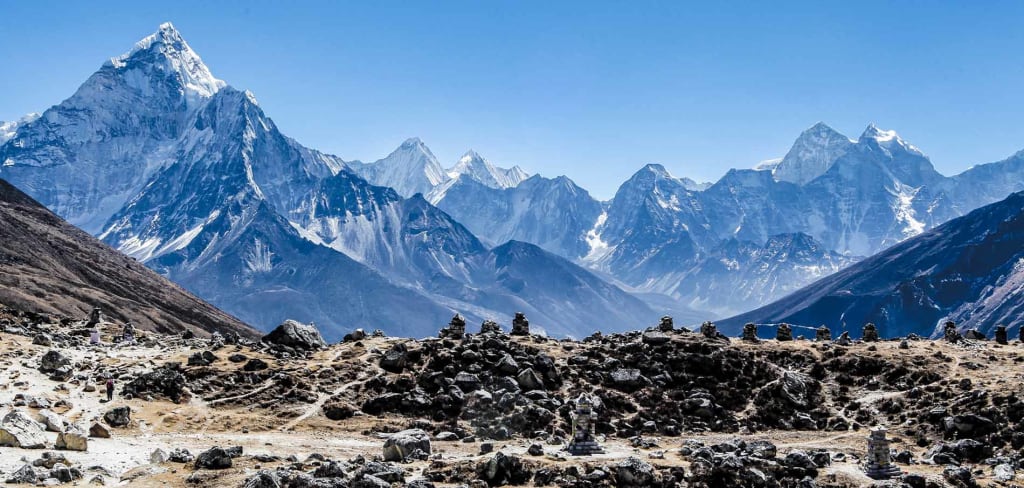
The Himalayas is a mountain range located in South Asia, spanning across five countries: India, Nepal, Bhutan, Tibet (China), and Pakistan. It is the highest and most extensive mountain range in the world, stretching over 2,400 km (1,500 miles) and covering an area of 595,000 square kilometers (230,000 square miles).
The Himalayas are home to several of the world's highest peaks, including Mount Everest, which stands at 8,848 meters (29,029 feet), as well as other peaks such as K2, Kangchenjunga, Lhotse, and Makalu. The range is also the source of many of the world's major rivers, including the Ganges, the Indus, and the Brahmaputra.
The Himalayas are known for their unique and diverse ecosystems, including alpine meadows, subtropical forests, and high-altitude deserts. The range is also home to a rich cultural heritage, with various indigenous communities living in the region, including the Sherpas, Tibetans, and Bhutanese.
Despite their natural beauty and cultural importance, the Himalayas face several environmental challenges, including deforestation, climate change, and overexploitation of natural resources. These challenges have significant implications for the region's ecosystems and the communities that depend on them.
The Himalayas are the result of the collision between the Indian Plate and the Eurasian Plate. The collision began around 50 million years ago and is still ongoing, causing the Himalayas to continue to rise at a rate of approximately 5 mm per year. The movement of these plates has created the unique geological features of the region, including deep gorges, high peaks, and rugged terrain.
The Himalayas have significant economic importance for the region. The range is home to several valuable resources, including minerals such as iron, copper, and gold, as well as hydroelectric power potential. The mountains also provide important ecosystem services, including freshwater and soil conservation, which support the agricultural communities that live in the region.
However, the region is also prone to natural disasters, such as earthquakes, landslides, and avalanches, which can have devastating effects on local communities. In recent years, the Himalayas have also been affected by climate change, with rising temperatures and melting glaciers leading to changes in the region's hydrological systems and impacts on the people and ecosystems that depend on them.
Tourism is also an important industry in the Himalayas, with millions of visitors every year drawn to the natural beauty of the region and the opportunity to trek and climb some of the world's highest peaks. However, the increasing number of tourists also brings challenges in terms of managing waste and ensuring sustainable development in the region.
In summary, the Himalayas are a unique and diverse region with significant cultural, ecological, and economic importance for the countries and communities that live in and around the range. However, the region also faces several challenges, including environmental degradation, natural disasters, and the need to balance economic development with sustainable practices.
The Himalayas are home to a rich and diverse array of flora and fauna, with over 10,000 plant species and 300 species of mammals, including snow leopards, Himalayan bears, and Tibetan wolves. The region is also home to over 500 bird species, including the Himalayan monal and the elusive spiny babbler. The unique biodiversity of the region has been shaped by the range's complex topography, which provides a variety of habitats, from alpine meadows to subtropical forests.
The Himalayas also have significant cultural and spiritual importance, with various religions and belief systems coexisting in the region. The range is home to several pilgrimage sites, including Mount Kailash, considered sacred by Hindus, Buddhists, Jains, and Bon practitioners. The region is also known for its rich history of art and architecture, including intricate wood carvings, thangka paintings, and traditional crafts such as weaving and pottery.
In recent years, the Himalayas have also faced geopolitical tensions, with territorial disputes between India and China, and ongoing conflict in regions such as Kashmir. These tensions have significant implications for the communities that live in the region, as well as for the natural resources and ecosystems of the Himalayas.
Overall, the Himalayas represent a complex and dynamic region with significant ecological, cultural, and geopolitical importance. The challenges facing the region, from environmental degradation to political tensions, highlight the need for concerted efforts to ensure the sustainable development and conservation of this unique and valuable region.
About the Creator
High-Speed Train Crash in Southern Spain Leaves at Least 21 Dead
A devastating high-speed train crash in southern Spain has left at least 21 people dead and dozens injured, shocking the nation and triggering a major emergency response. The incident, which occurred on a busy rail route connecting key southern cities, has reignited concerns over railway safety, infrastructure maintenance, and emergency preparedness in one of Europe’s most advanced rail networks.
By Aarif Lashari2 days ago in Earth
Icy Chaos in Central and Eastern Europe
Winter has unleashed its fury across central and eastern Europe, leaving travelers frustrated and transport networks struggling to keep up. Over the past few days, freezing rain and ice have wreaked havoc on airports, train stations, and highways — forcing flight diversions, delaying trains, and making roads treacherously slippery. From Vienna to Budapest, Prague to Bratislava, this icy grip has brought travel to a near standstill. Let’s take a closer look at what’s happening, how it’s affecting people on the move, and what it tells us about winter travel in Europe. A Sudden Winter Blow A sudden wave of freezing rain swept across the region, coating runways, rail tracks, and roads with a dangerous layer of ice. Major airports in Austria, Hungary, Slovakia, and the Czech Republic were particularly affected. At Vienna International Airport, operations were temporarily suspended when runways became too slick for flights to land safely. Travelers already in the air had to divert to alternative airports in Munich, Frankfurt, and Venice. Meanwhile, Budapest’s Ferenc Liszt International Airport paused all arrivals and departures, and Prague’s Václav Havel Airport continued operating but at limited capacity. Trains Crawling Through Ice Rail networks weren’t spared. Across Austria, Hungary, and the Czech Republic, ice on tracks and power lines caused delays and cancellations. Austria’s national rail operator, ÖBB, urged passengers to postpone non-essential journeys. In the Czech Republic, travelers at Prague’s main station faced long waits as trains struggled to maintain schedules. Hungary’s tram and suburban rail services were temporarily suspended due to ice buildup on power lines. This combination of black ice, frozen switches, and heavy snowfall has tested the limits of winter infrastructure in Europe. Roads Turn Into Skating Rinks The icy weather didn’t just affect public transport — roads became treacherous, too. Authorities in Slovakia and the Czech Republic warned residents to avoid non-essential travel as highways turned into slippery skating rinks. Accidents and minor collisions were reported, and emergency services were busy responding to dozens of injuries from slips and falls. Even schools weren’t immune: parts of Romania shifted to online learning, keeping children safe during the extreme temperatures, which dropped to around -13°C in some areas. Why This Weather Is So Disruptive Meteorologists point to several factors that made this storm particularly severe: Freezing rain on top of existing snow creates an icy layer that’s extremely hard to clear. Rapidly refreezing surfaces make conditions unpredictable. Temperatures hovering around freezing prevent efficient melting during the day. This “perfect storm” scenario underscores just how vulnerable transport systems are to extreme weather. Even well-prepared airports and rail networks can struggle when weather transitions from snow to freezing rain. Voices From the Ground Passengers took to social media to express their frustration: Crowded airports as travelers scrambled to rebook flights. Train stations packed with delayed commuters, unsure when the next train would depart. Warming centers opened to provide shelter and hot drinks for stranded travelers. For many, a simple trip turned into a test of patience and resilience. Tips for Traveling in Freezing Conditions If you must travel during winter storms, experts recommend: Check flight and train schedules regularly, as delays can change quickly. Allow extra time for travel to avoid missing connections. Consider travel insurance that covers weather-related disruptions. If driving, carry winter essentials: blankets, food, water, and check road conditions before departure. Most importantly, prioritize safety over schedules — icy conditions can change rapidly, making travel risky. A Reminder From Winter This recent chaos in central and eastern Europe serves as a stark reminder of how interconnected transport systems are, and how vulnerable they can be to extreme weather. Flights grounded, trains stalled, and highways turned icy show that winter can bring travel to a halt — sometimes with very little warning. As Europe continues to face volatile winter conditions, travelers and authorities alike are reminded: preparation and flexibility are key. Sometimes, the weather truly has the final say. ❄️🛫🚆
By Muhammad Hassan7 days ago in Earth
Smart phones, Humans and Aliens.
WARNING. I will be tapping into one of your favorite creative tensions: The absurdity of humans worshipping their glowing rectangles as if they were tiny oracles. There’s something deliciously poetic about that contradiction, and it lends itself beautifully to an instructive proviso.
By Novel Allen4 days ago in Poets


Comments
There are no comments for this story
Be the first to respond and start the conversation.