
Greek whale strands dead, humans are to blame
cause of death for whales

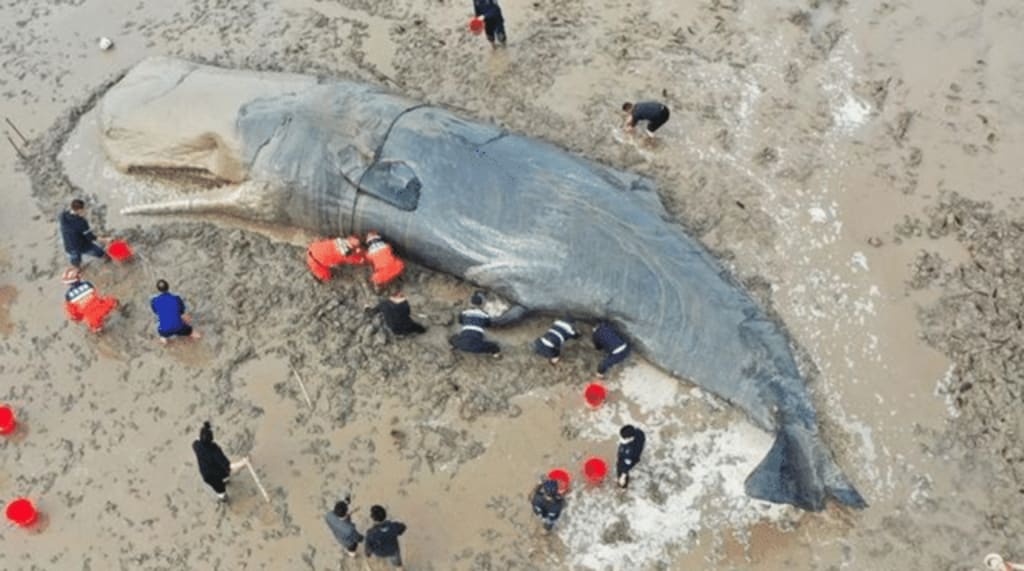
There are some very special creatures in the ocean, such as whales. Although we call them whales, they are not real fish. Unlike fish, whales are aquatic mammals. That said, whales are viviparous and breathe with lungs, and they need to surface frequently for air. Because whales are so large that they cannot survive in shallow waters, these whales can be life-threatening if they become stranded on the coast. For example, on April 19, 2022, a huge sperm whale was stranded on the coast in the waters of Xiangshan County, Ningbo. Because the sperm whale was over 19 meters long and weighed 70 tons, it was very difficult to rescue the sperm whale. Fortunately, with the efforts of rescuers, the sperm whale stranded on the coast finally returned to the sea safely.
Whale stranded in Greece dies
It is very lucky for whales to be able to return to the ocean again after being stranded on the beach. You must know that if you cannot return to the ocean in time, the only thing waiting for whales is death. No, a huge whale ran aground on the beach in Greece, and when it was found, it was already dead.
According to a report on May 6, 2022, on May 2, 2022 local time, a Cuvier's beaked whale with a length of about 5.3 meters was found on Kremasti Beach, Rhode Island, Greece. When it was found already dead. So, really sorry.
After the discovery of the whale carcass, Anastasia Komninou, a professor at the Faculty of Veterinary Medicine of Aristotle University of Thessaloniki, and other staff conducted a preliminary autopsy on the whale and found it. The reason for the death of a huge whale, we humans are the culprits of its death, what is going on?
It turned out that during the autopsy, the staff found that there was more than 15 kilograms of plastic waste in the whale's stomach. Anastasia Comninu said that for Cuvier's beaked whales and other whales, because swallowing It is not uncommon for people to die from plastic waste, or to have long-term harmful effects on their health as a result. When these whales swallow a large amount of plastic waste, the plastic waste accumulated in the whales' stomachs will make these whales unable to eat normally, and eventually lead to cachexia or even death of the whales.
It stands to reason that there is no such thing as plastic waste on the earth itself, so there should not be plastic waste and plastic particles in marine organisms including whales. However, with the development of human society, we mass production and use of plastic Some plastic wastes may be processed, and some plastic wastes will flow into the sea through groundwater and rivers if they cannot be completely processed. When these plastic wastes enter the sea, they may be swallowed by marine creatures such as whales, and these plastic wastes themselves are difficult to digest, which will eventually pose a threat to these marine animals that swallow plastic wastes. .
This is not the most worrying thing, because after these plastic wastes flow into marine animals, they will flow towards the top of the food chain through the food chain. We humans are one of the species at the top of the food chain on the planet. Our food sources come from land as well as from the ocean. Eventually, these plastic wastes will enter our own bodies. This is not alarmist, scientists have discovered that plastic waste does appear in our bodies.
Are microplastics all over the body?
We previously shared a study in which scientists tested the blood of 22 volunteers and found that 17 of them had quantifiable microplastic particles in their blood. This proportion is still relatively high, with 17 of the 22 blood samples containing plastic particles, accounting for 77%.
In another study, British scientists also found microplastics deep in the lungs of living people for the first time. The scientists took samples from tissue excised from 13 patients who underwent surgery, and 11 of the samples contained microplastics, the most common types of which include polypropylene used in plastic packaging and tubing and Polyethylene terephthalate used to make plastic bottles.
Laura Sadowski of Hull York Medical College, UK, said they had no idea that there would be so many microplastics deep in the lungs, nor how large the particles would be. This is a surprising finding, because the airways deep in our lungs are very narrow, and scientists previously thought that larger-sized plastic particles would be filtered out, or trapped, before entering the deep lungs. On the outside, but studies have found that larger-sized microplastics can also get into our lungs.
Where do microplastics come from?
Since the advent of plastic products, it has indeed brought a lot of convenience to our lives. At the beginning, these plastic products were mainly used to make food preservation bags, garbage bags or other products, but with the advancement of technology, plastic products It has been widely used in all aspects of our daily life. Even if some products do not seem to have much to do with plastics, they actually contain plastic components. For example, some cosmetic products used daily may contain plastic particles.
The plastic products we use every day are generally in the form of plastics that are difficult to degrade in a short time. Once these plastic wastes are discarded into nature, they will accumulate there for a long time. After a long time, some plastic products may be degraded. Degradation and fragmentation will eventually produce a large number of plastic particles. These ubiquitous plastic particles will spread to other places through air, groundwater, surface water, etc., for example, into the sea. When we breathe or eat food, some plastic particles may enter our body.
In order to reduce plastic waste, we have also made a lot of efforts, such as issuing a "plastic limit order" to limit the use of plastic shopping bags, and also vigorously developing non-plastic products for substitution to reduce the use of plastic products.
About the Creator
suzanne darlene
Take you to understand scientific knowledge
Keep reading
More stories from suzanne darlene and writers in Earth and other communities.
A disaster is brewing? UN: An oil tanker may disintegrate
The rapid development of human society is inseparable from resources, especially energy, because without energy, all kinds of equipment cannot operate. Humans officially entered the oil age in 1867. In that year, the proportion of human consumption of oil accounted for 40.4% of the primary energy consumption structure of that year, exceeding 38.8% of coal.
By suzanne darlene3 years ago in Earth
Heavy Snow Warning: When Winter Turns Dangerous Overnight
A quiet winter evening can quickly turn into something far more serious. The sky grows darker, the wind sharpens, and snow begins falling faster than anyone expected. What starts as a peaceful snowfall can suddenly lead to closed roads, power outages, and difficult travel conditions. This is when a heavy snow warning becomes more than just a weather alert. It becomes a signal that daily life may soon slow down or even stop. For many communities, these warnings bring both beauty and concern. Snow can cover the world in silence, but it can also create dangerous conditions if people are not prepared. Understanding what a heavy snow warning means and how it affects daily life can help individuals and families stay safe when winter becomes unpredictable.
By Muqadas khan6 days ago in Earth



Comments
There are no comments for this story
Be the first to respond and start the conversation.