
"Gravity's Reach: The Cosmic Power of Jupiter"
Random fact of the day

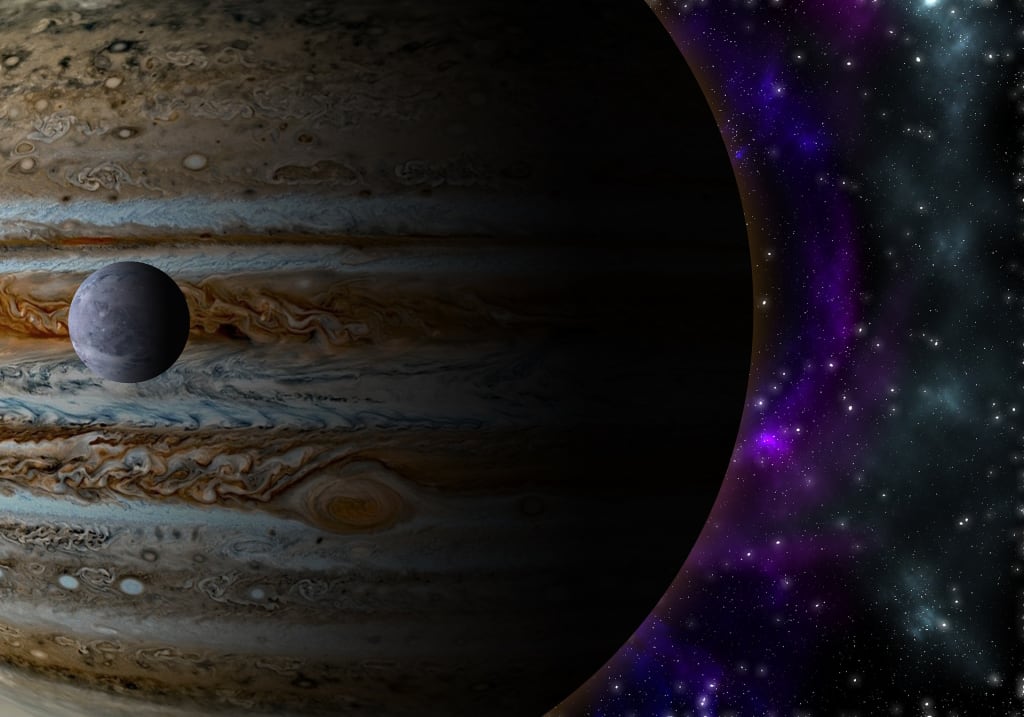
Space is a vast and wondrous expanse, filled with mysteries and wonders that have captivated humanity for generations. One such wonder is the planet Jupiter, a gas giant that boasts a plethora of fascinating and unique features. Despite its lack of a solid surface, Jupiter is a powerful force in our solar system, possessing a gravitational pull that is both impressive and awe-inspiring.
Jupiter's massive size is the key factor behind its strong gravitational pull. In fact, Jupiter is the largest planet in our solar system, with a diameter that is more than 11 times greater than Earth's. Due to this immense size, Jupiter's gravity is over two and a half times stronger than Earth's. If you were to stand on Jupiter's surface, you would feel a force that is more than twice as strong as what you feel on Earth. This powerful gravitational pull is what makes Jupiter such a fascinating and unique planet.
One of the most intriguing aspects of Jupiter's gravity is its effect on the planet's many moons. Jupiter has a whopping 79 known moons, with four large moons known as the Galilean moons: Io, Europa, Ganymede, and Callisto. These four moons are of particular interest to astronomers and astrobiologists, as they are thought to have subsurface oceans that could potentially harbor life.
Jupiter's gravitational pull on these moons is incredibly strong, causing them to experience significant tidal forces. These forces result in a constant flexing and squeezing of the moons' interiors, generating heat and creating geological activity. In fact, the tidal forces on Io are so strong that they cause the moon to be the most volcanically active body in our solar system. The intense heat generated by these volcanic eruptions is thought to be one of the key factors in preventing life from developing on Io.
Europa, on the other hand, is a much more promising target for astrobiologists. The moon's subsurface ocean is believed to contain twice as much water as Earth's oceans, and it is thought to be in contact with a rocky seafloor that could provide the necessary conditions for life to thrive. Jupiter's gravitational pull on Europa is also responsible for the moon's constant flexing and squeezing, which generates heat and could potentially keep the subsurface ocean from freezing.
The Galilean moons aren't the only bodies in Jupiter's orbit that are affected by the planet's gravity. Jupiter's gravitational pull also plays a critical role in protecting Earth from dangerous asteroids and comets. The planet's massive size and strong gravity act as a kind of cosmic "vacuum cleaner," deflecting or capturing many of the asteroids and comets that would otherwise pose a threat to our planet. Without Jupiter's gravitational pull, our solar system would be a much more dangerous place.
In addition to its impact on the Galilean moons and the asteroid population of our solar system, Jupiter's gravity also has a profound effect on the planet itself. The strong gravitational pull causes Jupiter's atmosphere to be compressed and heated, resulting in an incredibly powerful internal heat source. This internal heat source is thought to be responsible for the planet's intense weather patterns, including its iconic Great Red Spot, a massive storm that has been raging for centuries.
Jupiter's gravity also plays a critical role in shaping the planet's magnetosphere, a region of space surrounding the planet that is influenced by its magnetic field. The magnetosphere is responsible for trapping high-energy particles from the Sun and cosmic rays, protecting the planet and its moons from harmful radiation. Without Jupiter's strong magnetic field, these particles would be free to bombard the planet and its moons, potentially causing significant damage.
About the Creator
Todays fact
"Join me for daily fun facts and satisfy your curiosity. From science to pop culture, I'll bring you fascinating tidbits to brighten up your day and expand your knowledge. Let's explore the world together!"
Keep reading
More stories from Todays fact and writers in Earth and other communities.
"The Mysterious Legend of Atlantis: Fact or Fiction?"
The story of Atlantis has captured the imagination of people for centuries. According to the Greek philosopher Plato, Atlantis was a highly advanced civilization that existed thousands of years ago, before sinking into the ocean in a single day and night. The legend of Atlantis has spawned countless books, movies, and theories, but despite the fascination with this lost city, there is no concrete evidence that it ever actually existed.
By Todays fact3 years ago in Earth
Without Democracy, Donald Trump’s Venezuelan Oil Quest Will Fail
Donald Trump’s renewed interest in Venezuelan oil may seem, on the surface, like a hard-nosed geopolitical calculation. Venezuela holds the world’s largest proven oil reserves, and amid global energy uncertainty, access to those resources is undeniably tempting. But history, economics, and politics all point to the same conclusion: without democratic reform in Venezuela, any attempt by a Trump-led US administration to secure reliable Venezuelan oil will ultimately fail.
By Aarif Lashari3 days ago in Earth



Comments
There are no comments for this story
Be the first to respond and start the conversation.