
Global Aerosol Paints Market Forecast 2025–2033
Spray, Style, and Speed: How Aerosol Paints Are Coloring the Future of Global Coatings

Introduction
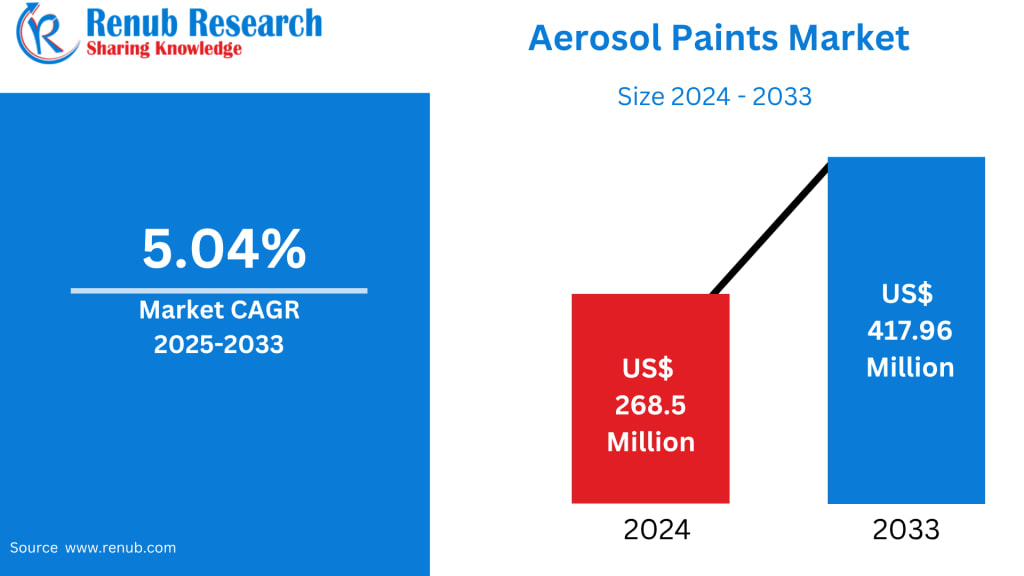
The global aerosol paints market is steadily transforming from a niche convenience product into a mainstream coating solution used across industries, homes, and creative spaces. In 2024, the market was valued at USD 268.5 million, and it is projected to reach USD 417.96 million by 2033, expanding at a CAGR of 5.04% during 2025–2033, according to Renub Research. This growth is driven by the convergence of DIY culture, automotive customization, construction activity, and industrial maintenance needs, alongside innovation in eco-friendly formulations and application technologies.
Aerosol paints—also known as spray paints—are packaged in pressurized cans that deliver paint in a fine mist, ensuring smooth, even application without the need for brushes or rollers. Their portability, fast-drying nature, and wide color range have made them indispensable across automotive, construction, art, furniture restoration, and industrial maintenance. As consumer lifestyles evolve and industries demand faster, more flexible coating solutions, aerosol paints are increasingly becoming a go-to option for professionals and hobbyists alike.
Global Aerosol Paints Market Outlook
Aerosol paints occupy a unique position in the coatings industry. Unlike conventional liquid paints, they combine convenience with precision, enabling users to coat irregular surfaces, tight corners, and complex shapes with minimal effort. Their versatility allows use on metal, plastic, wood, concrete, and composite materials, making them suitable for both decorative and protective purposes.
The market is also benefiting from advancements in formulation chemistry. Low-VOC, water-based, and hybrid aerosol paints are gaining popularity as governments tighten environmental regulations and consumers become more sustainability conscious. These innovations are expanding the addressable market while helping manufacturers maintain compliance without sacrificing performance.
Key Growth Drivers
1. DIY & Customization Culture Boom
The global surge in DIY home improvement, crafting, and personalization projects has significantly boosted aerosol paint demand. Social media platforms such as YouTube, Instagram, and Pinterest have popularized spray-paint-based makeovers—from furniture restoration to wall art and décor accents. Consumers value aerosol paints for their professional finish, fast drying, and availability in diverse textures such as matte, gloss, metallic, and satin.
Manufacturers are actively responding to this trend. For instance, PPG introduced a new series of water-based aerosol paints in 2022, targeting environmentally conscious DIY consumers. Such innovations are expanding aerosol paint usage beyond professionals into lifestyle and leisure segments.
2. Automotive Repair and Customization Growth
The automotive sector remains one of the largest end users of aerosol paints, especially for touch-ups, scratch repairs, trim refinishing, and custom detailing. Aging vehicle fleets and rising personalization trends are driving demand for quick and cost-effective repair solutions. Aerosol paints enable localized repairs without the need for full-body shop processes, making them popular among small workshops and car enthusiasts.
In April 2024, Nippon Paint launched its Mastercraft brand, aimed at consumer-oriented automotive body and paint repair, highlighting the growing importance of this segment.
3. Industrial and Construction Expansion
Industrial maintenance, equipment marking, and corrosion protection represent another major growth pillar. In construction, aerosol paints are widely used for site marking, color coding, and surface touch-ups. Their portability makes them ideal for on-site applications where large spray systems are impractical.
Rapid urbanization, infrastructure upgrades, and industrial expansion—especially in Asia-Pacific and the Middle East—are ensuring consistent demand. In India, AkzoNobel’s 2022 launch of Dulux Simply Refresh marked a strategic entry into the DIY and fast-application segment, further validating market potential.
Market Challenges and Gaps
Environmental and Regulatory Pressures
Traditional aerosol paints rely heavily on VOCs and hydrocarbon propellants, which contribute to air pollution and health risks. Regulations in the EU, North America, and parts of Asia are forcing manufacturers to invest in low-emission alternatives. However, reformulating products without compromising finish quality, shelf life, and spray performance remains a challenge.
Safety and Health Concerns
Inhalation risks, skin exposure, and flammability remain key concerns, particularly among DIY users who may not follow safety guidelines. While professional users adopt PPE and ventilation systems, awareness gaps among consumers increase liability and regulatory scrutiny for manufacturers.
Segment Analysis
Acrylic Aerosol Paints
Acrylic-based aerosol paints dominate consumer and artistic applications. They offer fast drying, low odor, UV resistance, and easy cleanup. Popular among graffiti artists, hobbyists, and interior decorators, acrylic sprays are increasingly favored for both indoor and outdoor use due to their reduced environmental impact.
Epoxy Aerosol Paints
Epoxy aerosols provide superior adhesion, chemical resistance, and durability, making them essential for industrial maintenance, marine applications, and heavy machinery. Although more expensive and complex to use, they are irreplaceable in harsh environments where performance outweighs convenience.
Solvent-Borne Aerosol Paints
Despite regulatory pressure, solvent-borne aerosols continue to dominate heavy-duty applications requiring superior gloss, adhesion, and weather resistance. Ongoing reformulation efforts aim to reduce VOC levels while maintaining performance standards.
Application Insights
Automotive
Automotive aerosol paints are widely used for touch-ups, detailing, and personalization. Growth is supported by the global rise in car ownership, DIY maintenance, and customization culture, particularly in the U.S., Europe, and Southeast Asia.
Industrial Coatings
Industrial aerosols are used for corrosion protection, labeling, and safety marking in manufacturing, energy, and marine sectors. Demand is increasing as industries seek quick and efficient maintenance solutions with minimal downtime.
Construction
In construction, aerosol paints are indispensable for layout marking, utility identification, and temporary signage. The demand is rising in line with global infrastructure development and smart city projects.
Regional Outlook
United States
The U.S. remains the largest aerosol paints market, supported by strong DIY culture, automotive repair demand, and industrial maintenance activity. Construction spending reached USD 1,978.7 billion in 2023, and building permits increased in early 2024, reinforcing demand for aerosol-based solutions. Strict EPA regulations are also accelerating innovation in eco-friendly formulations.
Germany
Germany’s market is driven by its advanced automotive sector and strict environmental regulations. Manufacturers focus heavily on R&D, producing high-performance, low-emission products. In April 2024, Nano-Care Deutschland AG launched a new sustainable product range, reinforcing Germany’s leadership in green coatings.
China
China’s aerosol paints market is expanding rapidly due to booming construction, industrial production, and a growing DIY consumer base. While local brands dominate on cost, international players are gaining ground with premium, eco-friendly products. Tightening environmental laws are reshaping the competitive landscape.
Saudi Arabia
Saudi Arabia’s market is benefiting from Vision 2030 infrastructure investments, industrial diversification, and a growing automotive care culture. Demand for heat- and UV-resistant aerosol paints is particularly strong due to extreme climatic conditions.
Competitive Landscape
Key players are competing on innovation, sustainability, and distribution reach. Companies covered in the market include:
Nippon Paint Holdings Co. Ltd.
Aeroaids Corporation
Valspar Corporation
Kobra Spray Paint
LA-CO Industries Inc.
Masco Corporation
PPG Industries Inc.
Rust-Oleum (RPM International Inc.)
Montana Colors S.L.
Southfield Paints Ltd.
Each company has been analyzed across five dimensions: overview, key personnel, recent developments, SWOT analysis, and revenue analysis, offering a comprehensive view of competitive positioning.
Final Thoughts
The global aerosol paints market is entering a phase of stable, innovation-driven growth. While environmental regulations and safety concerns pose challenges, they are also catalyzing technological advancement and product differentiation. The combination of rising DIY culture, automotive customization, infrastructure expansion, and industrial maintenance needs ensures sustained demand through 2033.
As manufacturers continue to invest in low-VOC, water-based, and high-performance formulations, aerosol paints will remain a vital and evolving segment of the global coatings industry—one that blends convenience, creativity, and efficiency into a single pressurized can.
Forecast Period: 2025–2033
Source: Renub Research
About the Creator
Keep reading
More stories from Aaina Oberoi and writers in Earth and other communities.
Europe Wheat Market Size and Forecast 2025–2033
Europe Wheat Market Overview The Europe Wheat Market is projected to grow from US$ 13.78 billion in 2024 to US$ 19.59 billion by 2033, expanding at a CAGR of 3.99% during 2025–2033, according to Renub Research. This steady growth is supported by rising food consumption, strong export demand, improved yields, government-backed agricultural policies, and the rapid adoption of modern farming technologies across the region.
By Aaina Oberoi4 days ago in Earth
GWR Confirms ‘Major Investment’ with Office Lease: What It Means for Plymouth and the South West
Great Western Railway (GWR) has confirmed a major long-term investment in Plymouth by securing a significant city-centre office lease close to the railway station. While the announcement may sound like a routine property deal on the surface, it actually signals something much bigger — a vote of confidence in the city, a boost for local regeneration, and a clear statement about the future direction of rail-led development in the South West.
By Muhammad Hassan3 days ago in Earth
Trump’s Greenland Threats Push Europe Toward Divorcing America
When you think of Greenland, the first things that probably come to mind are icebergs, polar bears, and maybe some adventurous explorers. But lately, Greenland has become the center of a major diplomatic drama — one that’s forcing Europe to question its long-standing relationship with the United States. And the spark? Donald Trump’s threats over Greenland. The Controversy: Trump’s Unusual Move Back in January 2026, Trump shocked the world again, not with an election campaign but with a bold — and many would say bizarre — plan to acquire Greenland. But he didn’t stop at just “expressing interest.” He threatened eight European nations with tariffs — starting at 10% and potentially climbing to 25% — unless Denmark agreed to sell Greenland to the U.S. Yes, you read that right: tariffs on allies to buy a remote Arctic island. For Europe, this was more than shocking — it felt like a betrayal from a partner they’ve relied on for decades. Europe’s Response: Outrage and Solidarity European leaders didn’t hold back. Germany, France, Norway, the UK, and others banded together to condemn Trump’s approach. The message was clear: Europe won’t be blackmailed. Even usually cautious leaders spoke up. Norway’s Prime Minister bluntly said, “Threats have no place among allies.” Meanwhile, European Commission President Ursula von der Leyen emphasized that tariffs between allies “have no place” and could undermine decades of cooperation. This isn’t just a political disagreement. Europe sees this as a test of trust, sovereignty, and alliance reliability. Why Greenland Matters At first glance, Greenland might seem like just a frozen island. But strategically, it’s a big deal: Location: Greenland sits between North America and Europe, controlling key air and sea routes. Military Importance: It hosts radar and U.S. military infrastructure critical to early-warning systems. Resources: Beneath the ice lie minerals and rare earth elements that the world desperately needs. For Europe, Greenland is also about principle. The island belongs to Denmark and the Greenlandic people, not Washington. Europe’s support for Denmark shows a broader commitment to respecting sovereignty — a principle that Trump’s threats directly challenged. The Bigger Picture: A Crisis of Trust Greenland may just be the tip of the iceberg. For years, European nations have felt frustrated by U.S. policies that seemed unpredictable — whether it’s climate agreements, trade deals, or security commitments. Trump’s Greenland threats amplified these frustrations. Suddenly, Europe is questioning something fundamental: Can the U.S. be trusted as a long-term partner? Some European leaders have even started talking about a kind of “divorce” from the U.S. — not literally leaving NATO, but rethinking how dependent they should be on America for security and strategic decisions. Europe’s Path Toward Strategic Independence This Greenland drama is accelerating discussions about European strategic autonomy. Basically, Europe is asking: Should we be able to protect our own interests without always relying on the U.S.? The EU has long talked about building stronger defense capabilities and investing more in its own military, but progress has been slow. Greenland might just be the wake-up call that finally pushes Europe to act. What’s Next? So, what happens from here? Europe isn’t just going to sit quietly. Leaders are looking at: Economic counter-measures like tariffs on U.S. goods Strengthening European defense and security collaboration Reasserting Europe’s role on the global stage, with less reliance on Washington Even if Europe doesn’t fully “divorce” America, Greenland is changing the terms of the transatlantic partnership. Europe will now demand more respect, clearer rules, and recognition of its sovereignty — and they’re not afraid to make that clear. Why This Matters to All of Us You might wonder why this matters if you’re not in Europe or the U.S. Greenland may seem remote, but this story is about alliances, trust, and how global power is shifting. The way Europe responds could reshape the world order, affect trade, military cooperation, and even the global economy. And for anyone following U.S.-European relations, it’s a reminder that sometimes the smallest places — even a frozen island — can have huge global consequences. Bottom line: Trump’s Greenland threats aren’t just a bizarre footnote in history. They’re a wake-up call for Europe, forcing the continent to rethink its ties with America and consider a future where it can act independently — strategically, economically, and politically. Greenland, icy as it is, might just melt the old rules of alliance forever.
By Muhammad Hassan3 days ago in Earth
Rachel Reviews: The Spiral Archive by Pieter Hendrik
It's difficult for me to know where to start with a review of this book as it was, for me, an entirely unique experience and one that I'll probably never have again. I don't want that to be interpreted as unenjoyable but it has left me scratching my head a little and ruminating on its content, its themes and its characters.
By Rachel Deeming4 days ago in BookClub


Comments
There are no comments for this story
Be the first to respond and start the conversation.