
From Icy Moons to Lunar Bases
The Next Chapter in Space Travel

Icy moons, lunar bases.
What secrets might we uncover about life's potential beyond Earth?
Man's fascination with space explorations is a testament to an unquenchable urge to learn more about and understand the universe.
As we move further into the latter half of the 21st century, there are two giant projects that symbolize this drive: NASA's Europa Clipper Mission, dedicated to unveiling all secrets concerning Jupiter's moon Europa, and ESA's Luna Training Facility in Cologne, Germany, training astronauts for living and working experiences on the Moon.
Both are also parts of the more significant human undertaking to explore, colonize, and further understand the immediate solar system that hosts the human species. In this combined discussion, we explore in depth these pioneering missions and what they mean for the future of human space travel.
The Europa Clipper Mission: The Search for Life on Jupiter's Icy Moon
Under the bright sun at Cape Canaveral, NASA launched its Europa Clipper spacecraft at 12:06 PM local time on a nearly 3-billion-kilometer journey to one of the most intriguing objects in our solar system: Europa, one of Jupiter's moons.
This isn't a mission of curiosity but one to finally answer one of the oldest questions known to humankind:
Are we alone in the universe?
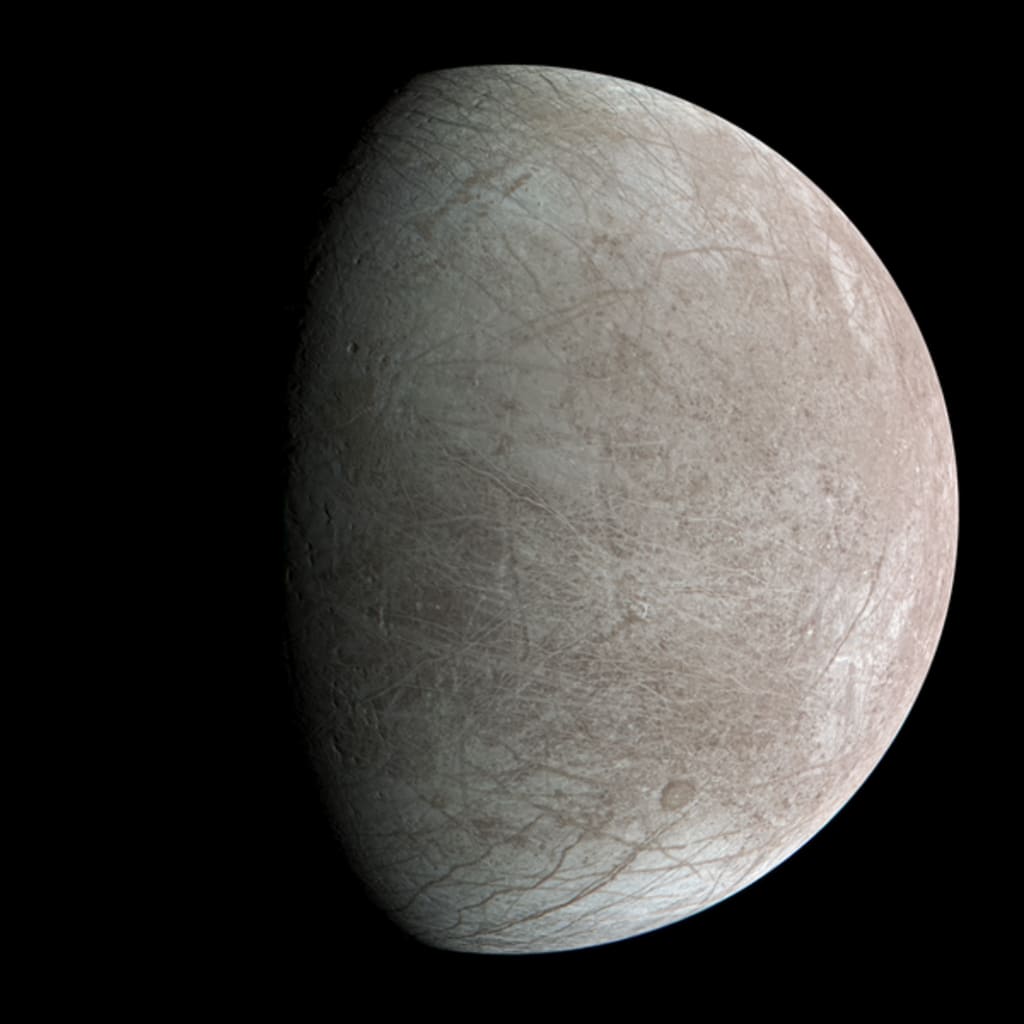
Due to its surface ice covering a presumably subsurface ocean, the hypothesis that Europa may have conditions suitable for life has long been one considered by scientists. Initial evidence to this hypothesis came from previous missions, such as Voyager 1 and 2 flybys in the late 1970s and the more extensive observations by the Galileo spacecraft in the 1990s.
These projects detected a number of intriguing hints at the existence of life, including dark, reddish-brown cracks in the icy surface of Europa, which could have been colored by salts and sulfur compounds-just the right ingredients for life. The main objective of the Europa Clipper will be to investigate these signs of habitability in far greater detail.
The spacecraft is not designed to directly search for life; instead, it will study whether conditions on Europa could harbor life. It will also involve the search for organic compounds and energy sources beneath the icy shell, believed to be as thick as 25 kilometers. Scientists theorize that beneath this layer of thick ice is an ocean of liquid water warmed probably by tidal forces created by gravitational tugs between Europa and Jupiter.
During its mission, the Europa Clipper will make 49 flybys of the moon, mapping its surface and characterizing dust particles with a suite of various scientific instruments. It might even fly through the water plumes that have been seen erupting from the surface. Such a plume, if derived from the subsurface ocean, would afford direct access to the inner chemistry of the moon and, by inference, its potential habitability.
But the voyage to Europa is long and precarious. The Europa Clipper will execute gravity-assist flybys of Mars and Earth to pick up enough speed to arrive at Jupiter and finally reach orbit around the gas giant this coming April 2030. If it actually reaches the Jupiter system, that spacecraft will also have to tolerate an exceptionally extreme radiation climate emanating from that gas giant, very perilous for both it and its sensitive scientific instruments.
Despite those challenges, NASA remains optimistic: In the process, the agency underlines that, though the Europa Clipper mission itself will not be directed at an immediate search for alien life, it will help answer some questions related to the habitability of icy worlds in our system. "Europa Clipper is not a life-detection mission, but it will help determine if Europa is capable of supporting life-a step towards answering the profound question of whether we are alone in the cosmos," says NASA.
The Luna Training Facility: Preparing for Life on the Moon
While NASA looks outwards to the distant moons like Europa, the ESA does the opposite, taking a closer-to-reach approach in its goal to train astronauts to venture to Earth's very own moon.
In Cologne, Germany, ESA had built the Luna Training Facility, a cutting-edge facility for training astronauts for the harsh conditions that await on the surface of the Moon.
Recently, ESA astronaut Matthias Maurer took a tour of the facility that includes a 700-square-meter hall filled with simulated lunar dust made out of volcanic rock from the Eifel region in Germany. This is a fine material known as EAC-1, possessing properties of regolith near the lowland regions of the Moon, and allowing astronauts to realistically train for walking, operating rovers, and performing tasks as they will be doing on the Moon.
Some of the central concerns for sending astronauts to the Moon regard how they will be able to navigate through its irregular and at times hazardous surface. The sharp, fully abrasive nature of the lunar dust creates significant risks in regard to equipment damage, clogging joints, and even causing interference with electrical connections. Understanding how to move and work in such an environment is primary to the success of future lunar missions.
As ESA Director General Josef Aschbacher underlined, this is a singular facility in the world. No other space agency has such advanced simulation environment for lunar conditions. Together with the German Aerospace Center, ESA will make another step toward giving European astronauts a head start in preparing for missions to the Moon as part of the broader international effort under NASA's Artemis program.
Artemis Program and Europe's Role
Named for the Greek goddess of the hunt and twin sister of Apollo, Artemis is NASA's ambitious plan for returning humans to the Moon with the ultimate goal of establishing a sustainable human presence on the lunar surface.
The mission will mark the first visit by humans to the Moon since the Apollo missions of the 1960s and 1970s. In contrast to those short-term missions, Artemis is focused on long-term habitation and exploration.
The first astronaut-crewed Artemis mission will launch in the next few years, but it won't land on the Moon just yet. Save that for a later mission currently targeted for 2026, where the astronauts will once again touch down on the lunar surface. Beyond these missions, there will be the establishment of a permanent habitat, somewhat similar in concept to the research stations in Antarctica, which could support lengthier stays and more comprehensive scientific missions.
And Europe stands at the forefront of this huge effort. ESA is providing the service module for the Orion spacecraft-the vehicle that will take astronauts to the Moon. The 13-ton module, manufactured by Airbus in Bremen, Germany, will provide the propulsion, life support systems, and temperature control for the spacecraft. Without it, Artemis missions would simply not be possible; a great achievement in European space exploration.
In return for this crucial technology, ESA has secured three seats for European astronauts on future missions to the Moon. These will not, however, carry Europeans to the lunar surface just yet: they will fly as part of the crew of the Lunar Gateway, a small space station that will orbit the Moon and act as a staging point for landings on its surface.
While this is a big stride ahead, the likes of ESA officials such as Josef Aschbacher would have wished for further, active European involvement in upcoming moon missions, even where surface operations are concerned.
The Challenges of Long-Term Lunar Missions
One of the primary goals of the Artemis mission is to establish a lunar outpost near the Moon's South Pole, believed to harbor large quantities of water ice in permanently shadowed craters. Water would become available for drinking, oxygen production, even rocket fuel for further journeys on to Mars and beyond.
The landscape around the lunar South Pole is anything but benign. When it does rise, the Sun barely climbs above the horizon, so shadow lengths are long and there are extreme contrasts between light and dark. This makes the surroundings difficult to judge, thus increasing accident risk. In Cologne, the Luna facility artificially makes use of certain lighting conditions which simulate the extreme light contrasts at the polar regions of the Moon as a means of preparing astronauts for bad visibility.
The other challenge constitutes the low gravity of the Moon, one-sixth the Earth's. This challenges the way astronauts move and work because their muscle memory will have to adapt to the new environment. So far, a harness system developed at the Luna facility provides some insight into what it is going to be like to move in lunar gravity, and the systems allow astronauts to practice everything from walking to heavy lifting in this low-gravity environment.
Not only will the astronauts have to prepare for such challenges. Robotic systems, also part of this major effort in establishing the lunar bases, are under testing in places like Luna. These robots will have to move along the rough terrain, dig deep into the lunar regolith, and support the astronauts in building and maintaining the lunar habitat.
A New Space Race?
It is no longer a competition, in the return to the Moon in full gear, between the U.S. and Europe over the lunar surface but also in highly ambitious plans by China and Russia regarding establishing a lunar base. Both also have their own ambitions on the South Pole of the Moon.
Whereas several players have ambitions on one region, over the next decade this might become a new space race that is different not only in its immense geopolitical consequence but also in kind from the first.
A few months prior to NASA's announcement, China and Russia announced a joint lunar research station that could rival the Artemis base. That raises some pretty interesting questions as to how international cooperation and competition in space will play out in the next several years. Will nations collaborate on establishing a peaceful presence on the Moon, or will the Moon become a new frontier for geopolitical tension?
The Dawn of a New Space Age
From NASA's Europa Clipper mission to ESA's Luna training facility and the Artemis program, it becomes clear: we're about to enter a new era of space exploration. A quest to explore worlds such as Europa combined with an effort to establish a sustainable presence on the Moon probably represents some of the most ambitious scientific and engineering challenges of our time.
And that's a dead certainty: what we will learn, what we will achieve in the next several decades will fundamentally change our view of the universe and ourselves. Whether finding life on Europa or a permanent presence on the Moon, humanity's adventure in space has just begun.
About the Creator
Tanguy Besson
Tanguy Besson, Freelance Journalist.
https://tanguybessonjournaliste.com/about/
Keep reading
More stories from Tanguy Besson and writers in Earth and other communities.



Comments
There are no comments for this story
Be the first to respond and start the conversation.