
From Ancestors to Spirituality: Tracing the Worship Gene (God gene)Through Generations
Part 1


Scientists have discovered a gene they call the "worship gene." This gene has been inserted into the human genome. Isn't that fascinating? Researchers can actually turn this gene on and off. What does this mean for us? The implications are intriguing!
Did you know you carry all the information from the beginning of time within you? Everything that has ever existed is present in this moment. Nothing has been added or removed. According to the law of thermodynamics, energy can’t be destroyed; it can only change form. Right now, you exist in this specific form. But your DNA holds vast information. If you could decode it, what might you discover? Understanding this could lead you to reprogram yourself.

Let's dive into the Anunnaki,these Atlantean beings are said to have visited Earth long ago. They didn't create humans; they modified them. If you analyze various texts, you'll find intriguing information. Start with the Sumerian texts. But don't stop there; explore other versions too. There's the Enuma Elish and the Epic of Gilgamesh. The Emerald Tablets also shed light on this topic. It’s fascinating to think that a form of humanity already existed here. They were genetically modified, serving as our ancestors before Homo sapiens appeared. What could this mean for our understanding of human origins?
What happened to us? Why are we working like this? Some say they disconnected our DNA. It's often called junk DNA, but could it really be unplugged DNA? Why would they unplug it? Many believe our ancestors, or cousins, were spiritually smarter than we are. They were more in tune with nature and the universe. They connected deeply with the planet itself. Did you know that the human resonant frequency of the Earth plays a role too? There are even skulls found all over the planet that suggest they had bigger brains. Could those bigger brains mean they had larger pineal glands? That gland is often referred to as our spiritual antenna.

Did you know that humans have billions of magnetite crystals in their brains? It's fascinating! We don't even use them. Some animals, like turtles and birds, rely on these crystals to navigate. Turtles use them to return to their egg-laying spots. Birds migrate south for the winter, guided by the magnetic field. So why can’t we do the same? It seems we've been disconnected from this ability. This change happened around 200,000 years ago. What could we tap into if we reconnected with our magnetite crystals?
Around that same time, something intriguing happened. Chromosome number two in the human body was pulled out and fused together. But that's not all! Two telomeres were placed on each end. Telomeres contain our genetic material. They enable our cells to replicate. They also serve as a biological buffer. This buffer is essential for cellular health. But here’s the catch: when this buffer material runs out, that’s when the body begins the death process.
Around 200,000 years ago, something significant happened at the Tower of Babel. This event is recorded in the modern-day Bible. In the story of the Tower of Babylon, God, referred to as Yeshua Yahweh, observes people building a tower reaching the heavens. This angers him. In response, he destroys the tower and declares that humans will have a maximum lifespan of 120 years. He also decides to confuse their languages. This separation scatters people across the planet.
The Samaran tablets present an intriguing perspective. They suggest that Yahweh is actually known as liil. In the Bible, there’s a moment when he returns and observes humanity. He realizes that people are becoming too intelligent and might realize they don't need rulers. To address this, he confuses their language. Everyone was speaking just one language at that time. Then, he shortens human lifespan to 120 years. Before this, people lived for centuries! Interestingly, researchers at Harvard have found the average maximum lifespan for humans is around 120 years if it weren’t for toxins and the other harmful factors in our food and environment
About the Creator
How Much Do You Need in an ISA for a Passive Income That Beats the State Pension?
For many people in the UK, the State Pension is expected to form the backbone of retirement income. But with rising living costs and growing uncertainty about the future, more savers are asking a crucial question: Can I build a passive income that beats the State Pension — and how much would I need in an ISA to do it?
By Aarif Lashariabout 16 hours ago in Earth
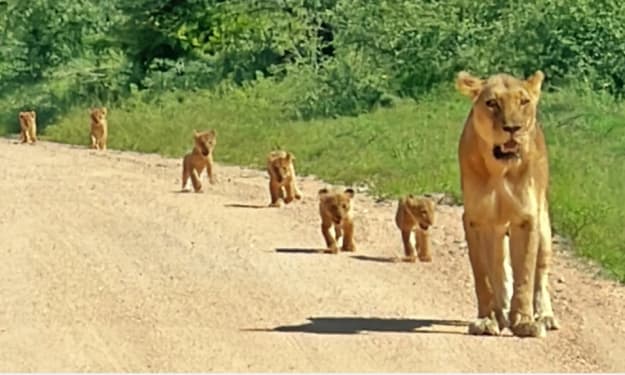
Tiny Lion Cubs Struggle To Keep Up With Mom
In the heart of the African savannah, life is a constant lesson for young animals. Few scenes are as endearing — or as heartwarming — as tiny lion cubs trying to keep pace with their mother. These little bundles of fur face a world full of challenges, from learning to hunt to avoiding dangers, all while depending on the guidance and protection of their experienced mom. Watching cubs wobble and tumble as they attempt to keep up with their mother reminds us that growing up, even in the wild, is a journey full of struggle, determination, and adorable missteps. The Early Days of Lion Cubs Lion cubs are born blind and helpless, usually in litters of two to six. For the first few weeks, they rely entirely on their mother for warmth, food, and safety. Even after opening their eyes and beginning to explore, the cubs are far from independent. The first months are crucial. Cubs learn social cues, hunting basics, and survival skills simply by watching their mother and the pride. But as anyone who has observed them knows, there’s often a huge gap between observation and action. Tiny cubs often struggle to match their mother’s pace, especially when she moves through long stretches of savannah or leads the family on patrols. A Mother’s Role in the Wild For a lioness, raising cubs is a full-time commitment. She hunts, defends her territory, and teaches her young, all while staying alert to predators such as hyenas, leopards, and even rival lions. The cubs, meanwhile, attempt to mimic her every move — often with clumsy yet charming results. A mother lion’s patience is remarkable; she frequently slows down, nudges them along, or stops to ensure no cub is left behind. These moments, while stressful for the tiny cubs, are vital learning opportunities. Struggling to Keep Up: Why It’s So Hard There are several reasons why tiny lion cubs have trouble keeping pace with their mother: Short Legs, Big Steps: Lion cubs’ legs are tiny and their coordination is limited, making it difficult to cover the same distance as an adult lioness. Curiosity: Cubs are naturally curious. A single butterfly or rustling bush can distract them, leaving mom to pause repeatedly. Energy Levels: Young lions tire quickly. Even with frequent naps, the cubs’ stamina is far lower than their mother’s. Learning Through Play: Play is not just fun; it teaches hunting, balance, and social skills. Running off to pounce on a sibling or chase an insect is all part of their education. Despite these challenges, the cubs’ determination to keep up demonstrates their resilience and growing understanding of the wild world. Lessons in Teamwork and Survival Every cub struggling to keep up is also learning crucial survival skills. The journey across the savannah is more than a test of speed — it’s a lesson in: Coordination: Cubs learn how to move efficiently across different terrains. Patience: They begin to understand the rhythms of adult life and the pace required for survival. Social Skills: Staying with the group teaches cubs how to interact with siblings and the pride, which is essential for their future roles. Observation: By following their mother, cubs study hunting techniques, territorial behavior, and predator awareness. Even the moments when cubs stumble or lag behind are essential for their development. These experiences prepare them for independence, which comes sooner than many might expect. The Cutest Moments in the Wild Anyone who has watched tiny lion cubs knows that their struggles are often irresistibly cute. Video clips from wildlife reserves frequently show cubs toddling along, tumbling over each other, or getting distracted mid-step. Observers often comment that these little stumbles reveal personality, determination, and playfulness, making them one of nature’s most heartwarming spectacles. While their mother is serious and focused, the cubs inject a sense of humor and lightness into life on the savannah. Why This Matters The struggles of lion cubs aren’t just adorable — they’re vital for understanding wildlife behavior. Conservationists and animal behaviorists use these moments to study growth patterns, social structures, and survival strategies in lion populations. These observations also highlight the importance of preserving natural habitats. Cubs must learn in a safe environment to survive; habitat loss, poaching, and climate change make these early struggles even more dangerous. Protecting the African savannah ensures that future generations of lions can experience the same lessons and playful tumbles. The Road to Independence Within a year, these tiny cubs will be more agile, faster, and more confident. By the time they reach two to three years old, males may begin to leave the pride, while females often stay and become caretakers themselves. Every misstep, tumble, and lagging moment is part of the journey toward strength, coordination, and independence. Watching them now gives us a glimpse of the challenges they will overcome, and the survival skills they will carry for life. A Celebration of Motherhood Ultimately, these scenes remind us of the incredible bond between mother and cubs. Her patience, vigilance, and teaching are the foundations of their future. The cubs’ struggles highlight the trials of growing up, while their determination showcases the resilience and beauty of wildlife. For those observing, it’s a powerful lesson in care, guidance, and perseverance, not just in lions but in the natural world as a whole. Final Thoughts Watching tiny lion cubs try to keep up with their mother is both entertaining and enlightening. It’s a story of growth, struggle, and resilience — a reminder that even the fiercest creatures start small, learning step by step. These little lions capture hearts while teaching life lessons: patience, determination, teamwork, and the importance of guidance. As they tumble and waddle across the savannah, they show us that growth is a process, one adorable misstep at a time. For wildlife enthusiasts, animal lovers, and anyone enchanted by nature, these tiny cubs are proof that even in the wild, love, care, and persistence are universal truths.
By Aarif Lashariabout 16 hours ago in Earth



Comments
There are no comments for this story
Be the first to respond and start the conversation.