
Flares from Magnetized Stars Can Forge Planets' Worth of Gold
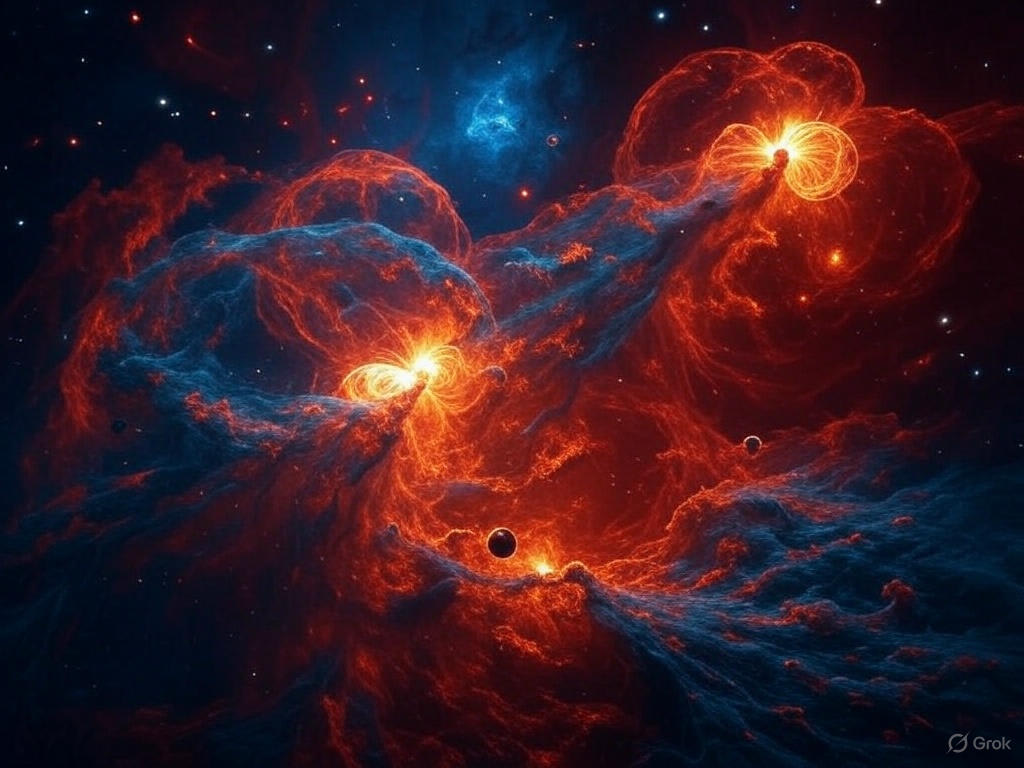
In a surprising twist to our understanding of cosmic alchemy, scientists have discovered evidence that flares from highly magnetized stars, specifically neutron stars and magnetars, may be capable of producing massive amounts of gold and other heavy elements. This discovery calls into question long-held beliefs about how elements such as gold, platinum, and uranium are formed and distributed throughout space.
Flares from Magnetized Stars Can Forge Planets' Worth of Gold
In a surprising twist to our understanding of cosmic alchemy, scientists have discovered evidence that flares from highly magnetized stars, specifically neutron stars and magnetars, may be capable of producing massive amounts of gold and other heavy elements. This discovery calls into question long-held beliefs about how elements such as gold, platinum, and uranium are formed and distributed throughout space.
Cosmic Goldsmiths: Neutron Stars and Magnetar:
For decades, astrophysicists have believed that the majority of the universe's heavy elements are formed during the violent mergers of neutron stars—ultra-dense stellar remnants left behind by supernovae. These collisions are rare but powerful, releasing enormous energy and creating ideal conditions for the *r-process*, or rapid neutron capture, a series of nuclear reactions that build heavy atomic nuclei.
However, new theoretical research and observational data indicate that intense flares from magnetars—neutron stars with magnetic fields trillions of times stronger than Earth's—could also cause these element-forming reactions. When magnetars experience violent magnetic reconnection events (similar to solar flares but much more powerful), they can eject neutron-rich material into space at high speeds. Under the right conditions, this material undergoes r-process nucleosynthesis, which results in the production of heavy elements.
Flares and Planetary Fortunes:
According to some studies, a single giant flare from a magnetar could produce enough gold to weigh an entire planet. To put this in perspective, Earth's total gold reserves (including unmined deposits) account for only a few parts per billion of its total mass. A flare-generated yield of gold and other heavy metals could match or exceed that in a matter of seconds, transforming stellar flares into cosmic-scale goldmines.
Implications for Galactic Chemistry:
If magnetar flares play a significant role in the production of heavy elements, it could change our understanding of how galaxies like the Milky Way obtain their chemical diversity. It could also explain differences in metal abundances in older stars, particularly in regions of the galaxy where neutron star mergers appear to be too rare to account for observed amounts of heavy elements.
Furthermore, the discovery highlights the importance of exotic stellar objects in shaping the chemical evolution of the universe. As more advanced telescopes and observatories, such as the James Webb Space Telescope and the Vera Rubin Observatory, become operational, astronomers will be better equipped to detect and analyze these powerful flare events and their elemental byproducts.
Implications for Galactic Chemistry:
The potential role of magnetar flares in producing heavy elements could fundamentally alter our understanding of galactic chemical evolution. In galaxies like the Milky Way, this process might explain the origins of chemical diversity, revealing how elements are distributed across stellar populations. Notably, magnetar flares could account for the observed metal abundances in older stars, particularly in regions where neutron star mergers are too rare to fully explain the presence of heavy elements. This suggests that magnetar activity may have played a critical role in enriching the interstellar medium, influencing the composition of subsequent generations of stars. Such insights could refine models of galactic formation and evolution, highlighting the importance of high-energy astrophysical phenomena in shaping the chemical makeup of galaxies and providing a new perspective on the processes driving the universe's elemental diversity.
The discovery underscores the critical role of exotic stellar objects, like magnetars, in driving the chemical evolution of the universe. These objects contribute significantly to the production and dispersal of heavy elements, shaping the elemental composition of galaxies. As advanced observational tools, such as the James Webb Space Telescope and the Vera Rubin Observatory, come online, astronomers will gain enhanced capabilities to detect and study these intense flare events and their elemental byproducts. This will enable more precise measurements of the contributions of magnetar flares to galactic chemistry, refining our models of how elements form and spread. These advancements promise to deepen our understanding of the processes that govern the universe's chemical diversity, highlighting the interplay between extreme astrophysical phenomena and the elemental foundations of stars and planets.
About the Creator
Keep reading
More stories from writers in Earth and other communities.
The Jinn Fled
This short story was narrated by my grandson Taimoor, who is thirteen years old. He heard it from the family of his friend Zain Ali. Zain Ali’s mother, Nusrat Bibi, loves Taimoor like her own son. She is a pious, well-mannered, kind-hearted, and refined woman.
By Sudais Zakwan5 days ago in Earth
Trump ‘Has Stopped Dyeing His Hair’ and Thinks He Will Be Dead in a Decade,
A Surprising Revelation About Trump According to recent reports, former President Donald Trump has reportedly stopped dyeing his hair and has openly mentioned that he believes he may only have about a decade left to live. This personal revelation has surprised the public and media alike, as Trump’s hair has been a defining feature of his persona for decades. The news comes amid ongoing discussions about Trump’s health, legacy, and future political ambitions, offering a rare glimpse into his personal reflections on aging and mortality. The Significance of Hair in Trump’s Public Image For years, Donald Trump’s hair has been iconic and heavily scrutinized, appearing in political cartoons, late-night shows, and public discussions. His distinctive style has often been associated with his brand and image as a larger-than-life figure. Stopping hair dyeing could be interpreted in multiple ways: As a personal choice embracing aging, or A subtle reflection of his acknowledgment of mortality In any case, this change signals a departure from the meticulously maintained public image Trump has cultivated for decades. Trump on Mortality The report suggests that Trump has shared his thoughts about his life expectancy, stating he believes he may die within the next decade. While he has not specified reasons for this belief, it has prompted public discussion about how political figures perceive aging and legacy. Many observers note that contemplation of mortality is not unusual for someone in their mid-70s, yet when expressed publicly by a former world leader, it can influence media coverage, public perception, and political discourse. Public and Media Reaction News of Trump’s decision to stop dyeing his hair and his remarks about life expectancy has led to a mix of reactions: Some view it as a humanizing moment, revealing vulnerability in a figure often portrayed as invincible. Others see it as a potential political signal, possibly affecting perceptions of his energy, future political involvement, or campaign strategies. Social media users and commentators have highlighted the story humorously, reflecting how Trump’s personal choices often become public fascination points. Despite the lighthearted responses online, serious discussions have emerged regarding the intersection of personal health, public image, and political leadership. Aging and Politics Trump’s candid acknowledgment of aging raises broader questions about how political figures confront their mortality while remaining in the public eye. History shows that aging leaders often face intense scrutiny regarding: Health transparency Cognitive and physical ability Future political plans and legacy By discussing his own life expectancy, Trump may be indirectly addressing public curiosity about his capacity to continue influencing politics, particularly as speculation about a potential 2024 candidacy persists. The Cultural Obsession with Trump’s Appearance The attention on Trump’s hair is emblematic of a larger cultural phenomenon: society’s fascination with appearance and identity in leadership. From style choices to physical health, the public often interprets a leader’s personal traits as indicators of vitality, credibility, or capability. Stopping hair dyeing could therefore be seen as a small but symbolic moment, signaling a shift in how Trump chooses to present himself, potentially prioritizing authenticity over image cultivation. Reflections on Mortality and Legacy Expressing thoughts about mortality is not unique to Trump. Leaders and public figures often grapple with questions of legacy, impact, and how they will be remembered. For Trump, who remains a polarizing figure, contemplating life expectancy may intersect with considerations of: Historical perception Political influence Personal and familial legacy Observers note that sharing such reflections publicly can humanize political figures but also invite scrutiny and speculation about decision-making and priorities. Public Curiosity and Media Coverage Trump’s comments have fueled a wave of media coverage, from traditional news outlets to social media discussions. Key aspects driving public curiosity include: The juxtaposition of personal vulnerability and political power The cultural fixation on Trump’s hair and appearance The broader implications for his political future This coverage highlights how personal revelations of public figures can become national conversations, influencing both public perception and political narratives. Implications for Political Discourse While the story may seem trivial at first glance, it offers insight into how personal image, aging, and public commentary intersect in contemporary politics. Trump’s decision may also spark debate over: The role of personal health transparency in leadership How aging leaders maintain influence in high-stakes political environments Media emphasis on appearance versus policy or ideology These conversations contribute to a larger understanding of political culture in the modern era, where private life and public persona are deeply intertwined. Conclusion Donald Trump’s reported choice to stop dyeing his hair and his reflections on mortality provide a rare window into the personal life of a highly visible political figure. Beyond the surface, this story raises questions about aging, legacy, and public perception, highlighting how personal decisions can resonate widely in the media and among communities. As public fascination continues, the story underscores society’s complex relationship with leaders’ appearance, vulnerability, and mortality, reminding us that even the most powerful figures confront the universal truths of aging and legacy.
By Aarif Lashari5 days ago in Earth



Comments
There are no comments for this story
Be the first to respond and start the conversation.