
Eyeball Planets: They Are As Eerie As They Sound
Searching for Our Second Home: Exploring the Possibilities of a Planet in Space and Discovering Bizarre Wonders Along the Way

NASA News: The hunt for interesting exoplanets and life forms somewhere out there in the vast expanse of the universe keeps going with no stopping here. We're basically searching for a second Earth - a planet that's similar to our home, and where we could finally find some space friends. Hey, we're not picky; any form of life is fine, even some bacteria-sized organisms. This search has mostly been going on in the habitable zone around other stars. We call this the Goldilocks zone; that's a region where conditions are barely just right for liquid water to exist, whether we're talking about the surface of a planet or a moon.
The hotter the star, the more space we get to explore because its habitable zone spreads far away. In terms of the endless space that we yet know so little about, that's a lot of work. That's why we're fans of red dwarfs. There are hundreds of billions of stars in our galaxy, and probably around 80 percent of them are red dwarfs. These tiny stars are much cooler than our sun, which means that their habitable zones are much smaller and closer to the star. So, we know better where to look for planets that are circling around their central star, and at some point, bingo! There it is. They pass in front of it and block out some of its light.
The Kepler Space Telescope has already helped us find thousands of planets using this method, and most of them are orbiting around red dwarfs. Some of these planets are similar in size to Earth, and many of them could have nearly 25 times more water than our entire planet.
Scientists discovered some of the most unusual planets through the Kepler Space Telescope. These planets have strange properties, such as being tidally locked planets, planets around red dwarfs, planets with unusual properties, and even planets that look like giant eyeballs.
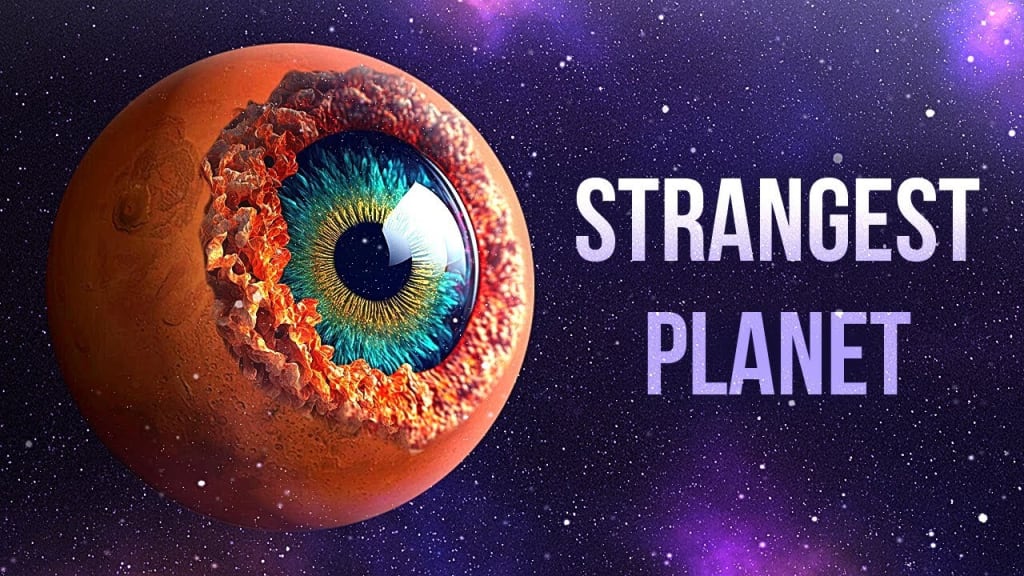
Recently, a giant eyeball was found on Google Earth Street View in Dallas, Texas. But, a giant eyeball in space is not just a fictional concept. It is called an eyeball planet, and it is a real thing. Eyeball planets are surprisingly common, and some normal planets can potentially turn into them too.
Eyeball planets form when matter and dust accumulate around a star and gradually turn into a solid object. It starts spinning, and over time, the gravity of the star pulls on the planet and slows its rotation until it becomes tidally locked. That means one hemisphere always faces the star while the other is in darkness all the time. Our moon is a good example of this phenomenon near us too; it takes the same amount of time to turn a single time on its axis, which means we always see the same face of the Moon.
One of the most interesting things about eyeball planets is their appearance. If they had water on their surface, the side facing the star would have clear bright blue oceans, the ones we'd want to visit if we ever got a chance to go on an interstellar vacation. The other side would be more for adventurers who like harsh and challenging surroundings since it's in constant darkness, it would most likely be very cold and covered in ice.
We've discovered so many planets outside of our solar system in the last 30 years. Super Earths are, of course, especially interesting. It seems that many of them are not that pleasant since they're pretty hazy and cloudy. It means it's harder to spot any life there, but some scientists still continue to study these planets, hoping to find signs of extraterrestrial life.
About the Creator
Daniel Ellison
Whether you’re into recent discoveries, space exploration, true stories, fitness, fun tests, and riddles, or useful tips for self-improvement, psychology, gadgets, or just your day-to-day routine, I write something for everyone!
Keep reading
More stories from Daniel Ellison and writers in Earth and other communities.
Why Planes Don't Fly Over the Pacific Ocean
Have you ever noticed that commercial flights tend to avoid flying over the Pacific Ocean? If you look at a flight map, you will see that most flights from North America to Asia take a more northerly route over Alaska, Russia, or Canada, rather than crossing the Pacific. So why is that?
By Daniel Ellison3 years ago in Earth
Manaslu Circuit vs. Langtang Valley: Which Nepal Trek Is Right for You?
Nepal offers some of the most extraordinary trekking routes in the world. While many travelers focus on famous trails like Everest Base Camp or the Annapurna Circuit, other routes provide equally memorable experiences with fewer crowds.
By Alex Winslowabout 14 hours ago in Earth


Comments