
Exploring the Wonders of the Universe: From Black Holes to Galaxies
A Journey Through the Mysteries and Marvels of the Cosmos

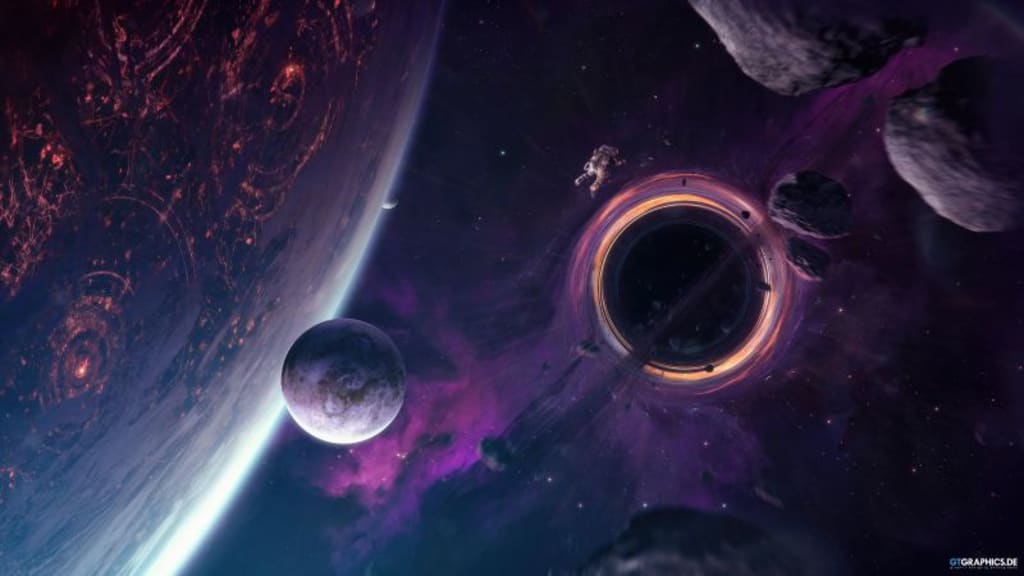
Black holes are one of the most fascinating and mysterious objects in the universe. They are regions of space where the gravitational pull is so strong that nothing, not even light, can escape. In this response, I will explain how black holes are formed and some of the key properties of these enigmatic objects.
1. Stellar black holes: The most common type of black hole is known as a stellar black hole. These are formed when a massive star runs out of fuel and collapses under its own weight. As the star collapses, its core becomes denser and denser until it becomes a point of infinite density known as a singularity. The gravitational pull of the singularity is so strong that it creates a region of space where nothing can escape, known as the event horizon.
2. Supermassive black holes: Supermassive black holes are much larger than stellar black holes, with masses ranging from millions to billions of times that of the sun. It is still not entirely clear how these objects are formed, but one theory is that they are formed from the merger of smaller black holes or from the collapse of a large cloud of gas and dust.
3. Intermediate black holes: Intermediate black holes are a relatively new discovery and are thought to have masses between 100 and 100,000 times that of the sun. They are thought to be formed from the merger of smaller black holes or from the collapse of a massive star.
4. Black hole mergers: When two black holes come close to each other, they can merge to form a larger black hole. This process releases a tremendous amount of energy in the form of gravitational waves, which were first detected in 2015 by the Laser Interferometer Gravitational-Wave Observatory (LIGO).
5. Accretion disks: When matter falls into a black hole, it forms an accretion disk around the event horizon. The matter in the accretion disk is heated to extremely high temperatures, releasing a tremendous amount of energy in the form of X-rays and other forms of radiation.
6. Event horizon: The event horizon is the boundary around a black hole beyond which nothing can escape. Once an object crosses the event horizon, it is pulled inexorably towards the singularity at the center of the black hole.
7. Spacetime curvature: Black holes are so massive that they warp the fabric of spacetime around them. This means that the closer you get to a black hole, the more time slows down and the more space is distorted.
8. Hawking radiation: According to the theory of quantum mechanics, black holes emit a type of radiation known as Hawking radiation. This radiation is thought to be caused by the interaction between the strong gravitational field of the black hole and virtual particles that pop in and out of existence in the vacuum of space.
9. Black hole information paradox: One of the most puzzling aspects of black holes is the so-called black hole information paradox. According to quantum mechanics, information cannot be destroyed, but if an object falls into a black hole, it is thought to be lost forever. This paradox is still not fully understood and is the subject of ongoing research.
10. Black hole jets: Some black holes are surrounded by powerful jets of matter that are ejected at high speeds into space. These jets are thought to be caused by the interaction between the black hole's strong gravitational field and the matter in the accretion disk.
11. Black hole simulations: Because black holes are so difficult to observe directly, scientists use computer simulations to study their properties and behavior. These simulations are based on the laws of physics and can provide valuable insights into the nature of these enigmatic objects.
12. Black holes and the universe: Black holes play a crucial role in the evolution of the universe. They are thought to be responsible for the formation of galaxies and other large-scale structures, and they are also thought to be involved in the process of cosmic inflation, which is thought to have occurred in the early universe.
About the Creator
Mohamed Aasis
I love exploring space and I write about them.
Keep reading
More stories from Mohamed Aasis and writers in Earth and other communities.
Scope of Indian astronomy and future
Indian astronomy has a rich and fascinating history that dates back to ancient times. The earliest known astronomical observations in India were made by the Indus Valley Civilization around 2500 BCE. These observations were primarily related to the movement of the sun and the stars, and were used to develop calendars and mark important events such as the solstices and equinoxes.
By Mohamed Aasis3 years ago in Earth
China Cracks Down on Ships Using Starlink
A New Front in China’s Technology Control China has intensified its crackdown on ships using Starlink, the satellite internet service operated by Elon Musk’s SpaceX, signaling a sharp escalation in Beijing’s efforts to control information flows and foreign technology. Authorities have warned commercial vessels, fishing boats, and private operators against using unapproved satellite communication systems, citing national security and data sovereignty concerns.
By Aarif Lashari4 days ago in Earth
Elon Musk Says Retirement Savings “Won’t Matter” in 20 Years—Here’s What Experts Think
Recently, Elon Musk sparked a heated debate on social media with a bold claim: in 20 years, traditional retirement savings “won’t matter.” The Tesla and SpaceX CEO suggested that the way people think about money and retirement today might be completely obsolete in a couple of decades. As usual, Musk’s statements are equal parts provocative and visionary, leaving many wondering whether they should rethink their financial plans entirely. To get clarity, we reached out to seven personal finance and AI experts to hear their thoughts on Musk’s prediction. Their insights provide a mix of caution, optimism, and futuristic thinking. 1. The Case for Obsolescence: AI and Automation AI strategist Dr. Karen Liu believes Musk isn’t exaggerating when he talks about the diminishing importance of retirement savings. “If AI and automation continue at the current pace, many traditional jobs could disappear,” she explains. “By 2046, people might earn income from AI-driven ventures, digital assets, or royalties rather than a 9-to-5 paycheck. In that case, the way we save for retirement could indeed look very different.” She emphasizes that new financial models might emerge, such as universal basic income (UBI) or AI-managed wealth portfolios, making conventional retirement accounts less critical. “People might no longer need 401(k)s or IRAs in the same way we do now,” she adds. 2. The Human Factor: Some Things Don’t Change Personal finance advisor Marcus Bell takes a more conservative view. “Even if the economy changes drastically, money management skills won’t be irrelevant,” he says. “Musk may be right that retirement savings as we know them may evolve, but having a financial cushion will always matter. Emergencies, healthcare costs, and life changes won’t disappear.” Bell suggests a hybrid approach: continue contributing to traditional retirement accounts while exploring alternative investments like digital currencies, AI-managed funds, or entrepreneurial ventures. 3. Cryptocurrency and the Digital Asset Revolution Crypto expert Priya Desai sees Musk’s comment as a nod toward the rise of digital assets. “By 2046, much of personal wealth may reside in cryptocurrencies, tokenized real estate, and NFTs rather than bank accounts or pensions,” she says. Desai believes that blockchain technology could redefine ownership and wealth accumulation, making traditional retirement savings less central. However, she cautions: “Digital assets are highly volatile. While they may replace some retirement vehicles, they aren’t a guaranteed substitute. Diversification will remain crucial.” 4. AI-Powered Wealth Management AI entrepreneur Rohan Kapoor points out that AI itself could make traditional retirement planning almost obsolete. “Imagine AI systems that continuously optimize your investments, taxes, and spending in real-time,” he says. “If AI handles wealth accumulation more efficiently than humans, you may not need to manually save and plan decades in advance.” Kapoor predicts that by 2046, AI advisors could create personalized financial lifelines that automatically adjust for inflation, market changes, and lifestyle goals. In this scenario, traditional 401(k)s might feel outdated. 5. The Social Safety Net Factor Economist Dr. Elise Morgan reminds us that social and political structures will also play a role. “Even if technology changes how wealth is accumulated, government programs like Social Security, healthcare, or UBI will shape retirement,” she explains. “Musk’s statement assumes a high-tech, highly automated economy, which is just one possible scenario.” Morgan urges caution: relying solely on futuristic predictions could be risky. Traditional savings may still act as a fallback if economic or technological disruptions fail to deliver as Musk anticipates. 6. Mindset and Wealth Beyond Money Financial psychologist Sandra Liu emphasizes that wealth isn’t only monetary. “Even if retirement accounts lose their traditional meaning, financial literacy, resourcefulness, and the ability to leverage technology will remain critical skills,” she says. “Musk’s prediction is more about mindset than accounts. People who can adapt, innovate, and use technology to generate income will thrive regardless of conventional savings.” 7. Preparing for the Future, Not Panicking Finally, futurist Jared Thompson encourages a pragmatic approach: “Don’t panic or abandon your retirement plan just because Elon Musk said so. Think of it as a signal to diversify—invest in tech, learn AI skills, and explore new income streams.” Thompson suggests a “layered strategy”: keep some traditional retirement savings while experimenting with AI-driven investment platforms, cryptocurrencies, and entrepreneurial projects. What Does This Mean for You? Musk’s prediction may sound extreme, but the expert opinions reveal a spectrum of possibilities. Here’s a practical takeaway: Keep saving, but diversify: Don’t abandon retirement accounts, but explore AI-driven investments, crypto, or digital assets. Invest in skills: AI, coding, and tech literacy may be as valuable as cash reserves in 20 years. Embrace flexibility: Financial plans should be adaptable to rapid technological and societal changes. Mind the basics: Emergency funds, debt management, and smart spending remain essential regardless of tech trends. In short, Musk’s warning isn’t necessarily a call to abandon traditional retirement planning—it’s a reminder that the future of money is changing rapidly. Those who combine conventional strategies with an eye on emerging technologies may be the ones who truly thrive in 2046. Conclusion: Elon Musk’s claim that retirement savings “won’t matter” in 20 years is provocative, but it opens an important conversation about the intersection of finance, technology, and the future of work. While some experts see it as a harbinger of radical change, others stress prudence and flexibility. Either way, the message is clear: the next two decades will demand both financial savvy and tech literacy. The question isn’t whether retirement savings will disappear—it’s whether you’ll adapt to the evolving financial landscape.
By Muhammad Hassan4 days ago in Earth



Comments
There are no comments for this story
Be the first to respond and start the conversation.