
"Exploring the Wonders of the Universe"
"Exploring the Wonders of the Universe: A Journey Through the Mysteries of Space and Time"

For centuries, humans have looked up at the night sky and wondered about the mysteries of the universe. From the patterns of stars and constellations to the movements of planets and galaxies, the cosmos has captivated the human imagination and inspired countless works of art, literature, and scientific inquiry.
Today, thanks to advances in technology and our ever-expanding knowledge of physics and astronomy, we are able to explore the wonders of the universe in unprecedented detail. From the smallest subatomic particles to the largest structures in the universe, scientists are constantly discovering new and exciting phenomena that challenge our understanding of the cosmos and expand our horizons.
One of the most awe-inspiring aspects of the universe is its sheer size and scale. To put things in perspective, consider that our own solar system is just a tiny speck in the Milky Way galaxy, which itself contains billions of stars and planets. And the Milky Way is just one of countless galaxies in the observable universe, which stretches out over 93 billion light-years in all directions.
To explore this vast expanse, scientists use a variety of tools and techniques, including telescopes, spacecraft, and computer simulations. By studying the light and other forms of radiation emitted by celestial objects, scientists can learn about their composition, temperature, and other physical properties. By measuring their movements and interactions with other objects, they can infer their mass, gravitational forces, and other important parameters.
One of the most exciting areas of exploration in astronomy today is the search for exoplanets, or planets orbiting stars other than our own. In recent years, astronomers have discovered thousands of exoplanets using a variety of detection methods, including the transit method (which looks for changes in a star's brightness as a planet passes in front of it), the radial velocity method (which looks for variations in a star's spectrum as it wobbles due to the gravitational pull of an orbiting planet), and the direct imaging method (which attempts to capture images of planets directly using advanced telescopes).
These discoveries have sparked renewed interest in the search for extraterrestrial life, as scientists speculate about the possibility of habitable worlds beyond our own. While the search for intelligent life remains elusive, the discovery of microbial life on other planets or moons would be a major milestone in our understanding of the universe and our place in it.
Another area of active research in astronomy is the study of dark matter and dark energy, two mysterious substances that appear to make up the majority of the mass and energy in the universe. While their exact nature remains unknown, scientists have been able to infer their presence through observations of the motions of galaxies and other cosmic structures. By studying their effects on the universe, scientists hope to unravel the mysteries of these enigmatic substances and gain a deeper understanding of the fundamental laws of physics.
Of course, there are still many unanswered questions and unsolved mysteries in the universe, and much work remains to be done. But as we continue to explore the wonders of the cosmos, we are gaining new insights and perspectives that enrich our lives and expand our understanding of the world around us.
In conclusion, the exploration of the universe is a never-ending journey of discovery and wonder. From the smallest subatomic particles to the largest structures in the universe, the cosmos is full of mysteries waiting to be unraveled. By using the latest tools and technologies, scientists are able to explore the universe in unprecedented detail, opening up new vistas of knowledge and inspiring the next generation of explorers and thinkers. As we continue to push the boundaries of our knowledge and understanding, we are sure to uncover even more amazing wonders and mysteries in the years to come.
About the Creator
Keep reading
More stories from writers in Earth and other communities.
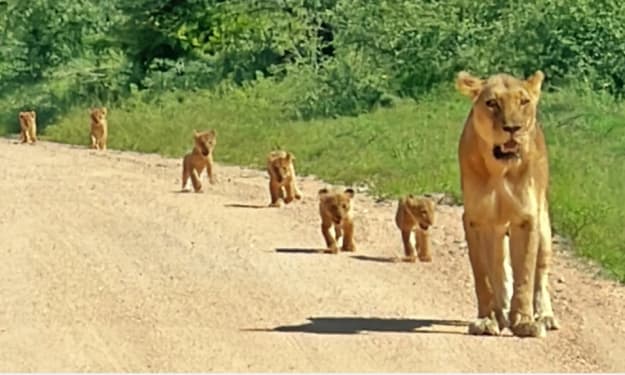
Tiny Lion Cubs Struggle To Keep Up With Mom
In the heart of the African savannah, life is a constant lesson for young animals. Few scenes are as endearing — or as heartwarming — as tiny lion cubs trying to keep pace with their mother. These little bundles of fur face a world full of challenges, from learning to hunt to avoiding dangers, all while depending on the guidance and protection of their experienced mom. Watching cubs wobble and tumble as they attempt to keep up with their mother reminds us that growing up, even in the wild, is a journey full of struggle, determination, and adorable missteps. The Early Days of Lion Cubs Lion cubs are born blind and helpless, usually in litters of two to six. For the first few weeks, they rely entirely on their mother for warmth, food, and safety. Even after opening their eyes and beginning to explore, the cubs are far from independent. The first months are crucial. Cubs learn social cues, hunting basics, and survival skills simply by watching their mother and the pride. But as anyone who has observed them knows, there’s often a huge gap between observation and action. Tiny cubs often struggle to match their mother’s pace, especially when she moves through long stretches of savannah or leads the family on patrols. A Mother’s Role in the Wild For a lioness, raising cubs is a full-time commitment. She hunts, defends her territory, and teaches her young, all while staying alert to predators such as hyenas, leopards, and even rival lions. The cubs, meanwhile, attempt to mimic her every move — often with clumsy yet charming results. A mother lion’s patience is remarkable; she frequently slows down, nudges them along, or stops to ensure no cub is left behind. These moments, while stressful for the tiny cubs, are vital learning opportunities. Struggling to Keep Up: Why It’s So Hard There are several reasons why tiny lion cubs have trouble keeping pace with their mother: Short Legs, Big Steps: Lion cubs’ legs are tiny and their coordination is limited, making it difficult to cover the same distance as an adult lioness. Curiosity: Cubs are naturally curious. A single butterfly or rustling bush can distract them, leaving mom to pause repeatedly. Energy Levels: Young lions tire quickly. Even with frequent naps, the cubs’ stamina is far lower than their mother’s. Learning Through Play: Play is not just fun; it teaches hunting, balance, and social skills. Running off to pounce on a sibling or chase an insect is all part of their education. Despite these challenges, the cubs’ determination to keep up demonstrates their resilience and growing understanding of the wild world. Lessons in Teamwork and Survival Every cub struggling to keep up is also learning crucial survival skills. The journey across the savannah is more than a test of speed — it’s a lesson in: Coordination: Cubs learn how to move efficiently across different terrains. Patience: They begin to understand the rhythms of adult life and the pace required for survival. Social Skills: Staying with the group teaches cubs how to interact with siblings and the pride, which is essential for their future roles. Observation: By following their mother, cubs study hunting techniques, territorial behavior, and predator awareness. Even the moments when cubs stumble or lag behind are essential for their development. These experiences prepare them for independence, which comes sooner than many might expect. The Cutest Moments in the Wild Anyone who has watched tiny lion cubs knows that their struggles are often irresistibly cute. Video clips from wildlife reserves frequently show cubs toddling along, tumbling over each other, or getting distracted mid-step. Observers often comment that these little stumbles reveal personality, determination, and playfulness, making them one of nature’s most heartwarming spectacles. While their mother is serious and focused, the cubs inject a sense of humor and lightness into life on the savannah. Why This Matters The struggles of lion cubs aren’t just adorable — they’re vital for understanding wildlife behavior. Conservationists and animal behaviorists use these moments to study growth patterns, social structures, and survival strategies in lion populations. These observations also highlight the importance of preserving natural habitats. Cubs must learn in a safe environment to survive; habitat loss, poaching, and climate change make these early struggles even more dangerous. Protecting the African savannah ensures that future generations of lions can experience the same lessons and playful tumbles. The Road to Independence Within a year, these tiny cubs will be more agile, faster, and more confident. By the time they reach two to three years old, males may begin to leave the pride, while females often stay and become caretakers themselves. Every misstep, tumble, and lagging moment is part of the journey toward strength, coordination, and independence. Watching them now gives us a glimpse of the challenges they will overcome, and the survival skills they will carry for life. A Celebration of Motherhood Ultimately, these scenes remind us of the incredible bond between mother and cubs. Her patience, vigilance, and teaching are the foundations of their future. The cubs’ struggles highlight the trials of growing up, while their determination showcases the resilience and beauty of wildlife. For those observing, it’s a powerful lesson in care, guidance, and perseverance, not just in lions but in the natural world as a whole. Final Thoughts Watching tiny lion cubs try to keep up with their mother is both entertaining and enlightening. It’s a story of growth, struggle, and resilience — a reminder that even the fiercest creatures start small, learning step by step. These little lions capture hearts while teaching life lessons: patience, determination, teamwork, and the importance of guidance. As they tumble and waddle across the savannah, they show us that growth is a process, one adorable misstep at a time. For wildlife enthusiasts, animal lovers, and anyone enchanted by nature, these tiny cubs are proof that even in the wild, love, care, and persistence are universal truths.
By Aarif Lashari6 days ago in Earth
Greenland’s Strategic Position in Seven Maps: Why Trump Wants the Island
In 2019, former U.S. President Donald Trump made waves by suggesting the United States should buy Greenland from Denmark. While his offer was quickly dismissed by the Danish government, the incident sparked a wider discussion about the geopolitical and strategic significance of the island. Why, out of all the territories in the world, would a major world power be so keen to acquire this cold, remote landmass?
By Muhammad Hassan3 days ago in Earth
📢 Raise Your Voice Thread: 01/22/2026
Our “Raise Your Voice Threads” are hosted most alternating Thursdays at 12PM ET to offer creators more avenues to uncover exceptional stories on Vocal. As we are continuously searching for fresh creators and inspiring stories, this thread provides an opportunity to exchange and discuss the stories that have moved and motivated us on Vocal.
By Raise Your Voice by Vocal3 days ago in Resources



Comments