
Explained | GIFT City: The history & tax incentives of India’s first ‘Smart City’
Gift city
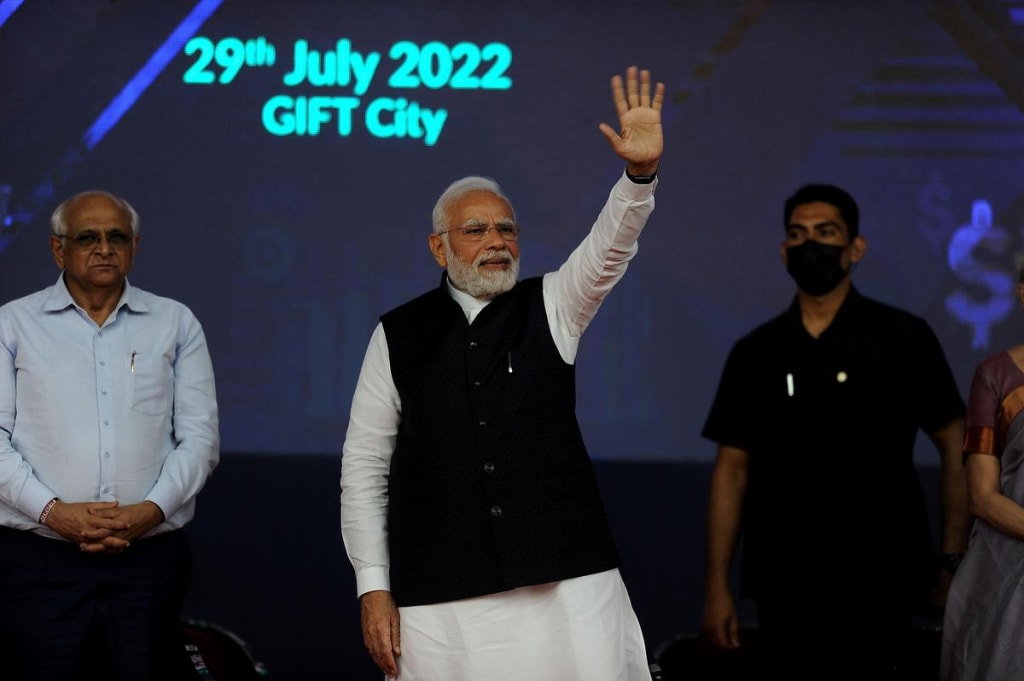
The story so far: In a major milestone for his dream project, the Gujarat International Finance Tec-City (GIFT), Prime Minister Narendra Modi on July 29 launched the India International Bullion Exchange (IIBX) – the nation’s first such exchange. The Exchange will be constructed in the heart of GIFT city – an international financial services hub conceptualised by Mr. Modi in 2008.
Highlighting India’s first ‘IT services hub’ — the Gujarat International Finance Tec-City (GIFT) city — Mr. Modi said that with the launch of the International Financial Services Centres Authority (IFSCA), India had joined the league of global financial centres like the United States, the United Kingdom and Singapore.
Stating that IFSCA will enable innovation in the financial services sector, he said , “Today, India alone has a 40 per cent share in real-time digital payments all over the world”. He also said that the various measures taken by his government on Foreign Direct Investment (FDI) policy had resulted in India receiving its highest-ever FDI inflow of ₹6,31,050 crore in the financial year 2021-22.
Recently, on August 23, Chartered Speed Ltd. launched a fleet of four electric buses and 20 e-bikes to aid commuters to GIFT City. The company has plans to expand the fleet to 50 electric buses in the coming 12 to 18 months.
What is GIFT city?
In 2008, the then-Gujarat Chief Minister Mr. Modi first announced that the state government would build a ‘Nano city’ and the Gujarat International Finance Tec-City (GIFT) at Gandhinagar. Addressing the ‘Invest Gujarat’ summit organised by Assocham, Mr. Modi said that the land between Ahmedabad and Gandhinagar would be developed as a Central Business District (CBD) with office spaces, residential apartments, schools, hospitals, hotels, retail and other recreational facilities.
Also read: A GIFT, to be delivered
After a feasibility study was conducted by consulting firm McKinsey and Co, GIFT was launched as a joint venture between the state-run Gujarat Urban Development Co. Ltd and Infrastructure Leasing and Financial Services Ltd (IL&FS), with an initial outlay of Rs 78,000 crores. The city is planned on 886 acres of land with 62 million sq. ft. of built-up area with 67 per cent commercial (42 million sq. ft), 22 per cent residential (14 million sq. ft) and 11 per cent social space (6 million sq. ft).
Helmed by Mr. Ramakant Jha in 2009, the project was initially stalled due to the 2008 U.S economic recession. However, it picked up pace by 2011 when the State government gave 673 acres across Ratanpur, Firozpur, Valad and Lavarpur at Rs. 1. Headed currently by Mr. Tapan Ray, IAS (Retd.) as Managing Director & CEO, the city is 12 km from Ahmedabad’s Sardar Vallabhbhai Patel International Airport and 8 km from Gandhinagar on thebanks of the Sabarmati.
Shift in focus from BKC
With Mr. Modi’s elevation to Prime Minister in 2014, GIFT turned from a real-estate project into India’s first smart city. While presenting the 2015-16 Union Budget, the then-Finance Minister Arun Jaitley shifted the Centre’s focus from Mumbai to GIFT as a potential global financial centre like Singapore or Dubai.
Previously, the Congress-led UPA government focused on developing Mumbai’s Bandra-Kurla Complex as a financial hub. In 2007, a government-appointed committee led by former World Bank official Percy Mistry recommended transforming Mumbai along the lines of New York, London and Singapore with BKC at its centre. Since then, Maharashtra government-run Metropolitan Region Development Authority (MMRDA) has developed and promoted BKC as a destination for global companies to house their Indian branches. However, with the Modi government’s shift in focus to developing GIFT and Mumbai’s geographical constraints, BKC has encountered issues in its expansion.
About the Creator
Greenland: New Shipping Routes, Hidden Minerals – and a Frontline Between the US and Russia?
Once seen as a remote and largely isolated Arctic territory, Greenland is rapidly emerging as a focal point of global geopolitics. Climate change, melting ice, and technological advances are transforming the island into a strategic hub defined by new shipping routes, vast mineral resources, and growing rivalry between major powers, particularly the United States and Russia. As the Arctic opens up, Greenland’s geographic position and untapped potential are pushing it to the center of international attention, raising questions about security, sovereignty, and sustainable development. Melting Ice and the Opening of New Shipping Routes One of the most visible impacts of climate change in the Arctic is the reduction of sea ice, which is making previously inaccessible waters navigable for longer periods each year. New Arctic shipping routes, including passages near Greenland, promise shorter travel times between Europe, Asia, and North America. Compared to traditional routes like the Suez Canal, Arctic pathways can reduce shipping distances by thousands of kilometers, cutting fuel costs and emissions. For global trade, this could be transformative. Greenland’s coastal waters are increasingly important as potential transit corridors and support hubs for these routes. However, the expansion of Arctic shipping also raises concerns about environmental risks, maritime safety, and the lack of robust emergency infrastructure in the region. Hidden Mineral Wealth Beneath the Ice Beyond shipping, Greenland holds significant reserves of critical minerals, many of which are essential for modern technologies and the global energy transition. These include rare earth elements, lithium, graphite, uranium, and other strategic resources used in electric vehicles, wind turbines, batteries, and defense systems. As demand for these materials grows, Greenland is being viewed as a potential alternative to existing supply chains dominated by a small number of countries. This has increased interest from Western governments seeking to diversify mineral sourcing and reduce strategic dependencies. However, mining in Greenland is controversial. Local communities and policymakers must balance economic opportunities with environmental protection and cultural preservation. Greenland’s harsh climate and fragile ecosystems make resource extraction both technically challenging and politically sensitive. The United States’ Strategic Interest in Greenland The United States has long considered Greenland strategically vital, largely due to its location between North America and Europe. The US already maintains a military presence at Pituffik Space Base (formerly Thule Air Base), which plays a key role in missile warning systems and space surveillance. In recent years, Washington has renewed its focus on Greenland, emphasizing Arctic security, infrastructure investment, and cooperation with Denmark, which oversees Greenland’s foreign and defense policy. US interest is driven by several factors: protecting transatlantic security routes, countering rival powers in the Arctic, and ensuring access to critical minerals. Greenland is increasingly viewed as a frontline in maintaining Western influence in the High North. Russia’s Arctic Ambitions Russia, meanwhile, sees the Arctic as central to its economic and military strategy. It has invested heavily in Arctic military bases, icebreaker fleets, and energy projects, particularly along its northern coastline. Although Greenland is geographically distant from Russia’s main Arctic territories, Moscow closely monitors developments there. The island’s proximity to key Arctic sea lanes and North Atlantic routes makes it strategically relevant in any broader confrontation between Russia and NATO. As tensions between Russia and the West remain high, Greenland’s location places it near the intersection of competing security interests, increasing its geopolitical significance. Greenland Between Global Powers The growing attention from major powers puts Greenland in a delicate position. While the island seeks greater economic independence and development, it must navigate complex relationships with Denmark, the United States, and other international actors. Greenland’s government has emphasized the importance of maintaining control over its resources and ensuring that development benefits local populations. At the same time, geopolitical competition risks turning Greenland into a strategic chessboard rather than a partner in decision-making. This balancing act is becoming more difficult as Arctic competition intensifies. Environmental and Social Challenges Greenland is on the front lines of climate change. Melting ice sheets contribute to global sea-level rise, while local communities face changes to traditional livelihoods such as fishing and hunting. The expansion of shipping and mining could bring jobs and infrastructure, but it also threatens fragile ecosystems and raises concerns about pollution, habitat disruption, and long-term sustainability. Any future development in Greenland will require careful regulation, international cooperation, and meaningful engagement
By Aarif Lashari5 days ago in Earth



Comments
There are no comments for this story
Be the first to respond and start the conversation.