
Europe Bioplastic Market Size and Forecast 2025–2033
Sustainable Materials Take Center Stage as Europe Accelerates the Shift Away from Conventional Plastics

Europe Bioplastic Market Overview
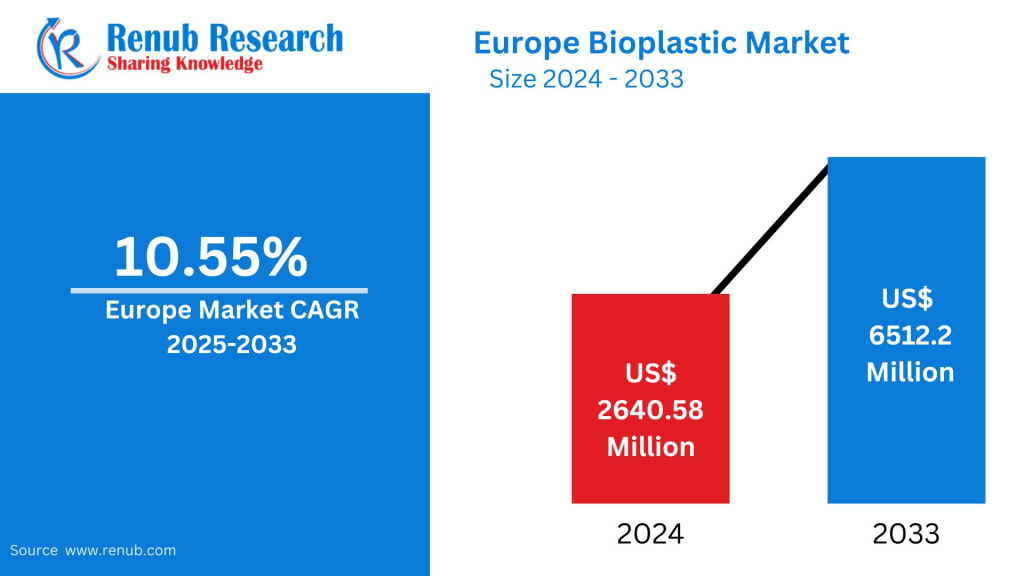
The Europe Bioplastic Market is undergoing a transformative phase, driven by a powerful mix of regulatory mandates, sustainability commitments, and changing consumer behavior. According to Renub Research, the market is expected to reach US$ 6,512.20 million by 2033, up from US$ 2,640.58 million in 2024, growing at a robust CAGR of 10.55% from 2025 to 2033.
This rapid expansion reflects Europe’s determination to move away from fossil fuel–based plastics toward bio-based, biodegradable, and compostable alternatives. With environmental protection firmly embedded in public policy and corporate strategy, bioplastics are emerging as a cornerstone material in Europe’s circular economy transition.
The increasing enforcement of single-use plastic bans, combined with ambitious recycling and carbon reduction targets, has accelerated adoption across packaging, agriculture, consumer goods, textiles, automotive, and construction sectors. Europe is not only the largest adopter of bioplastics globally but also a key innovation hub for advanced biopolymer technologies.
Regulatory Momentum Fuels Market Expansion
One of the strongest forces shaping the Europe bioplastic market is regulation. European authorities have implemented stringent rules to curb plastic pollution, reduce landfill waste, and lower greenhouse gas emissions. Initiatives such as the European Union Green Deal and the Circular Economy Action Plan mandate sustainable material usage, pushing industries to rethink plastic consumption.
Single-use plastic directives, packaging waste regulations, and recycling quotas have created a favorable environment for bioplastics. Manufacturers now face both legal pressure and reputational risk if they fail to align with sustainability goals. As a result, bioplastics are increasingly seen not as a niche alternative but as a strategic necessity.
Rising Consumer Awareness and Brand Responsibility
European consumers are among the most environmentally conscious in the world. Growing awareness of marine pollution, overflowing landfills, and climate change has shifted purchasing behavior toward eco-friendly products. Shoppers are actively seeking packaging labeled as biodegradable, compostable, or bio-based.
This shift has forced retailers, food & beverage companies, and consumer goods manufacturers to integrate bioplastics into their supply chains. Sustainability claims are now central to brand identity, particularly in food packaging, personal care, and household products. The result is a virtuous cycle where consumer demand reinforces corporate investment in bioplastic materials.
Technological Advancements Strengthen Performance
Historically, bioplastics faced criticism for limited durability, heat resistance, and higher costs. However, recent advances in material science have significantly narrowed the performance gap between bioplastics and conventional plastics.
Innovations in PLA, PHA, PBAT, and starch blends have improved flexibility, strength, and thermal stability. These enhancements allow bioplastics to be used in demanding applications such as automotive interiors, electronics packaging, and industrial films. As production scales up and technology matures, cost competitiveness continues to improve, further supporting market growth.
Key Factors Driving the Europe Bioplastic Market
Tight Environmental Regulations
Strict environmental laws across Europe directly encourage bioplastic adoption. Bans on certain plastic products, mandatory recycling targets, and eco-design requirements are compelling manufacturers to switch to sustainable materials. These policies also stimulate innovation in processing technologies and end-of-life solutions.
Government Incentives and Funding
European governments actively support bioplastics through subsidies, tax benefits, and research grants. Public–private partnerships and university collaborations accelerate innovation, while pilot projects help scale commercial production. These initiatives lower entry barriers for startups and strengthen Europe’s leadership in green materials.
Circular Economy Initiatives
Bioplastics align closely with circular economy principles by emphasizing renewable feedstocks, reduced carbon footprints, and improved end-of-life options. Compostable and biodegradable plastics play a crucial role in organic waste management, particularly in food packaging and agriculture.
Challenges Facing the Europe Bioplastic Market
Limited Industrial Composting Infrastructure
Despite progress, industrial composting facilities remain unevenly distributed across Europe. Many biodegradable plastics require controlled conditions to break down effectively. In regions lacking such infrastructure, bioplastics may end up in landfills or incinerators, limiting their environmental benefits.
Consumer Confusion and Labeling Issues
Misunderstanding around terms like “bio-based,” “biodegradable,” and “compostable” continues to create confusion. Inconsistent labeling can lead to improper disposal, contaminating recycling streams and reducing efficiency. Clear standards and consumer education are essential to overcome this challenge.
Higher Production Costs
Although costs are declining, bioplastics are still generally more expensive than conventional plastics. Price sensitivity in certain industries can slow adoption, especially in applications where sustainability benefits are not immediately visible to end users.
Europe Bioplastic Market by Region
Germany Bioplastic Market
Germany is a leader in Europe’s bioplastic ecosystem, supported by a strong chemical industry, advanced R&D capabilities, and efficient waste management systems. Bioplastics are widely used in packaging, automotive components, and consumer goods. While cost and labeling challenges remain, regulatory pressure and innovation continue to drive steady growth.
France Bioplastic Market
France’s commitment to reducing plastic waste and promoting circular economy practices has accelerated bioplastic adoption. Agriculture and packaging are key growth areas, supported by favorable policies and rising consumer demand. Continued infrastructure development will be crucial for sustained expansion.
Italy Bioplastic Market
Italy stands out for its well-developed composting infrastructure, making it an ideal environment for biodegradable plastics. Strong collaboration between government, industry, and academia fuels innovation. Packaging and agriculture remain dominant applications, positioning Italy as a model for bioplastic waste management.
United Kingdom Bioplastic Market
The UK bioplastic market benefits from ambitious net-zero targets and strong consumer awareness. Bioplastics are increasingly used in packaging, textiles, electronics, and automotive sectors. Although infrastructure gaps persist, ongoing R&D investments are expected to support long-term growth.
Latest Developments in the Europe Bioplastic Market
April 2025: USEON partnered with TotalEnergies Corbion to expand the global commercialization of EPLA molded products made from Luminy PLA bioplastics, targeting high-performance and eco-friendly foam applications.
January 2024: Braskem and FKuR expanded their European distribution agreement to include additional I’m Green bio-based EVA grades, increasing access to renewable, flexible, and lightweight resins.
Market Segmentation
By Material Type
Biodegradable:
PBAT, PBS, PLA, PHA, Starch Blends, Others
Non-Biodegradable:
PE, PET, PA, PP, PTT, Others
By Application
Packaging, Agriculture, Consumer Goods, Textile, Automotive & Transportation, Building & Construction, Others
By Country
France, Germany, Italy, Spain, United Kingdom, Belgium, Netherlands, Russia, Poland, Greece, Norway, Romania, Portugal, Rest of Europe
Competitive Landscape
The Europe bioplastic market is moderately consolidated, with global chemical giants and specialized biopolymer producers competing on innovation, sustainability credentials, and scale.
Key Players Covered:
Total Corbion
Mitsubishi Chemical Holding Corporation
Toray Industries
BASF SE
Green Dot Bioplastics
Amcor Limited
Each company is analyzed based on overview, key personnel, recent developments, SWOT analysis, and revenue performance.
Final Thoughts
The Europe bioplastic market is no longer an emerging niche—it is a rapidly expanding pillar of the region’s sustainability strategy. With strong regulatory backing, rising consumer awareness, and continuous technological innovation, bioplastics are reshaping how materials are produced, used, and disposed of across industries.
While challenges such as infrastructure gaps and consumer confusion remain, Europe’s commitment to a circular economy positions it at the forefront of the global bioplastics revolution. As investments increase and standards become clearer, bioplastics are set to play a defining role in Europe’s transition to a low-carbon, resource-efficient future.
About the Creator
jaiklin Fanandish
Jaiklin Fanandish, a passionate storyteller with 10 years of experience, crafts engaging narratives that blend creativity, emotion, and imagination to inspire and connect with readers worldwide.
Keep reading
More stories from jaiklin Fanandish and writers in Earth and other communities.
Australia Folding Furniture Market Size and Forecast 2025–2033
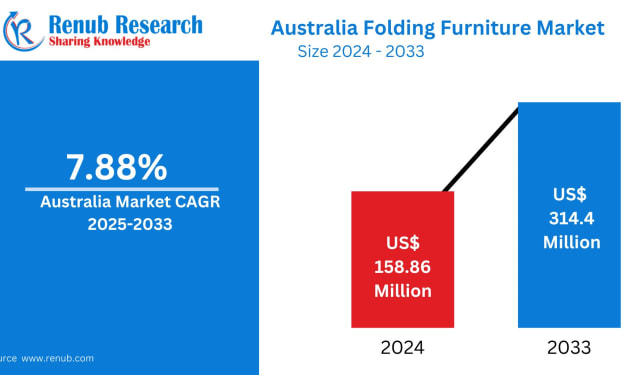
Australia Folding Furniture Market Outlook The Australia Folding Furniture Market is poised for robust growth over the coming decade, reflecting the country’s evolving lifestyles, housing patterns, and consumer priorities. According to Renub Research, the market is expected to reach US$ 314.4 million by 2033, up from US$ 158.86 million in 2024, expanding at a CAGR of 7.88% from 2025 to 2033.
By jaiklin Fanandish16 days ago in Earth
Stanislav Kondrashov on the Frontlines of the Energy Transition: Key Renewable Sources Powering the Future
As the global energy landscape shifts under the weight of climate change, political will, and public pressure, the question of “what comes next” no longer feels abstract. The energy transition is not a distant concept — it's underway. In this changing environment, thought leaders like Stanislav Kondrashov have emerged as measured voices guiding the conversation about which renewable sources hold real promise in the coming decades.
By Stanislav Kondrashov5 days ago in Earth
The steps to losing a child
Step One: Lose a child. Not what anyone wants to happen and nothing you can do to change it, but you can go through steps to becoming happy again. You can go through steps to loving again. You can go through steps to become a new you because after losing a child you will never be the same person you once were.
By Tabitha Hinkley3 days ago in Fiction


Comments
There are no comments for this story
Be the first to respond and start the conversation.