
Escaping Atlantis: The Human Rights Approach (Part I)
“In a single day and night of misfortune all your warlike men in a body sank into the earth, and the island of Atlantis in like manner disappeared in the depths of the sea.” - Plato


In The Republic of Plato, Socrates established his idea for the structure of a just city. In his vision, a king rules by philosophy and wisdom. Utility is meticulously moderated. Virtue is the law of the land. Every soul is governed accordingly. And every realm of the soul is governed accordingly.
Socrates' simulation of his regime reminded his friends of the ancient city of Atlantis. This great civilization resembled the just city with one critical distinction: the military held the crown. The leadership of greedy auxiliaries led to a lavish lifestyle dependent on the overindulgence of resources and imperial warfare. The corruption of Atlantis willed the Gods to sink their kingdom, drowning their luxuries in a single day.
The international community mirrors the relentless expansion of Atlantis. Governments and corporations bolster economic growth through fossil fuel-based production, distribution, transport, and utility. This dependence on industrialization has disrupted the natural greenhouse gas (GHG) cycle, which typically moderates planetary temperatures by radiating pollutants into outer space. The growing concentrations of GHG spawned by human activity has significantly altered the balance of pollutants, accelerating warmer temperatures across the planet.
From 1850 to 2020, annual global GHG emissions have grown from 54.59 tons to 4 billion tons. Post-industrial era human activity is responsible for average global temperatures rising by at least 1.0°C. This exorbitant trajectory echoes the downfall of Atlantis, warning of the consequences of unchecked ambition and unsustainable practices.
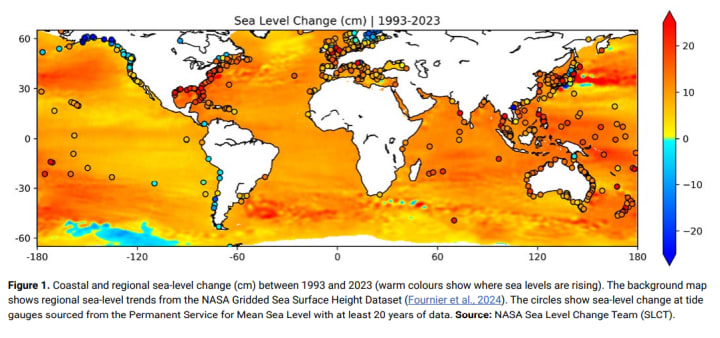
A 2024 United Nations technical brief by the UN Secretary-General's Climate Action Team outlined alarming trends under varying rising global temperature scenarios.
Under the 1.4°C lowest-emissions scenario, average global sea level is forecasted to rise to 15-23 cm by 2050 and 28-55cm by 2100. Under the 4.4°C highest-emissions scenario, the average global sea level is expected to rise to 20-29 cm by 2050 and 63-101 cm by 2100. At the moderate projection of a 60 cm increase by 2100, approximately 120 million current homes would face high tide levels.
Small Island Developing States (SIDS) are stranded on the frontlines. Sea level rise exacerbates coastal erosion, ecosystem degradation, and freshwater salinization. Warming oceans and coastal flooding have led to the decline of agricultural production and fishing reserves.
In the Pacific islands of Kiribati, storm surges and high tides contributed to unemployment, disease outbreaks, waste mismanagement, and social unrest. On the Australian archipelago of the Torres Strait Islands, sea level rise has desecrated the resources, infrastructure, and farmland of indigenous people.
Houses turn into rubble. Ceremonial land becomes seafloor. Flooded graves scatter the remains of ancestors.
Kiribati and the Torres Strait Islands are predicted to be uninhabitable in 10-15 years at the current rate of sea level rise. These Pacific regions would join the eight other islands that have already surrendered to the waves. The increasing frequency and intensity of storms exacerbates deprivation and displacement. These vulnerable island states — where the majority of their population lives less than 5 meters below sea level — cannot withstand these swarming tides.
Without immediate intervention, many SIDS will be immortalized as the modern Atlantis.

Atlantis will not stop at these islands. The International Organization for Migration (IOM) predicts 25 million to 1 billion climate migrants by 2050 - one in every 45 people would be displaced. While many of these vulnerable populations are not subject to international migration, establishing an actionable framework for climate migration grows urgent for low-lying nations that lack the capacity to withstand substantial climate displacement.
The current international structure does not grant permanent residence to people displaced from climate change.
Under Article 1 of the 1951 Refugee Convention, a person must have a "well-founded fear of persecution for reasons of race, religion, nationality, membership to a particular social group or political opinion" to be a refugee.
Environmental degradation, despite its catastrophic consequences, is not included within this definition. Climate disasters lack the general criteria of discrimination, intentionality, and causation to prove a reasonable possibility of persecution. Without classifying climate change as a well-founded fear of persecution, climate migrants do not receive refugee status.
Ineligibility of refugee status endangers climate migrants. Without a clear path to seek permanent sanctuary or long-term stability, many inhabitants of low-lying regions are helplessly exposed to devastating climatic shocks. As the oceans toss and churn frightened communities, several academic approaches have bubbled to the surface.
This investigative series explores the human rights approach. Drawing upon its current conception and legal framework, this analysis examines the interplay between human rights and international climate migration. This research primarily focuses on the impact of sea level rise and climatic shocks on SIDS, given their pressing vulnerabilities and unique challenges related to environmental degradation. To present the human rights approach in action, this analysis reviews the progression of climate migrant litigation in human rights complaints.
From the ice caps of Canada to the sandy shores of Kiribati, let’s explore international climate migration in our world treading over troubled water.
- To watch bite-sized videos on climate migration, visit Migration Matters
- To view graphs on global greenhouse gas emissions, explore Ritchie et al.
- To learn more about island degradation, read Holland and Babson
- To learn about different forms of climate migration, read Yayboke et al.
- For further sources, visit the Recommended Reading Folder
To view this investigative series with complete academic citations and references, visit my academic paper here.
For Part II of Escaping Atlantis, click here.
About the Creator
DJ Nuclear Winter
"Whenever a person vividly recounts their adventure into art, my soul itches to uncover their interdimensional travels" - Pain By Numbers
"I leave no stoned unturned and no bird unstoned" - The Sabrina Carpenter Slowburn
Reader insights
Outstanding
Excellent work. Looking forward to reading more!
Top insights
Compelling and original writing
Creative use of language & vocab
Easy to read and follow
Well-structured & engaging content
Expert insights and opinions
Arguments were carefully researched and presented
Eye opening
Niche topic & fresh perspectives
Masterful proofreading
Zero grammar & spelling mistakes
On-point and relevant
Writing reflected the title & theme
Keep reading
More stories from DJ Nuclear Winter and writers in Earth and other communities.
Escaping Atlantis: The Human Rights Approach (Part V)
This article is Part V of an investigative series about climate migration. For Part VI of Escaping Atlantis, click here. The Teitiota ruling was a heart-wrenching outcome for climate migration advocates. The UNHRC ruling enforced overly strict refugee requirements, excluding many climate migrants from life-saving international protection. Thus, many climate migrants remain trapped in increasingly dire situations.
By DJ Nuclear Winter4 months ago in Earth
Trump’s Plan to Own the Western Hemisphere and Greenland Is Not What Americans Want
Donald Trump’s foreign policy ambitions have always made headlines, but in early 2026, the conversation took a new turn — one that’s making Americans sit up and take notice. From proposals to dominate the Western Hemisphere to floating ideas about acquiring Greenland, Trump’s rhetoric has been bold, controversial, and, for many, out of step with what the public actually wants. While these ideas might energize parts of the political base, polls and public opinion suggest most Americans are skeptical, even alarmed, about using the military or U.S. influence to expand territory. Let’s break down what’s happening and why the majority of Americans are not on board. The “Don‑roe Doctrine” and a Bold Vision Trump’s team has revived the Monroe Doctrine — the 19th-century policy that told European powers to stay out of the Western Hemisphere — but with a modern twist. Some have jokingly dubbed it the “Don‑roe Doctrine”, emphasizing America’s supposed right to dominate the region and block rivals like China and Russia from gaining influence. In recent statements, Trump and his advisers have stressed that the Western Hemisphere should be under U.S. control, signaling a willingness to increase American power in Latin America. While rooted in history, this rhetoric goes far beyond traditional diplomacy, suggesting active intervention or oversight in neighboring countries’ affairs. Greenland: The Arctic Gambit If dominating the hemisphere wasn’t ambitious enough, Trump has also made headlines with Greenland, the world’s largest island and an autonomous territory of Denmark. Trump has suggested that the U.S. should explore acquiring Greenland, citing strategic national security reasons. The White House went even further, confirming that “a range of options” is on the table — including military involvement if negotiations fail. This statement made global headlines, sparking criticism not just from Denmark but from European leaders across the board. It’s an idea that would have seemed unthinkable a decade ago, and it raises serious questions about international law, diplomacy, and the U.S.’s reputation abroad. Why Americans Aren’t Buying It You might assume bold expansionist rhetoric would excite a nationalist base, but surveys and polls tell a different story. Only about 11% of Americans support purchasing or annexing Greenland. A majority of respondents oppose it outright, including many Republicans. Most Americans prefer a focus on diplomacy, domestic issues, and practical governance, rather than acquiring distant lands. There’s also a strong sense of military fatigue. After decades of overseas interventions, many Americans are wary of costly and risky military actions that may not directly protect U.S. interests. International Pushback Trump’s Greenland idea hasn’t just been controversial domestically — it’s caused outrage abroad. Denmark, the sovereign nation over Greenland, made it clear that the island is not for sale. European leaders have voiced strong support for Greenland’s autonomy and warned that any U.S. attempt to take control could strain alliances, including NATO. Even countries in the Western Hemisphere are cautious. Many Latin American leaders view heavy-handed U.S. influence as unwelcome, highlighting the risks of a foreign policy focused on territorial dominance. The Public Sentiment Gap The contrast between Trump’s ambitions and American public opinion is stark: Sovereignty matters: Most Americans recognize that countries, including Greenland, have the right to self-govern. Military intervention fatigue: There’s little appetite for new foreign conflicts, especially for reasons seen as symbolic or expansionist. Focus on domestic priorities: Healthcare, the economy, education, and infrastructure consistently outrank foreign conquest in Americans’ list of priorities. In short, the public is telling leaders that the future of U.S. influence lies in cooperation, not domination. Why This Matters Trump’s rhetoric has drawn global attention, strained alliances, and created diplomatic tensions. But beyond the headlines, it’s also a reminder of the limits of foreign policy that ignores public opinion. Americans want their leaders focused on practical issues — and most see territorial expansion or hemispheric control as a distraction at best, a liability at worst. The Greenland debate, in particular, highlights the potential clash between ambitious political theater and real-world consequences. While Trump’s ideas make for sensational headlines, they don’t reflect the priorities of everyday Americans. Final Thoughts Donald Trump’s vision of owning the Western Hemisphere and potentially acquiring Greenland is bold — some might even call it audacious. But boldness alone doesn’t win hearts and minds. In fact, Americans are largely rejecting expansionist rhetoric, favoring diplomacy, alliances, and domestic problem-solving over territorial ambition. In a world that is interconnected and wary of unilateral power grabs, the public seems to be sending a clear message: power is important, but consent, cooperation, and practicality matter even more. As Trump continues to push these ideas, he faces the reality that public opinion, international norms, and global diplomacy may be the real limits on his ambitions — not headlines or political theatrics.
By Muhammad Hassan6 days ago in Earth
BRICS Wargames: Why They Matter — And Why India Chose to Sit Out
BRICS — the economic and political bloc comprising Brazil, Russia, India, China, and South Africa — has long been seen as a counterweight to Western-dominated global institutions. Over the years, it has expanded its influence in finance, trade, and diplomacy. Yet, in recent times, BRICS has begun exploring another domain that grabs headlines and sparks speculation: military cooperation, including large-scale wargames. These exercises are designed to simulate joint operations, test interoperability, and send a signal of strength. For members like Russia and China, wargames serve as both a show of force and a tool to deepen military collaboration within the bloc. However, India’s decision to opt out of recent BRICS wargames has raised questions: why does this matter, and why is India taking a different path from its BRICS partners? The Rise of BRICS Military Exercises Historically, BRICS has been portrayed as primarily economic, focused on initiatives like the New Development Bank (NDB) and trade agreements aimed at reducing Western dominance. But recent years have seen an evolution. Military drills among BRICS members are increasingly prominent, especially in the context of global tension and regional conflicts. These wargames are about more than just tactical drills. They serve multiple purposes: Strategic signaling: By conducting joint exercises, BRICS countries demonstrate unity and military capability to the rest of the world. Operational readiness: Countries test their ability to coordinate in complex scenarios, from humanitarian missions to potential combat operations. Diplomatic leverage: The exercises send subtle messages to other global powers, indicating that BRICS members can collaborate beyond economic forums. For nations like Russia, recently facing sanctions and international scrutiny, these exercises are particularly important. They showcase the ability to maintain partnerships and project power despite global isolation. For China, it is a way to cement strategic influence in Asia and beyond. Why BRICS Wargames Matter Globally The significance of these exercises extends beyond the bloc itself. Analysts note several key implications: Challenge to NATO and U.S. influence: BRICS wargames signal that alternative power centers exist outside Western-led military alliances. Regional security dynamics: Countries bordering BRICS members, particularly in South Asia, Africa, and Latin America, must monitor these developments carefully. Economic-military linkages: Military coordination among major emerging economies could shape security considerations in trade corridors, energy supply routes, and resource-rich regions. In essence, BRICS wargames are not just about soldiers and tanks, but about the broader geopolitical landscape: signaling, strategy, and shaping perceptions of influence. India’s Calculated Decision to Opt Out While Russia, China, Brazil, and South Africa have shown interest in participating actively, India has strategically chosen to abstain from the most recent wargames. This decision may appear surprising, given India’s economic and political stake in BRICS, but several factors explain it. Geopolitical balancing: India maintains complex relations with both China and Russia. While it has defense and historical ties with Russia, its relationship with China has grown tense due to border disputes and regional competition. Joining a wargame with China could be politically and militarily sensitive. Alignment with Western partnerships: India has strengthened ties with Western-led coalitions, including the Quad (U.S., Japan, Australia, India). Participating in BRICS military drills could conflict with these alliances, potentially sending mixed signals. Strategic autonomy: India has long emphasized a policy of strategic autonomy — making decisions based on national interest rather than bloc pressure. Opting out allows India to maintain flexibility in foreign policy and avoid entanglement in exercises that may not align with its regional objectives. Domestic perception: Indian public opinion and political narratives favor cautious engagement with China and Russia on military matters. Skipping the wargames minimizes domestic criticism of appearing too closely aligned with either of the more assertive BRICS powers. What India Gains by Sitting Out Choosing not to participate does not mean India is disengaged from BRICS. Economically and diplomatically, it remains a key player in the bloc. By skipping the wargames, India can: Maintain regional credibility in South Asia while avoiding the perception of aligning militarily with China. Signal strategic independence, reinforcing its image as a nation that prioritizes national security over bloc politics. Focus on bilateral and multilateral exercises elsewhere, such as those with the U.S., Japan, and Australia, which are more aligned with India’s current security priorities. In short, opting out allows India to navigate the delicate balance between its BRICS commitments and broader global strategic interests. Implications for BRICS and Global Security India’s abstention also reflects broader trends within BRICS: the bloc is not monolithic. While economic cooperation is often strong, military integration faces political and strategic limits. Differing national interests, historical rivalries, and regional tensions prevent uniform alignment. For global observers, this is crucial. It shows that while BRICS wargames are important, they are not necessarily indicative of a fully unified military bloc. The exercises are as much about optics as operations, and India’s absence underscores the challenges of aligning countries with divergent security priorities. Conclusion BRICS wargames matter because they are a window into the bloc’s evolving strategic ambitions. They signal power, test cooperation, and demonstrate emerging global influence. Yet India’s decision to opt out highlights that even within this growing coalition, national interests remain paramount. For India, the choice reflects a calculated approach: engage where it benefits national interest, avoid where risks outweigh gains, and maintain strategic flexibility. For the rest of the world, it is a reminder that BRICS, while increasingly important, is not a military monolith. Ultimately, BRICS wargames are as much about geopolitics and signaling as they are about military maneuvers — and India’s careful stance illustrates how emerging powers navigate this complex global chessboard.Start writing...
By Muhammad Hassana day ago in Earth


Comments
There are no comments for this story
Be the first to respond and start the conversation.