
Entropy: the thermodynamic unit that speaks to the rules of nature, so against the rules of nature you can hardly discipline yourself!
Entropy: the thermodynamic unit that speaks to the rules of nature

Firstly, an introduction to Clausius who proposed the unit of entropy. Clausius, whose full name was Rudolf Julius Emanuel Clausius, was a German physicist and mathematician who was one of the main founders of thermodynamics. He restated the Nicolas Carnot law (Carnot cycle) and pushed the theory of heat to a more realistic and sound basis. The basic concept of the second law of thermodynamics was later clearly stated and the concept of entropy was introduced.
Let's introduce what entropy is again. Entropy is a thermodynamic unit and is one of the parameters characterizing the state of matter. The physical meaning of entropy is a measure of the degree of chaos in a system. The principle of entropy increase is that the entropy in an isolated thermodynamic system does not decrease, but always increases or remains constant.
That is, in an isolated system (i.e. without external forces/energy)/adiabatic process (a process in which there is no heat exchange between the system and the environment), the degree of chaos will only increase or remain constant, it cannot decrease or become ordered.
The second law of thermodynamics is based on this, and the problem is that heat cannot be transferred spontaneously from a low-temperature object to a high temperature (low temperature means molecular inactivity, high temperature means molecular activity. Without energy, molecules cannot be active or very active).
Einstein said, "The theory of entropy is the first law of the whole of science." In physics, the principle of entropy increase, and the conservation of energy have equal status. However, conservation of energy is an equation and the entropy increase principle is an inequality.
Entropy is a macroscopic quantity that encompasses the collective nature of all the microscopic particles in a system; microscopic particles that do not make up the system are meaningless. Entropy exists everywhere around us, from the universe to us. If it cannot be understood, then we ignore the heat, a parameter we cannot intuitively understand, and consider only the degree of chaos. For example, everything around us is easily chaotic and difficult to recover, and in some cases impossible to recover.
So in non-isolated systems, does entropy increase not happen? No, it's just that when there are external factors, entropy increase doesn't seem as prominent and it's not as easy to reach the equilibrium state of maximum entropy (a state where macroscopic properties remain constant over time), because entropy increase is accompanied by entropy decrease. We change our surroundings, consciously or unconsciously, and the environment gives us feedback, so we don't feel the entropy increase principle in its full state.
But whatever it is, the result is mostly an increase in entropy, because entropy reduction requires us to do work, and entropy reduction is often much slower than entropy increase.
For example, our rooms need to be tidied up, or we usually have the habit of putting things back where they belong. Otherwise, it will just get messier and messier. The mess does not make it impossible for us to live, but it certainly affects the quality of life.
Our bodies need us to exercise, otherwise, we will get worse and worse. Although we can stay fit or in a state of sub-health by taking necessary actions (such as walking, etc.). Usually, we are bound to get sick at some point; you also need to keep exercising to lose weight, otherwise, you will rebound, i.e. the entropy value increases repeatedly
Nature needs our protection. We have destroyed the ecology. It is now impossible to protect the environment and restore the earth to its original state. It is only possible to slow down the destruction of the earth's ecology.
The increase in entropy is spontaneous. To stay the same or have entropy decrease, you can only do work to change it. We need to discipline ourselves about repeated entropy increases. This is the law of nature and the direction in which it evolves (our universe was created after a big bang with very little entropy and can only evolve in the direction of increasing entropy). You can't change it, you have to change yourself. Why do you always find self-discipline difficult? It is because you are going against the laws of nature.
Of course, it's okay not to fight this natural law, you can still live. Because there is a lot of entropy reduction that you do unintentionally, this part of entropy reduction may be just enough to offset the entropy increase, but it may not be enough at all. Life is a process of constant entropy reduction. If the entropy reduction ends that day, the maximum entropy dies out as well.
Here we expand on the opposite of entropy, 'negative entropy, which is a measure of the ordered, organized, and complex state of a material system. Negentropy can be light, it can be food, it can be information. These are all forms of low entropy, just different relative systems. And the most fundamental source of negentropy on Earth is sunlight. Negentropy is easily accessible and necessary for us.
Keeping the body in shape and organizing external information for our use is keeping it in an ordered state of low entropy. Low entropy beings or objects are absorbing the negative entropy around them. Plants absorb light and water to keep their entropy low, and plants are also negentropic and can keep us low entropy. So the same object needs negentropy and can become negentropic. We are all absorbing negative entropy and, at the same time, transforming it into entropy and releasing it.
A thermodynamic unit tells us the rules of the world. The world may not be complicated, but it is amazing. Many seemingly unrelated things are connected. Needless to say, the world still needs to be explored. There are too many things we have not yet discovered, do not yet know, do not yet know.
I think it is a summary of the main points :
1. Entropy is a thermodynamic unit that represents the degree of chaos. The principle of entropy increase is that the entropy in an isolated thermodynamic system does not decrease, but always increases or remains constant. The second law of thermodynamics is based on the fact that heat cannot be transferred spontaneously from a low-temperature object to a high-temperature object.
2. Clausius, whose full name was Rudolf Julius Emanuel Clausius, was a German physicist and mathematician who was one of the main founders of thermodynamics. He restated the Nicolas Carnot law (Carnot cycle) and pushed the theory of heat to a more realistic and sound basis. The basic concept of the second law of thermodynamics was later clearly stated, introducing the concept of entropy.
3. Entropy is a macroscopic quantity that exists everywhere around us. It is well understood by assuming that heat is ignored and only the degree of chaos is considered.
4. In non-isolated systems, entropy increases insignificantly because the same entropy decreases exist. We change the environment and the environment feeds back, so in a perfect state, we don't feel an increase in entropy. But everything tends to increase in entropy because the rate of entropy decrease is much slower than the rate of entropy increase.
5. Entropy increase is spontaneous, natural law and direction of evolution. To stay the same or to decrease entropy, one can only do work to change it.
6. Life is a process of continuous entropy reduction. If the day entropy decreases end, entropy reaches its maximum and you die.
7. Negative entropy can be light, it can be food, it can be information. These are all forms of low entropy, just different relative systems. And the most fundamental source of negative entropy on Earth is sunlight.
8. Negentropy is readily available and necessary for us. Low entropy beings or objects are absorbing the negative entropy around them.
9. The same object both need negentropy and can become negentropic.
About the Creator
Sukkning
Science will give mankind's greatest gift is? Is to make the power of humans believe that truth。
Global Lawn Mowers Market Set for Strong Growth as Smart Landscaping Goes Mainstream (2025–2033)
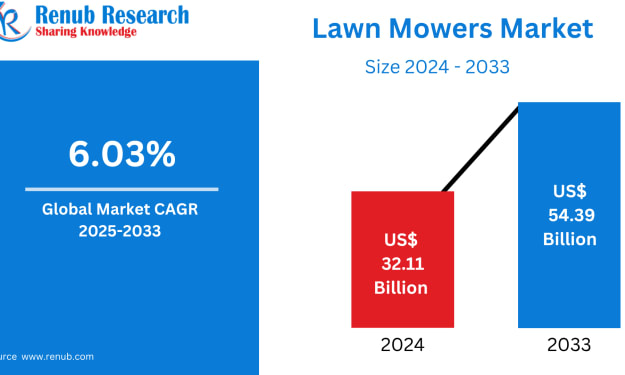
Global Lawn Mowers Market Size & Forecast 2025–2033 The Global Lawn Mowers Market is entering a transformative decade, reshaped by rapid urbanization, the rise of smart homes, and growing environmental awareness. According to Renub Research, the market is projected to grow from US$ 32.11 billion in 2024 to US$ 54.39 billion by 2033, expanding at a CAGR of 6.03% from 2025 to 2033.
By jaiklin Fanandisha day ago in Earth
Homeowners Don’t Want to Move: The Big Deal About Shrinking Backyards
In neighborhoods across the country, a subtle but growing trend is taking root: homeowners aren’t moving, and it’s not just because of the housing market. Many are staying put because their backyards—once spaces for relaxation, gardening, and family fun—are shrinking, either physically due to new development or symbolically as life priorities shift. What may seem like a minor detail—an ordinary backyard—is, for many, a defining feature of home life. Losing it can change how people live, play, and even feel about their communities. This shift has consequences for families, urban planning, and even the way cities are designed. It also sheds light on why homeowners are willing to compromise on size, style, or even location rather than give up their outdoor space. Why Backyards Matter More Than Ever Backyards are more than just patches of grass. They are extensions of our living space, providing: Personal outdoor retreats for reading, gardening, or hosting friends. Safe spaces for children and pets to play. Social hubs for barbecues, birthdays, and neighborhood gatherings. Mental and physical health benefits, including fresh air, sunlight, and exercise. For families who have invested years into landscaping, planting trees, or building decks and patios, the backyard is an emotional asset. Moving to a new home often means losing these personal touches—and many homeowners aren’t willing to take that step. “Backyards are part of our identity,” says Laura Jennings, a landscape designer in suburban Chicago. “People have memories tied to them—first steps, garden harvests, family barbecues. That’s why so many homeowners are staying put, even if it’s tempting to relocate for a bigger house or a better neighborhood.” The Trend of Shrinking Yards Urban densification and suburban development have slowly eaten into traditional backyard space. In many cities, large lots are being replaced with townhomes, duplexes, or small-lot single-family homes. Even in suburban neighborhoods, new constructions often prioritize indoor square footage over outdoor space. The shrinking backyard trend has several effects: Less room for recreation: Families may struggle to fit a swing set, pool, or garden into a smaller yard. Increased desire to stay put: Homeowners prefer maintaining a familiar outdoor space rather than trading it for a slightly larger indoor area. Higher emotional attachment: As yards become more limited, the significance of every tree, patch of grass, or vegetable garden grows. For many, the choice isn’t just about square footage—it’s about quality of life. Homeowners Are Making Trade-Offs As a result, more homeowners are staying in place longer, even if it means: Skipping a bigger kitchen or extra bedroom. Living in a less “trendy” neighborhood. Paying more in maintenance or property taxes to keep a cherished yard intact. Some have embraced innovative backyard solutions to maximize smaller spaces: Vertical gardens and container planting. Multi-functional patios that serve as dining, lounging, and play areas. Creative landscaping, including raised beds, pergolas, and tiny ponds. These adaptations allow homeowners to maintain the sense of space and enjoyment they’ve built over years without relocating. Emotional and Social Dimensions Beyond practical reasons, the backyard has a symbolic meaning. It represents: Continuity and stability: Homeowners see staying put as preserving a lifestyle. Family history: Many yards hold stories—graduations, summer afternoons, first bike rides. Community connection: Long-term residents know neighbors, local schools, and nearby amenities. Moving often means giving up these ties. A survey by the National Association of Home Builders found that over 60% of homeowners aged 35–55 preferred staying in their current homes, citing yard size and outdoor enjoyment as key factors. For these individuals, giving up a backyard is not a small inconvenience—it’s a major life decision. The Impact on Neighborhoods and Cities The trend of staying put also affects broader urban and suburban planning. Fewer homeowners moving means: Less turnover in neighborhoods, which can reduce housing market fluidity. Pressure on developers to include quality outdoor space in new builds. Greater demand for parks and community green spaces, as private yards shrink. Urban planners and developers are noticing the importance of outdoor space in retention and satisfaction metrics. Homes with usable yards, green roofs, or communal gardens often have higher value and attract long-term residents. The Future of Backyard Living As city lots shrink and suburban sprawl continues, homeowners are adapting: Smaller, highly curated gardens instead of sprawling lawns. Multi-functional backyards designed for work, play, and entertainment. Investment in outdoor amenities such as fire pits, decks, or small pools. Some communities are exploring shared backyard concepts, like community gardens and pocket parks, to supplement shrinking private spaces. While these aren’t a complete replacement for personal yards, they provide social and environmental benefits and may encourage homeowners to stay in their homes longer. Conclusion: More Than Grass and Trees Shrinking backyards might seem like a minor design issue, but for homeowners, it’s deeply tied to lifestyle, family life, and personal identity. The reluctance to move is not just a reaction to the housing market; it reflects an emotional, social, and practical connection to outdoor space that indoor square footage alone can’t replace. As urban density grows and lot sizes shrink, the importance of backyards will continue to shape homeowner decisions, neighborhood design, and community dynamics. Families are showing that a yard is not just grass and trees—it’s a place of memory, freedom, and connection. In a world where real estate trends often prioritize indoor luxury, the backyard remains a powerful symbol of home, anchoring families to the places they love—and keeping many from moving at all
By Muhammad Hassana day ago in Earth
Miss Persephone's Manual to a Seemingly Ordinary Life
Miss Persephone was found at the dining table, her blue eyes swollen, her tears arriving and retreating like the tides of the ocean. Earlier that day, her family had visited her in the retirement home where she had lived for eight years. It was her eightieth birthday.
By Imola Tóth5 days ago in Fiction



Comments
There are no comments for this story
Be the first to respond and start the conversation.