
Echoes Beneath the Waves: The Mystery of the Titanic
Unraveling Secrets Lost in the Depths of the Atlantic

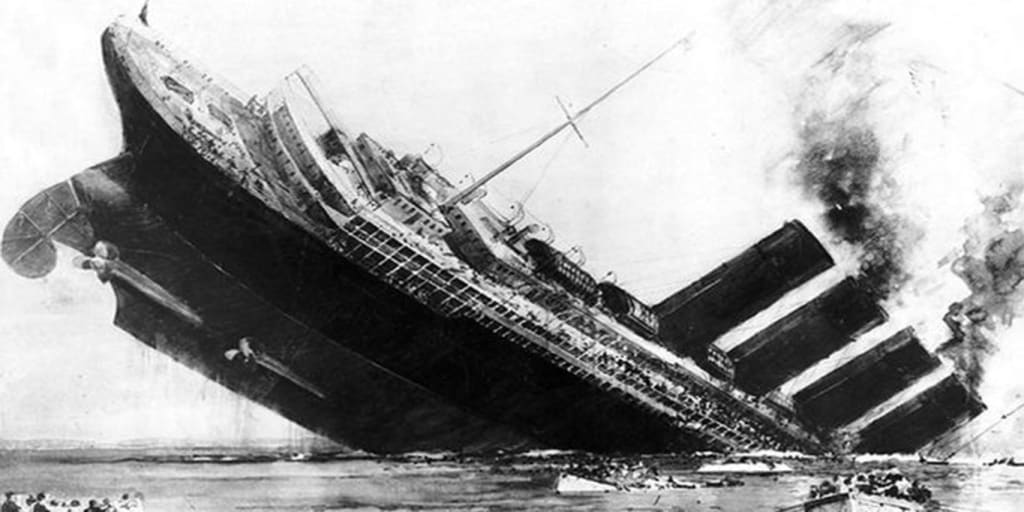
The sea was calm on the night of April 14, 1912. The sky, a blanket of stars, watched over the RMS Titanic as it cut through the icy waters of the North Atlantic. Dubbed “The Unsinkable Ship,” she was a floating palace—boasting luxury, innovation, and grandeur the world had never seen before. But beneath her glowing decks and elegant ballrooms lurked a secret, one that would vanish with her into the ocean’s cold embrace.
Over a century later, in the year 2025, deep-sea archaeologist Dr. Elara Hayes stood aboard the research vessel Ocean Whisper, staring at a monitor displaying sonar scans of the Titanic’s wreck site. She had spent a decade studying the Titanic, but this mission was different. Recently uncovered naval logs from 1912 hinted at a mystery beyond the well-known iceberg collision—an unauthorized cargo crate loaded at midnight in Belfast, marked only with the symbol of an ancient compass rose.
“Ready to descend,” her voice crackled over the headset as the submersible Abyss Explorer prepared to dive. The ocean swallowed the craft as Elara and her small team descended through miles of pressure-crushing darkness.
At 12,500 feet below sea level, the wreck appeared—massive and ghostly, covered in rusticles, resting silently on the seabed. But this time, their eyes weren’t on the grand staircase or the broken bow. They searched the lower cargo hold, a part of the ship rarely explored due to its instability.
“There,” Elara whispered, pointing at a warped metal door barely hanging on its hinges. They maneuvered through, beams of light piercing through silt-filled water. Inside, half-buried beneath crates and debris, was what they came for: a rusted, sealed container with the same compass rose symbol.
Using robotic arms, they carefully cut through the lock and pried it open. Inside were stacks of documents wrapped in oilcloth, a peculiar glass orb, and a small leather-bound journal. Elara’s hands trembled as she retrieved it.
Back aboard the Ocean Whisper, the team gathered around the journal. Its pages, remarkably preserved, were written in a mix of English and an older script—Aramaic. The author identified himself as Dr. Thomas R. Cavendish, a British antiquarian who had boarded the Titanic in secret under the name “Mr. Gray.” His journal revealed a chilling truth: the Titanic was not only carrying passengers and mail—but also a relic believed to be linked to an ancient civilization predating even Mesopotamia.
According to Cavendish, the orb was discovered in a collapsed temple in northern Egypt—rumored to grant visions of the future. Its power had driven men to madness. Fearing it would fall into the wrong hands, Cavendish arranged its transport aboard the Titanic, believing the ship’s secrecy and speed would protect it. But he also feared the orb's curse—one he claimed had already begun affecting the crew through hallucinations and erratic behavior.
The journal ended abruptly, with the final words:
"The sea calls it home. May none ever awaken what sleeps within."
Elara’s breath caught. The orb was still on board. Scientists on her team conducted scans—inside the orb were crystalized fragments emitting low-frequency vibrations. The patterns were not natural. They resembled coded messages. One researcher, Dr. Singh, cracked a segment and gasped.
“It’s a warning… and a map.”
The coordinates pointed to an underwater trench, hundreds of miles from the Titanic. Could there be more relics? Was the Titanic just the beginning of a larger cover-up?
News of the discovery leaked. The world reeled. Governments demanded access, private collectors offered billions, and conspiracy theorists shouted of curses and lost civilizations.
But Elara had made her decision.
She returned the orb to the wreck, placing it gently where it had been found. “Some mysteries,” she said, “aren’t meant to be solved—only remembered.”
As they ascended, a storm brewed above. Thunder cracked, waves crashed, but the sea below remained still, as if satisfied. The Titanic had given up one of its secrets, but many more still slept beneath the waves.
Back on land, Elara published her findings—not all of them, just enough to honor the past without disturbing it further. The world now knew that the Titanic's story was more than a tragedy—it was a warning, a whisper from the deep.
Because the ocean remembers.
And sometimes, it speaks.
About the Creator
Mati Henry
Storyteller. Dream weaver. Truth seeker. I write to explore worlds both real and imagined—capturing emotion, sparking thought, and inspiring change. Follow me for stories that stay with you long after the last word.
Keep reading
More stories from Mati Henry and writers in Earth and other communities.
Into the Clouds: Conquering Mount Everest
The wind howled like a wild beast, tearing through the fabric of the tents and whistling across the icy ridges. Above 26,000 feet, in the heart of the “Death Zone,” air was thin, frost clung to eyelashes, and every breath felt borrowed. Yet, amidst the unforgiving cold and near-vertical cliffs, a figure pressed forward—Aryan Malik, a 29-year-old mountaineer from Pakistan, chasing a dream carved into the sky.
By Mati Henry 10 months ago in Earth
The Star That Keeps Dimming for No Known Reason
In 2015, astronomers analyzing data from NASA's Kepler Space Telescope discovered a star designated KIC 8462852, located about 1,470 light-years from Earth in the constellation Cygnus, that was exhibiting brightness fluctuations unlike anything that had been observed in over 150,000 stars surveyed by the Kepler mission, and the pattern of dimming was so unusual and irregular that it could not be explained by any known natural phenomena including planets orbiting the star, stellar pulsations, or dust clouds, leading some scientists to seriously propose that the dimming might be caused by artificial structures built by an advanced alien civilization, specifically something like a Dyson swarm of solar collectors orbiting the star to harvest its energy, though this explanation while exciting was considered a hypothesis of last resort only to be entertained after all natural explanations had been exhaustively ruled out. The star, which became known informally as Tabby's Star after astronomer Tabetha Boyajian who led the research team studying it, showed dimming events where its brightness dropped by up to 22 percent, far more than could be explained by a planet passing in front of it, which typically causes dimming of only a fraction of a percent, and the dimming events were irregular and aperiodic, meaning they did not repeat on any predictable schedule, and different dimming events had different characteristics with some showing gradual dimming over days and others showing more sudden brightness drops.
By The Curious Writerabout 11 hours ago in Earth



Comments
There are no comments for this story
Be the first to respond and start the conversation.