
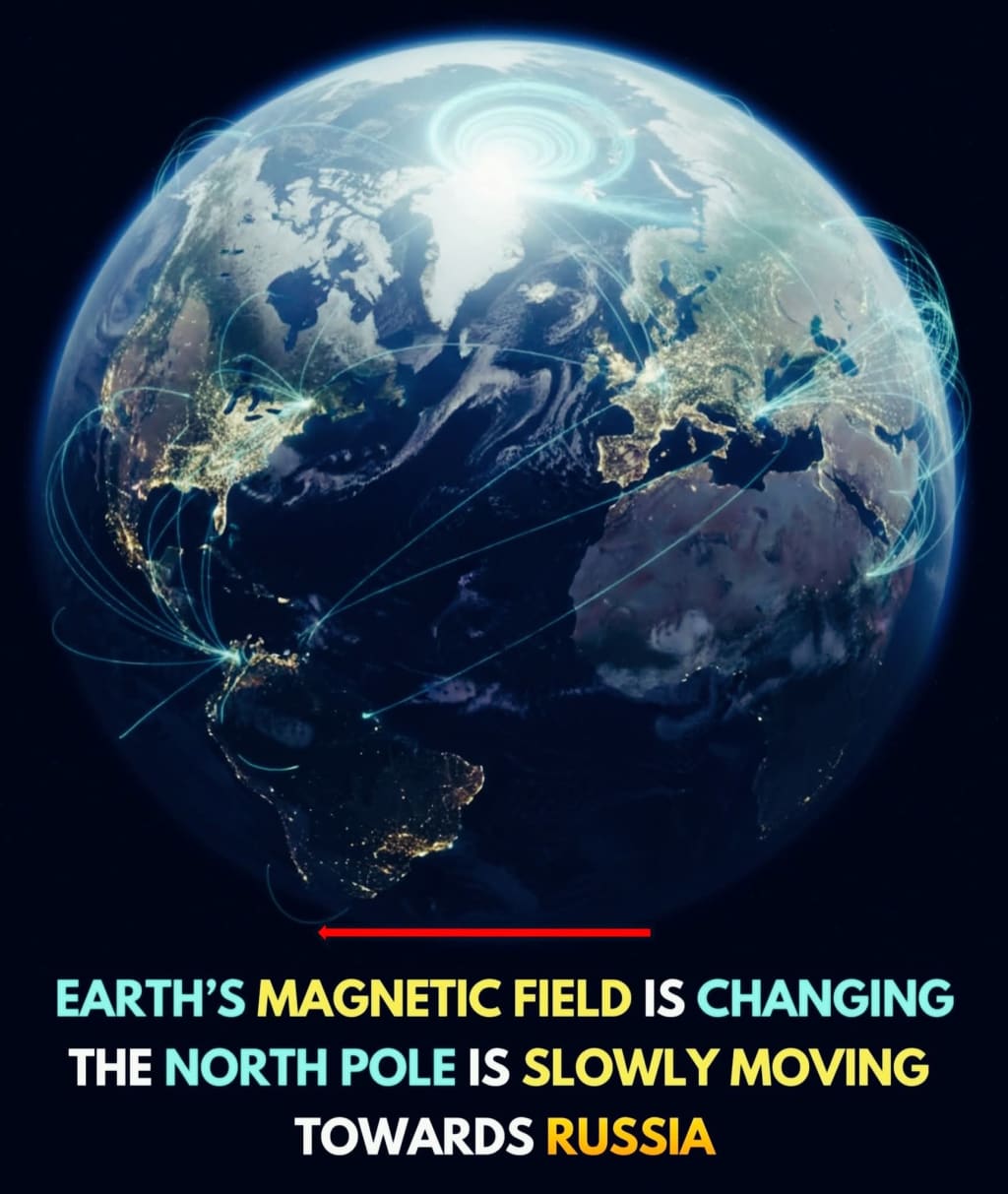
EARTH'S MAGNETIC FIELD IS CHANGING THE NORTH POLE IS SLOWLY MOVING TOWARDS RUSSIA
Earth

What’s Happening
The North Magnetic Pole (not to be confused with the geographic North Pole) — the point on Earth where a compass needle points — is slowly shifting across the Arctic. Over the past several decades, this pole has been migrating from northern Canada toward Siberia in Russia.
Scientific observations show its movement has been unusually fast in recent decades. From a historical drift of only a few kilometers per year, the magnetic North Pole sped up, at times moving 50–60 km per year. That said — in the last few years — its speed appears to have slowed somewhat.
---
🔧 Why It’s Moving: Earth’s Inner Engine
The Earth’s magnetic field is generated by molten iron and nickel swirling in the outer core — a process known as the "geodynamo."
Underneath the planet’s surface, in the boundary between the core and mantle, there are zones (or "lobes") of magnetic flux. One such lobe lies under Canada, another under Siberia. Over the last few decades, the Canadian lobe weakened while the Siberian lobe strengthened.
This shift in magnetic strength essentially “pulls” the North Magnetic Pole — which is why it has been drifting eastward and northward toward Russia.
Think of it as the magnetic balance inside Earth tilting: as one region’s magnetic influence fades and another’s grows, the pole repositions accordingly.
---
📡 Why People Care: Impacts on Navigation and Technology
The movement of the magnetic pole has forced an unscheduled update to the World Magnetic Model (WMM). This is the global reference used by GPS devices, navigation systems, aircraft, ships — and even smartphones — to correct magnetic north.
If navigation systems don’t account for the shifting pole, compasses and other magnetic-based tools can become inaccurate — especially near the Arctic and at high latitudes.
Because these changes are dynamic, updates to navigational datasets must be timely — even ahead of the usual schedule.
In short: in a world still relying in part on magnetic navigation, the drift of the North Magnetic Pole is more than academic — it has practical consequences.
---
⚠️ What This ISN’T — And What It DOES Mean
This shift does not mean the Earth is tipping over, or that the geographic North Pole is moving. The geographic pole — the fixed rotational axis — remains where it is. Only the magnetic pole is drifting.
While the magnetic field’s changes may seem dramatic over decades, it still performs its function: protecting Earth from solar radiation and helping with navigation.
Some people worry about a full magnetic reversal (where north becomes south) — but such events occur over geological timescales (hundreds of thousands to millions of years) and are not imminent.
So: this is not doomsday. This is Earth’s natural magnetic dynamics at work.
---
🔭 What’s Next: Monitoring, Studying, and Adapting
Researchers will continue monitoring the magnetic field using satellite data and ground stations. The evolving data helps anticipate the pole's future path.
As long as the flow of molten core material remains unstable, the pole may keep drifting — possibly further into Siberia over the next decades.
Global navigation systems and industries (aviation, marine, GPS-based services) will need frequent updates to stay accurate. The recent early update to the World Magnetic Model is an example of adaptation in action.
---
🧠 Why It Matters
The shifting of Earth’s magnetic field reminds us that our planet is not static. Deep below our feet, in the liquid core, complex movements shape not only the magnetic shield protecting life — but also influence technologies humans rely on daily.
The journey of the magnetic North Pole toward Russia is a vivid illustration of this dynamic: a natural phenomenon happening slowly over decades — but with real, immediate ripple-effects for navigation, science, and our understanding of Earth’s inner workings.
About the Creator
Species in Danger
Our planet is full of life. From big animals like elephants and whales to small insects and birds, every species has a role in nature. But today, many species are in danger. Some are disappearing slowly, and others are very close to extinction. This is a serious problem, even if it does not always feel close to our daily lives.
By Nawaz Hassan6 days ago in Earth
Center Stage with Gina C.
*** I'm keen to republish the interviews I did for my series with Vocal creators. It's been a few years and I thought it might be nice to revisit these wonderful conversations. I'll be releasing them one at a time for a few weeks/months.
By Heather Hubler5 days ago in Interview


Comments
There are no comments for this story
Be the first to respond and start the conversation.