
"Do Non-Human Animals Grieve? Unraveling the Emotional Landscapes of the Animal Kingdom"
The question of whether non-human animals grieve is a complex and tricky one.
Introduction:
In 2018, an orca named Tahlequah gave birth, but her daughter died within an hour. What followed was a remarkable display of behavior as Tahlequah refused to leave her body, keeping it afloat atop her own for the next 17 days and 1,600 kilometers. She would dive to retrieve the body whenever it slipped away, even after it began deteriorating. Tahlequah's actions altered her feeding and travel patterns, raising questions about whether she was mourning or just confused.
Understanding Animal Emotions:
The question of whether non-human animals grieve is a complex and tricky one. In 1871, Charles Darwin argued that other animals experience a wide range of emotions, including grief. Darwin's observation of mourning behaviors in animals like elephants and dogs led him to believe that emotions were not unique to humans. However, projecting human emotions onto animals has been a point of caution for many scientists, given the lack of a dependable bridge between human and animal minds.
The Paradigm Shift:
For a long time, the prevailing paradigm was that humans were exceptional in their capacity to think and feel, while other animals were merely reacting and surviving. However, this conception was increasingly challenged during the 20th century as researchers delved deeper into animal cognition and behavior. Studies on primates, dolphins, elephants, and other animals revealed complex social structures and advanced problem-solving abilities, suggesting that emotions might be more widespread in the animal kingdom than previously thought.
Examples of Grief in Non-Human Animals:
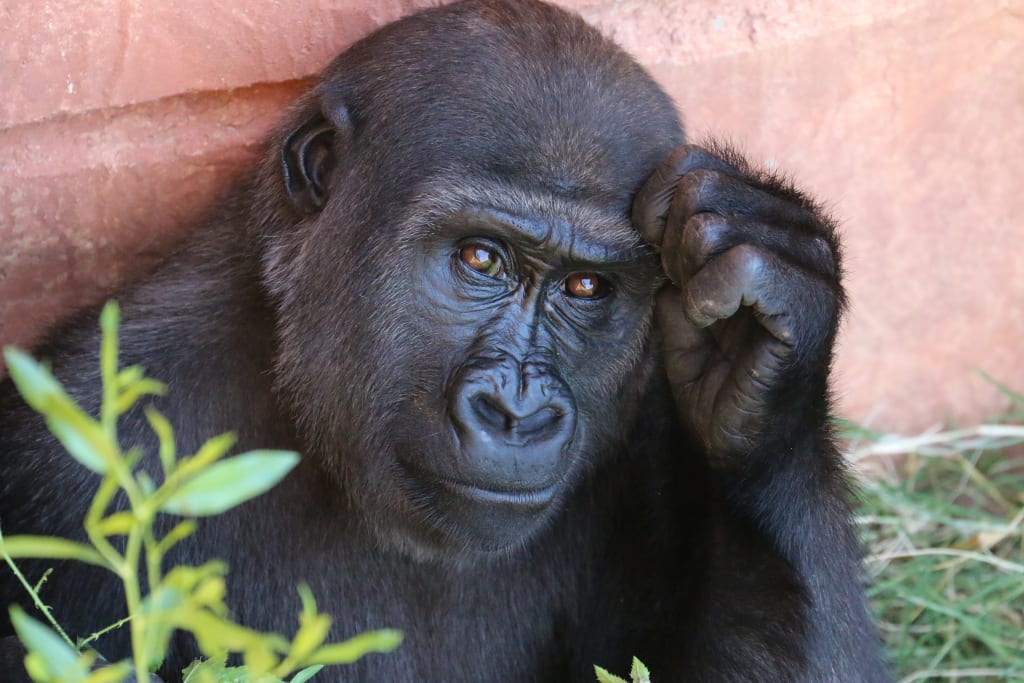
The case of Koko, the gorilla trained in American Sign Language, provides a compelling example. After learning about the death of her kitten companion, Koko displayed distress, signing "cry," "sad," and "frown" when shown a photo of another kitten. This incident demonstrated a level of emotional understanding and attachment beyond simple survival instincts.
Elephants, known for their strong social bonds, have also provided compelling evidence of grief. In 2003, an elephant matriarch named Eleanor collapsed, and another matriarch called Grace immediately rushed to help her stand. When Eleanor fell again and eventually died, other elephants, including those from different families, visited her body over the course of a week. Observers noticed what appeared to be mourning behavior, as they gently touched her body and rocked back and forth.
Similar observations have been made with giraffes. In 2010, a giraffe calf with a deformed foot died after living just four weeks. For several days, 22 females and four juveniles closely attended and occasionally nuzzled the calf's body. Even after hyenas began eating the remains, the mother giraffe stayed by her dead calf, showing clear signs of grief and refusing to eat as she usually would.
Scientific Studies on Animal Grief:
Scientists have begun to quantitatively study animals' responses to death. For example, researchers analyzed baboon fecal samples for glucocorticoids, stress hormones that spike when humans are bereaved. Female baboons who lost close relatives in a predator attack showed significantly higher glucocorticoid levels in the month following the death. Interestingly, these bereaved baboons then increased their grooming behavior and the number of their grooming partners, broadening and strengthening their social networks. Within two months, their glucocorticoid levels returned to baseline, indicating a possible grieving process.
Limitations and Future Research:
While the evidence for grief in non-human animals is growing, our current understanding of their emotional landscapes remains limited. To gain a better grasp on mourning in the animal kingdom, further research is needed. However, conducting studies on emotions in animals can be challenging due to ethical considerations and the difficulty of interpreting non-verbal behavior accurately.
Implications for Ethical Considerations:
The ongoing debate about animal emotions has real-world implications. The question of whether non-human animals experience grief impacts decisions about their treatment in various contexts. For instance, considering the evidence of grief in orcas like Tahlequah, the ethical debate surrounding keeping these intelligent creatures in captivity becomes even more pressing.
Conclusion:
Conversations about whether non-human animals experience emotions, like grief, can be emotionally charged. While we still have much to learn about the emotional lives of animals, the growing body of evidence suggests that they may indeed experience grief and other complex emotions. Until we have more data on the subject, it might be prudent to treat non-human animals as if they may have the capacity to grieve, considering the potential consequences of assuming otherwise.
About the Creator
Keep reading
More stories from Sadra Maleki and writers in Earth and other communities.
The Last Letter- A story written by AI
So let us start, this emotional story. NOTE : this whole story was written by AI, and the point is to see if it has a little amount of emotion. Once upon a time in a quaint little town, there lived a young woman named Emily. She was an old soul who spent her days wandering through the picturesque meadows, finding solace in the beauty of nature. Emily's heart was burdened by an indescribable longing; she had lost her beloved family in a tragic accident years ago.
By Sadra Maleki3 years ago in 01
Saudi Arabia Flour Market Size and Forecast 2025–2033
The Saudi Arabia Flour Market is undergoing a significant transformation, supported by population growth, urbanization, dietary changes, and government initiatives to strengthen food security. According to Renub Research, the market is expected to grow from US$ 2.01 billion in 2024 to US$ 3.03 billion by 2033, registering a compound annual growth rate (CAGR) of 4.66% from 2025 to 2033.
By Sushant. Renub Research2 days ago in Earth
Plans Lodged for Assembly Rooms Replacement
Plans have been officially submitted for the replacement of the historic Assembly Rooms, signaling a significant transformation in the heart of the city. The Assembly Rooms, long regarded as a cultural and architectural landmark, have been a venue for public gatherings, performances, and civic events for decades. With the new plans now lodged, the community, local authorities, and heritage groups are preparing for a debate over modern development versus preserving historical character.
By Muhammad Hassan5 days ago in Earth




Comments
There are no comments for this story
Be the first to respond and start the conversation.