
Dim, explode? The legend of Betelgeuse – the immortal star in the sky
The legend of Betelgeuse - the immortal star in the sky

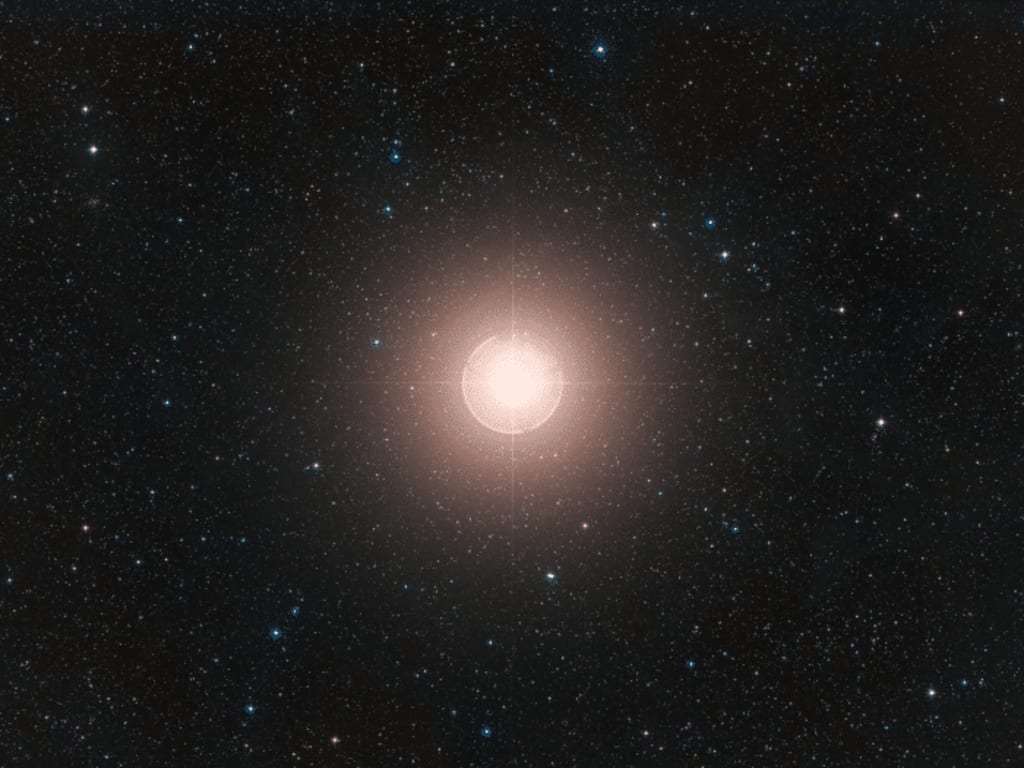
Introduction: Betelgeuse has been observed to dim since December 2019, and scientists have speculated whether Betelgeuse is about to explode. It stands to reason that its supernova explosion will last brightly for about a month, which must be a beautiful sight, but within a few months, Betelgeuse will return to its previous brightness. Although it was an empty joy, it helped scientists further understand interstellar matter.
A red supergiant star in the constellation Orion: Betelgeuse, arguably one of the most famous stars in the night sky, came as a surprise to astronomers in 2020 when it began to dim unexpectedly. In fact, it got so dark that scientists thought it was teetering on the brink of a cataclysm...until it didn't, which didn't happen.
And all this can start from December 2019-at the end of the year, the new coronavirus began to ravage the earth, and a series of legendary events about the light change of Betelgeuse also began with it.
While scientists scrambled to trace the source of the outbreak, astronomers had to be drawn to a different kind of anxiety. Betelgeuse's brightness is dimming significantly. Follow-up observations in late 2019 and the first few weeks of 2020 showed that the star had dimmed to about 36 percent of its normal brightness. This has also led some astronomers to believe that Betelgeuse's life is about to enter a countdown and may turn into a supernova explosion.
A supernova occurs when a star's "fuel" runs out and the core collapses under its own gravity. Astronomers can only observe supernovas of faint stars in distant galaxies, so the idea of watching Betelgeuse explode in real time above our heads is — in some ways — far more exciting than the stars themselves.
This comparison image shows Betelgeuse before and after its unprecedented dimming, taken in January and December 2019 with the SPHERE instrument on ESO's Very Large Telescope. The results show how much the star has faded and how its apparent shape has changed.
The brightness of the explosion must be very high so that we can see the explosion from Earth. We can even see it exploding during the day as a bright spherical object, like Venus at dusk. And the light from the explosion lasts for months, then fades out within a year or two.
It's a pity that Betelgeuse is a little "stage fright". After "teasing" astronomers for months, the star began to slowly regain its former brightness in March. While astronomers don't know exactly what caused the star to dim, they have a few theories that sound like they might explain it.
A study published in June in The Astrophysical Journal Letters showed that not only was the star not on the verge of death, it actually didn't change in its luminosity at all. Instead, the paper suggests, Betelgeuse's signature bright light is temporarily blocked from our view by material shed by the star in the form of a cloud of dust.
Material is often shed during the life cycle of red supergiants like Betelgeuse. The material condenses around the star in the form of dust, the researchers say, meaning it absorbs some of the star's light and blocks our view from Earth. And observations by NASA's Hubble Space Telescope later in 2020 appear to support that theory.
In the first two small images, as seen in ultraviolet light with the Hubble Space Telescope, a large convective pool emerges from the star's surface, ejecting a jet of bright, hot plasma. In the third panel, the outgoing and outgoing gas rapidly expands outward. And it cooled to form a huge cloud of dust particles. The last image shows the massive dust cloud blocking almost a quarter of the light (as seen from Earth) on the star's surface. So, while we haven't been able to witness a giant star explode in the sky, we may have solved a cosmic age-old mystery, and perhaps this is the beginning.
About the Creator
tannie rusty
little science knowledge
Keep reading
More stories from tannie rusty and writers in Earth and other communities.
Scientists have discovered that "Heaven", a place in the sky for a day and a year on the earth really exists?
Nowadays, our living standards are constantly improving, the quality of life is also improving, and people's thinking is gradually changing. Some people pay more and more attention to their own health problems, and some people have never given up on the exploration of outer space.
By tannie rusty3 years ago in Earth
Birds with Wild Hairdos
Cockatoos are known for their expressive crests, which they raise or lower depending on their mood. The crests can be white, yellow, or pink. These charismatic birds are native to the Australian continent, the islands of the Indo-Australian archipelago, and parts of New Guinea. There are 21 different species of cockatoo, varying in size from the diminutive Galah to the imposing Sulphur-crested Cockatoo. Most cockatoo species are highly social birds, forming strong pair bonds that often last a lifetime. Cockatoos are primarily herbivores, with a diet consisting of seeds, nuts, fruits, roots, and occasionally insects and larvae.
By Rasma Raisters2 days ago in Earth
Regenerative Agriculture's Quiet Revolution
by Futoshi Tachino Regenerative agriculture — a holistic approach to farming that restores soil health, biodiversity, and resilience — has rapidly gained traction in recent years. This shift remains largely underappreciated by the public; in a 2024 survey, around 43% of U.S. consumers had never heard of regenerative agriculture (and another 28% had only minimal awareness) [4]. Despite this low profile, tangible developments in regenerative farming are delivering robust results. Farmers are proving that it’s possible to maintain high yields with fewer chemical inputs, improve profitability, and enhance ecological outcomes — all at once. This article explores the evidence-backed progress of regenerative agriculture across regions, the policies and technologies driving its adoption, and why this overlooked sustainability success story deserves greater recognition.
By Futoshi Tachino8 days ago in Earth



Comments
There are no comments for this story
Be the first to respond and start the conversation.