
Choking Skies
When the air turned toxic, survival became the only story left to tell.

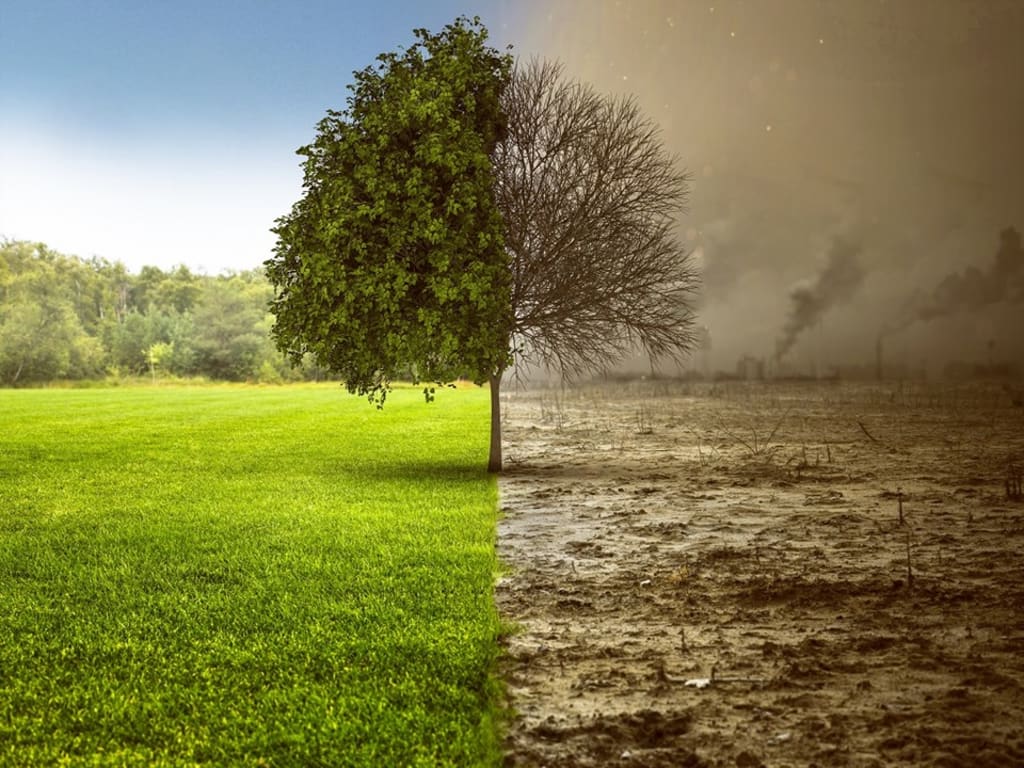
"When the air turned toxic, survival became the only story left to tell."
The sky was once blue. People had forgotten what that looked like. For the last twenty years, the sky above the city of Virelia had been a permanent shade of gray—thick, heavy, and still. The sun rarely pierced through the layers of soot and smog, and when it did, it cast an eerie, orange glow that felt more like a warning than warmth.
The air was poison now. Everyone knew it. They wore masks, not for fashion, but for life. Children grew up thinking clean air was a myth, a bedtime story their grandparents told to make them dream of impossible things.
In the ruins of what used to be a park, fifteen-year-old Amira crouched under the metal skeleton of a rusted swing set. She carefully pulled a cracked plastic bag over her nose as an extra filter to her mask—her official government-issued filter had been overdue for replacement for three months. She had already had two friends collapse from lung damage, and she wasn’t ready to be next.
Amira was a scavenger. One of thousands of teens who combed through the abandoned outskirts of the city each day, looking for scraps of copper wire, old batteries, even moldy food that could be traded for cleaner water. Her little brother, Leo, waited for her every evening in a windowless apartment they shared with their aunt, a silent woman whose lungs wheezed every time she tried to speak.
As Amira moved through the hollow remnants of a supermarket, her breath came out in short, calculated huffs. The pollution was worse today—thicker, like tar. She wrapped a scarf around her already-masked face and pushed forward. On aisle five, beneath collapsed shelves, she found it: a sealed can of beans. Intact. She smiled behind her mask. This was gold.
Suddenly, a sharp siren wailed across the sky. The clouds above rippled unnaturally, and a greenish haze began to descend.
"Acid wave incoming. Seek shelter immediately."
The automated voice blared across the speaker poles lining the streets, most of them half-fallen or malfunctioning. Amira’s heart raced. Acid rain. She only had minutes.
Clutching the beans, she darted out the broken front of the store and sprinted toward the nearest shelter. The air was already burning her exposed hands. She slipped on oil-slick pavement but kept moving.
A metallic door embedded in the sidewalk loomed ahead—a public air vault. It was open.
Amira ducked inside and slammed it shut. A hiss sounded as the inner chamber pressurized. She fell to her knees, coughing hard as her lungs tried to expel the smog she had inhaled. Her mask had broken.
Inside the vault, a few others sat slumped against the walls—elderly men, a crying toddler, a woman with a cracked face shield. No one spoke. Speaking wasted oxygen.
Above ground, the world burned in silence.
Two hours later, the door reopened. The air outside was marginally better—still dangerous, but not instantly fatal. Amira made her way back home, clutching the can like a trophy.
Their building was barely standing, its windows long shattered, plastic sheets nailed over them like makeshift lungs. Inside, Leo ran to her and hugged her tightly, burying his masked face in her soot-stained coat.
“I found beans,” she said hoarsely.
Leo’s eyes lit up. “Real ones?”
She nodded.
Their aunt sat on the floor, knitting what looked like a scarf out of old plastic. “The sirens hit again today,” she wheezed.
“I know. I was outside.” Amira began heating the beans over a makeshift solar panel cooker. “The sky’s worse than yesterday.”
“It’s always worse,” her aunt said, eyes distant.
That night, Amira looked out the hole in the ceiling that used to be their skylight. The clouds shifted lazily above, slow-moving death veils. She wondered what the world looked like before everything went gray. The history books said it was the factories—endless consumption, careless waste, the refusal to stop burning things they couldn’t replace. The air used to belong to everyone. Now it belonged to the few who could afford to bottle it.
Rumors spread that beyond the eastern mountain ridge, a settlement called Clearwater had found a way to grow trees again. Trees that actually breathed. Amira had never seen a tree in her life. Just illustrations in a children’s book.
“Do you think Clearwater is real?” Leo whispered as he lay beside her.
“I don’t know,” she said. “But we’re going to find out.”.
In the morning, with a half-pack of water, the can of beans now empty, and her brother’s hand in hers, Amira stepped into the haze. She didn’t know how far Clearwater was, or if it even existed. But staying meant slow death.
They were two silhouettes against the gray sky, walking east through a world forgotten by its creators, searching for one that might remember how to breathe again.
About the Creator
Masih Ullah
I’m Masih Ullah—a bold voice in storytelling. I write to inspire, challenge, and spark thought. No filters, no fluff—just real stories with purpose. Follow me for powerful words that provoke emotion and leave a lasting impact.
Keep reading
More stories from Masih Ullah and writers in Earth and other communities.
The Feathered Kingdom
In a world beyond clouds, where islands floated in the sky and trees grew upside down from the mist, there existed a realm known as the Feathered Kingdom. This was no ordinary kingdom—for it was ruled not by kings or queens, but by birds. Birds of all kinds lived here, from regal falcons and wise owls to tiny hummingbirds and gentle doves.
By Masih Ullah7 months ago in Writers
Greenland News
Greenland News Greenland has increasingly drawn global attention in recent years due to its political developments, environmental changes, and growing strategic importance. As the world looks more closely at the Arctic region, news from Greenland reflects a unique mix of local priorities and international interest. From climate-related challenges to economic opportunities and governance issues, Greenland continues to shape its own path while remaining closely connected to global affairs.
By America today about 17 hours ago in Earth
Davos 2026: The Last-Chance Saloon to Save the Old World Order?
Every January, the Swiss town of Davos becomes a temporary capital for the world’s elite. Politicians, CEOs, bankers, and thought leaders converge on the snowy Alps for the World Economic Forum (WEF), a gathering that blends diplomacy, business strategy, and high-profile networking. But in 2026, Davos carries an unusually heavy weight: many are asking whether this year’s forum is the last-chance saloon to preserve the old world order. The “old world order” refers to the system of global governance, trade, and alliances dominated by Western powers since the end of World War II. It’s a framework built on liberal democracy, free markets, and institutions like the United Nations, NATO, and the International Monetary Fund. But cracks have been appearing for years—rising nationalism, economic inequality, technological disruption, and the ascent of new global powers are challenging the old guard. Davos 2026 may be where these challenges are addressed—or exposed. A Gathering of Uneasy Allies Davos has always been more than a conference; it’s a stage. World leaders like the U.S. president, Chinese premier, and European Union officials attend alongside CEOs of tech giants, investment banks, and energy conglomerates. In past years, it has been a place for deal-making, policy announcements, and networking in an environment removed from daily political pressures. This year, however, the tone is tense. With geopolitical rivalries intensifying—from U.S.-China competition to ongoing conflicts in Eastern Europe—the forum is less about optimism and more about survival. Many attendees see it as a final opportunity to steer global institutions in a way that sustains stability, economic growth, and cooperation in a rapidly shifting world. As one European diplomat reportedly told journalists: “We’re past casual discussion. This is about whether the rules of the game we’ve known for decades can continue to function.” Economic Uncertainty and the Quest for Stability The global economy is at a crossroads. Inflation, supply chain disruptions, and debt crises have put pressure on governments and corporations alike. Davos provides a platform to coordinate strategies, whether that’s stabilizing financial markets, agreeing on new trade frameworks, or tackling climate and energy crises. But the challenge is bigger than economics alone. The rise of digital currencies, artificial intelligence, and global tech conglomerates has shifted the balance of power. Traditional Western institutions are struggling to keep pace with these innovations, while emerging economies leverage technology and alternative governance models to increase their influence. In this context, Davos 2026 is not just about discussion—it’s about defining who sets the rules for the next era. The Climate Crisis as a Litmus Test One area where the old world order faces a major test is climate policy. Despite decades of conferences and commitments, global emissions continue to rise. The forum’s agenda includes discussions on renewable energy investment, carbon taxation, and sustainable finance—yet the real question is whether collective action can overcome national self-interest. For some attendees, climate is more than an environmental issue; it’s a proxy for global governance. Nations that fail to cooperate on climate risk destabilizing trade, migration, and economic security. Davos 2026 may reveal whether the old mechanisms for multilateral cooperation can still work—or whether the world is moving toward fragmented blocs of competing interests. The Rise of New Powers Another key dynamic is the shifting balance of global power. Emerging economies in Asia, Africa, and Latin America are asserting themselves politically, economically, and technologically. Countries like China, India, and Brazil are shaping new trade and financial networks, sometimes outside traditional Western-dominated institutions. This diversification of influence poses a challenge for Davos. While the forum has historically been Western-centric, ignoring emerging voices could make its conclusions irrelevant. In 2026, the question is whether the WEF can integrate new powers into a cooperative framework—or whether the old world order will crumble under the weight of its exclusivity. Technology, AI, and the Future of Governance Technology is another frontier where the old world order is on trial. Artificial intelligence, cyber warfare, and digital surveillance are reshaping economies and politics alike. CEOs and policymakers in Davos 2026 are expected to discuss regulatory frameworks, ethical AI use, and cybersecurity collaboration. The stakes are high: how nations and corporations govern technology today could determine whether global systems remain stable or fracture. If the old world order fails to set rules for emerging tech, alternative models led by new powers could take hold, redefining global norms. Why Davos 2026 Feels Like a “Last-Chance Saloon” The term “last-chance saloon” evokes urgency. For decades, the old world order relied on cooperation, multilateralism, and shared values to maintain relative peace and prosperity. Today, cracks are visible: rising populism, regional conflicts, economic nationalism, and technological disruption all threaten the status quo. Davos 2026 is unique because it isn’t just a forum for ideas—it’s a test of relevance for the institutions themselves. Leaders will attempt to negotiate solutions, but the outcomes may reveal whether the old structures are adaptable—or obsolete. What to Watch Some of the key signals to watch at Davos 2026 include: Trade agreements and economic cooperation: Will major powers commit to joint frameworks or pursue protectionist policies? Climate action pledges: Are countries willing to act collectively, or do national priorities dominate? Technological governance: Will there be consensus on AI, cybersecurity, and digital currency regulations? Representation of emerging powers: Are new voices integrated into the conversation, or marginalized? The answers could indicate whether the forum reinforces the old order—or marks its final chapter. Final Thoughts Davos 2026 is more than a gathering of the global elite; it’s a litmus test for the old world order. The forum’s success—or failure—may determine whether multilateralism, cooperation, and shared governance survive in an era of rising nationalism, technological disruption, and shifting power dynamics. For observers, policymakers, and citizens alike, the stakes couldn’t be higher. The snowy streets of Davos may once again host ambitious speeches, networking dinners, and visionary panels—but the real question remains: can the old world order be saved, or is it time to prepare for a new world entirely?
By Muhammad Hassanabout 13 hours ago in Earth



Comments
There are no comments for this story
Be the first to respond and start the conversation.