
Carboniferous "era of giant insects": dragonflies as big as eagles, centipedes have more than 2 meters!
The Carboniferous "Age of Giant Worms"

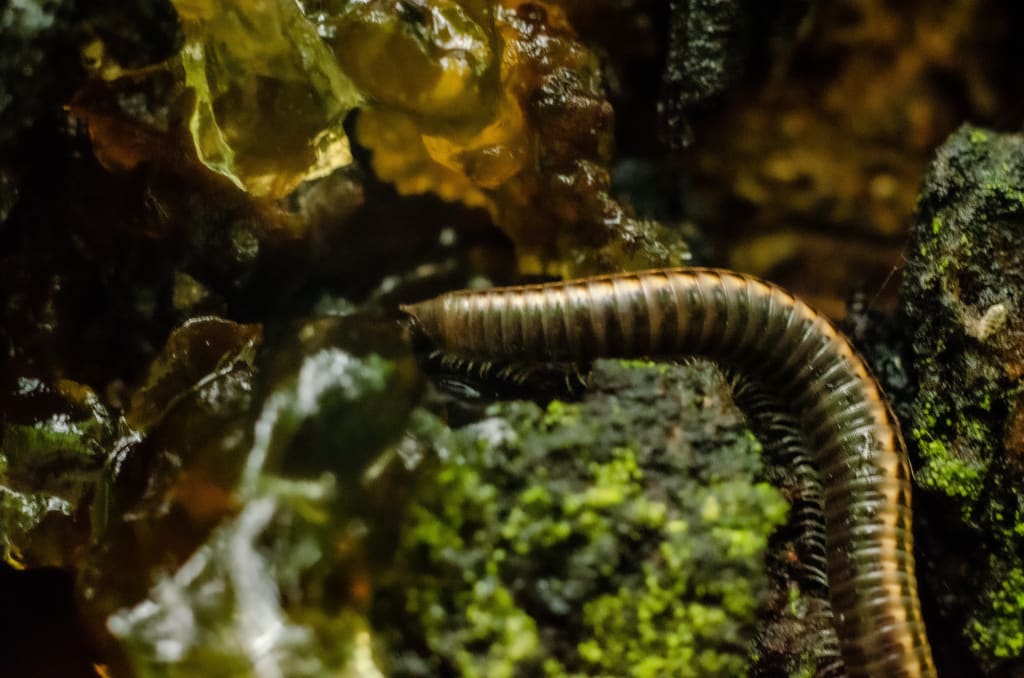
In the 2018 American Phobia survey by Chapman University in California, 39% of respondents were found to be afraid of insects, centipedes or spiders. It's almost certainly a universal phenomenon, with many people getting a little queasy inside when it comes to insects or spiders. But thankfully, when giant insects ruled the earth, they did not live in the Carboniferous period (355 million years ago - to 295 million years ago). After all, modern insects are nothing compared to the giant bugs of prehistoric times.
Before introducing the prehistoric giant bugs, it is worthwhile to take a look at what are the big bugs existing on earth: the Galapagos giant centipede (Scolopendra galapagoensis) can reach 30-40 cm in length; the Amazonian giant bird-eating spider is nearly 30 cm in length; the giant sand katydid in New Zealand can reach 10 cm in length; the sebiferous giant silkworm moth has a wingspan of 20 cm ......
But these and the following prehistoric giant insects on the scene, compared to the really is a small witch.
1、Mid-transverse spider
In the BBC's "Walking with the Giants", a giant spider as big as a human head appears to be some exaggerated ingredients. But according to archaeological shows, the spider in the Carboniferous period was indeed this big. Scientists classify this giant spider as a suborder of Mesothelae, which fed on invertebrates and small reptiles of the time (no detailed data on body size were found).
The biggest difference between this giant spider and modern spiders is that they do not make their webs in trees, but dig a hole in the ground. Digging a hole in the ground, then laying a web for the pit, then hiding in the hole and waiting for the rabbits. When a vibration comes from the web, the spider hiding in the hole suddenly rushes out to bite its prey.
2、Pulmono scorpion
Pulmonoscorpius, also known as the "breathing scorpion" and "lung scorpion", is an extinct giant aquatic scorpion that appeared in the Carboniferous period 350-330 million years ago, with a body length of about 70 cm to 1 meter, as big as a It was about 70 cm to 1 m long, as big as a small dog. Its earliest fossils were found in 1994 in areas such as West Lothian, Scotland, but too few fossils have been unearthed, so its diet and lifestyle are very mysterious.
But biologists speculate that it may have eaten some smaller invertebrates or primitive tetrapods. The strength of the Pumono scorpion's venom cannot be known from the fossil remains, but for modern species, if the pincer-like cheeks are larger, it means the venom is less toxic; conversely, a stouter tail with relatively smaller pincers indicates a more toxic venom. From the recovery diagram, the Pumono scorpion should be a master with poison, poisoning down the prey and then tearing it apart with two pincers.
3、Arthropleura
Arthropleura, also known as the giant arthropleura centipede, lived in the late Carboniferous period from 340 million to 280 million years ago. Despite the name "centipede", they are closer in lineage to Malus.
The body structure of the centipede is the same as the name, consisting of one segment connected to another, with a total of 30 segments. Each segment has a foot on each side, and all together there are 60 feet. The back of each section is covered with dorsal armor that extends to the left and right, as if the centipede were wearing "armor". Usually, the dorsal armor of a segmented centipede disintegrates after the death of the animal, and only a few parts or plates are preserved as fossils.
Unfortunately, no one has yet found a complete arthropod individual. From fossils found in southwestern Germany with a partial body length of 90 cm and fossils found in Canada with a partial width of 50 cm, it is speculated that with a maximum body length of up to 2.6 m and a width of up to 50 cm, it may be the largest invertebrate ever found on Earth's land.
In "Walking with the Giants", there is a big fight between a jointed-thorax centipede and a 2.5-meter-long proto-water scorpion salamander. But in reality, there should be no animal that would attack an adult of the giant arthropod centipede.
In the past few years, German paleontologists Otto Kraus Carsten Brauckmann have reexamined known fossils and found that the knob-thorax's sturdy dorsal armor was only a few millimeters thick and was not reinforced by calcium carbonate. Considering their size, adults had almost no rivals, so they did not need heavy armor. And from the fern spores found in the fossils with the remains of Staphylinidae plants, it is speculated that the knotty thorax may have been a cute and harmless herbivorous creature.
4, giant vein dragonfly (Meganeura monyi)
Meganeura monyi, the largest flying insect known to have appeared on Earth, can reach a wingspan of 0.75 meters. When the fossils of Meganeura were first discovered in France in 1880, imagine what it was like to have a dragonfly the size of an eagle fly over your head. It was named "Meganeura" by French paleontologist Charles Brongniart because its reticulated wing veins, like the veins of a leaf, were so well preserved.
During the Carboniferous era, the Meganeura was the dominant dragonfly in the sky. The environment and the amount of energy used for flight made it impossible for a few centimeters of small flying insects to meet their daily needs, so Meganeura probably intercepted and captured other large insects in the air, as well as invertebrates, small amphibians and recently emerged reptiles, just as modern dragonflies do.
Analysis of the fossils suggests that the giant-veined dragonfly was a very fast aerial predator, flying at speeds in excess of 30 kilometers per hour. It was not only able to fly forward, but also to hover and fly backwards, as well as make sudden aerial turns and dodge currents. When it locks onto its prey on the ground from the sky, it swoops down like an eagle, then grabs the prey with its long barbed limbs and finally shreds it with its mouthparts.
About the Creator
gaut chen
share some science stories



Comments
There are no comments for this story
Be the first to respond and start the conversation.